Gythio
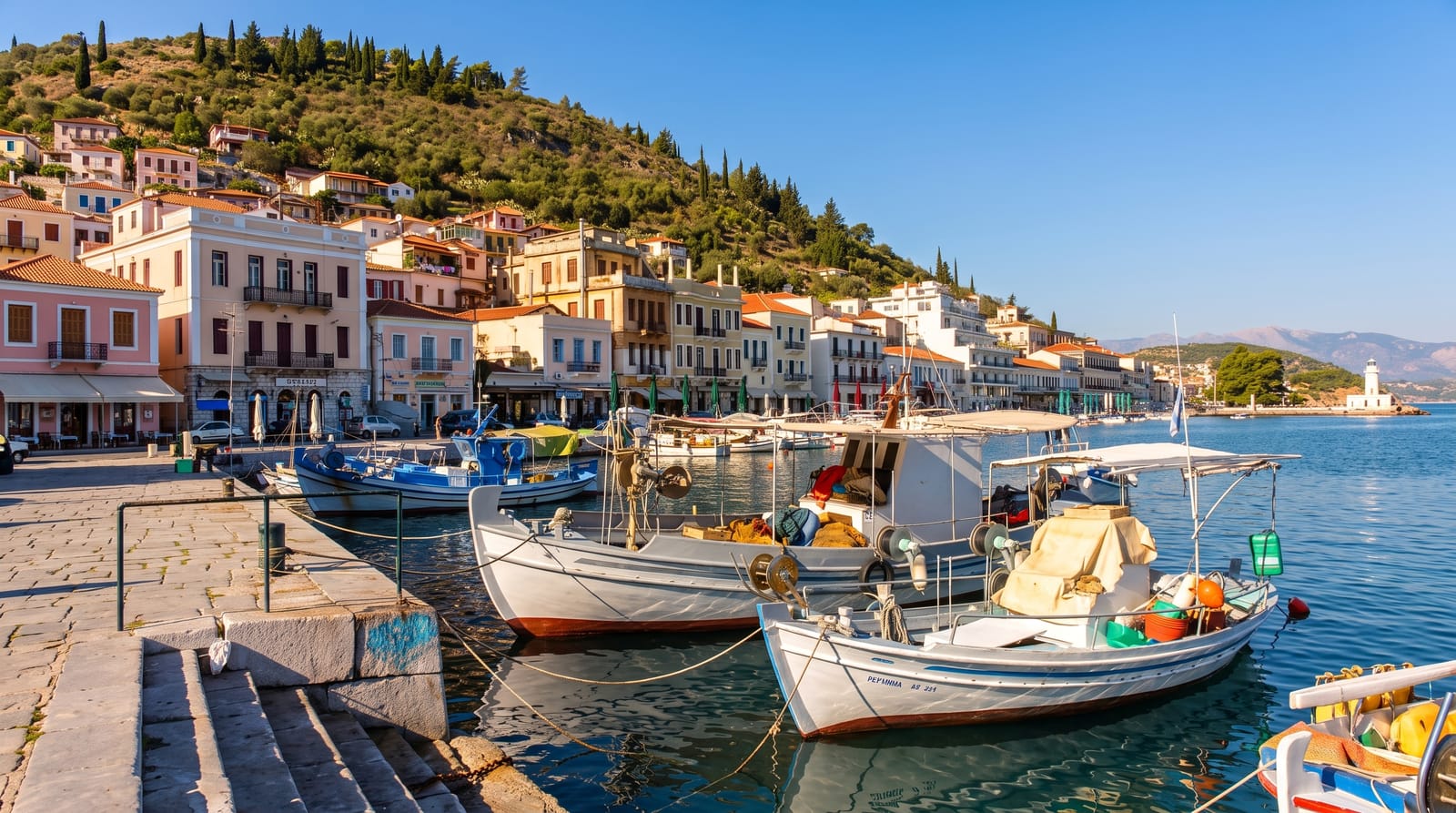
A tiered harbour town of pastel houses, joined by a causeway to an islet with a lighthouse and a mythological past.
Updated 19 October 2026
AI illustration
Gythio was the port of Sparta and later a Roman town made rich by purple dye extracted from murex shells; today it is a working fishing harbour whose pastel houses climb the slope in tiers above a quayside lined with fish tavernas. A causeway leads to the islet of Kranai, where a lighthouse of 1873 built in Maltese stone stands beside the Tzanetakis tower, now a museum of the Mani; in legend this is where Paris and Helen spent their first night after leaving Sparta. Above the town sit the remains of an ancient theatre, small but well preserved, tucked beside a modern military area. The beaches run north toward Mavrovouni, long stretches of sand where loggerhead turtles nest in summer.
History
Gytheio was the seaport of ancient Sparta, about 40 kilometres to the north, and remained a major port until its destruction in the 4th century CE, possibly by an earthquake. Its mythical founders were Heracles and Apollo, often shown on its coins, along with Castor and Pollux, and the town may have been a centre of the Phoenicians' purple dye trade on the Laconian coast; by myth, Paris and Helen spent their first night together on the islet of Cranae before sailing for Troy (Wikipedia, Gytheio).
What's there
- The tiered waterfront - pastel houses above a working fishing quay.
- Kranai islet - the causeway, the 1873 lighthouse and the tower museum.
- The ancient theatre - a compact Roman-era theatre above the town.
- Mavrovouni beach - a long sand beach with turtle nesting in summer.
When to go
Spring and autumn for comfortable sightseeing; midsummer is hot but the beaches are the draw. The fish market and quayside are liveliest in the early morning.
What to expect
The town is pleasant rather than spectacular, and the waterfront tavernas are geared to visitors with prices to match. The ancient theatre sits beside a fenced military zone, which limits access at times. Traffic through the centre is heavy in season.
Nearby
Areopoli and the Mani begin south; Sparta and Mystras lie inland to the north.
Key facts
Source: Wikidata, item Q992256, read on 18 October 2026.
What to pack for Gythio
Chosen from what this place is for. Tap a kit for the full checklist.
- Travel rod + reel - A packable multi-piece rod fits in a case and covers most holiday fishing. Find on Amazon
- Reef-safe sunscreen - High SPF that will not bleach the coral you are swimming over. Find on Amazon
- Binoculars - The single best wildlife tool - even a compact pair transforms a sighting. Find on Amazon
- Comfortable walking shoes - Sightseeing means kilometres of pavement and cobbles daily. Find on Amazon
Some links on this page are Amazon affiliate links - if you buy through them we may earn a small commission at no extra cost to you.
All packing kitsPlan your trip
Where to start if Gythio is going on the list.
Booking links on this page are affiliate links - if you book through them we may earn a small commission at no extra cost to you. It never changes what we write about a place.
Opening times, ticket prices and seasonal closures change - check the official source before you go: official site.