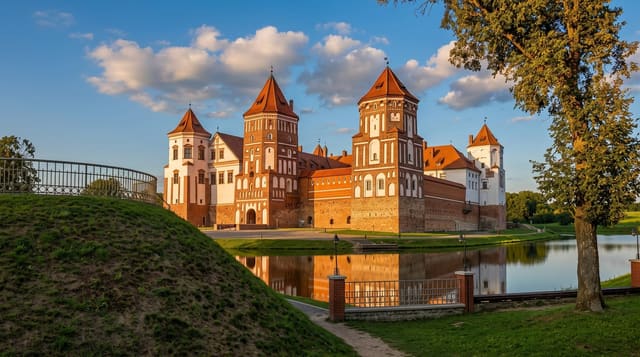
Wartburg Castle
The castle of Luther and legend - a near-thousand-year fortress above Eisenach where the New Testament was turned into German.
Updated 18 October 2026

AI illustration
UNESCO World Heritage
The Wartburg has watched over Eisenach from its wooded precipice since about 1067, and almost every century added a legend - St Elisabeth of Hungary tended the poor from these halls in the 1220s; the minstrels' contest of the Sangerkrieg supposedly rang through the Palas; and in 1521-22 Martin Luther, hidden here as the bearded 'Junker Jorg', translated the New Testament into German in his plain panelled room, an act that helped shape the German language itself. The Romanesque Palas ranks among the finest secular halls of its age north of the Alps, the Singers' Hall so impressed the young Ludwig II that Neuschwanstein borrowed the idea, and the ramparts survey the Thuringian Forest in every direction. UNESCO inscribed the castle in 1999; the Luther Room, with its worn desk and whale-vertebra footrest, remains the quietest and most consequential corner.
History
Count Louis the Springer laid the castle's foundations around 1067, said to have brought soil from his own lands to the hilltop so he could swear it stood on his ground, and it is first recorded in 1080; from 1172 to 1211 it was one of the leading princely courts of the Empire, where Landgrave Hermann I supported poets such as Walther von der Vogelweide and Wolfram von Eschenbach, setting for the legendary Minstrels' Contest of 1206-1207. Elisabeth of Hungary lived here from 1211 to 1228, known for her charity, and from May 1521 to March 1522 Martin Luther, hidden here as Junker Jörg after the Diet of Worms, translated the New Testament from Greek into German in just ten weeks. The castle inspired Ludwig II's Neuschwanstein, hosted the Wartburg festival of 1817 and was inscribed on the World Heritage List in 1999 (Wikipedia, Wartburg).
Highlights
- The Luther Room - the plain study where the New Testament turned German.
- The Romanesque Palas - arcaded halls from the castle's medieval prime.
- The Singers' Hall - the minstrel-contest hall that inspired Neuschwanstein.
- The ramparts - walkways over the Thuringian Forest's green swell.
When to go
April to October for full tours and open courtyards; autumn wraps the forest below in colour and mist. Winter visits are atmospheric but check reduced hours.
Practical notes
Interiors go by guided tour, run in German with English materials - time your arrival to the schedule. The approach is a genuinely steep walk from the car park, further from town. Reformation-themed anniversaries and summer weekends bring queues.
Nearby
Eisenach with Bach's birthplace museum, the Thuringian Forest trails and Erfurt's old town an easy train away.
Key facts
Source: Wikidata, item Q151545, read on 18 October 2026.
What to pack for Wartburg Castle
Chosen from what this place is for. Tap a kit for the full checklist.
- Binoculars - The single best wildlife tool - even a compact pair transforms a sighting. Find on Amazon
- Comfortable walking shoes - Sightseeing means kilometres of pavement and cobbles daily. Find on Amazon
- A zoom camera or long lens - Animals rarely come close; reach beats megapixels. Find on Amazon
- A slim anti-theft daypack - Zips that close properly; keep it in front in crowds and on transit. Find on Amazon
Some links on this page are Amazon affiliate links - if you buy through them we may earn a small commission at no extra cost to you.
All packing kitsPlan your trip
Where to start if Wartburg Castle is going on the list.
Booking links on this page are affiliate links - if you book through them we may earn a small commission at no extra cost to you. It never changes what we write about a place.
Opening times, ticket prices and seasonal closures change - check the official source before you go: official site.