Johannisburg Palace
A red sandstone Renaissance palace on the Main, holding the world's largest collection of architectural cork models.
Updated 19 October 2026
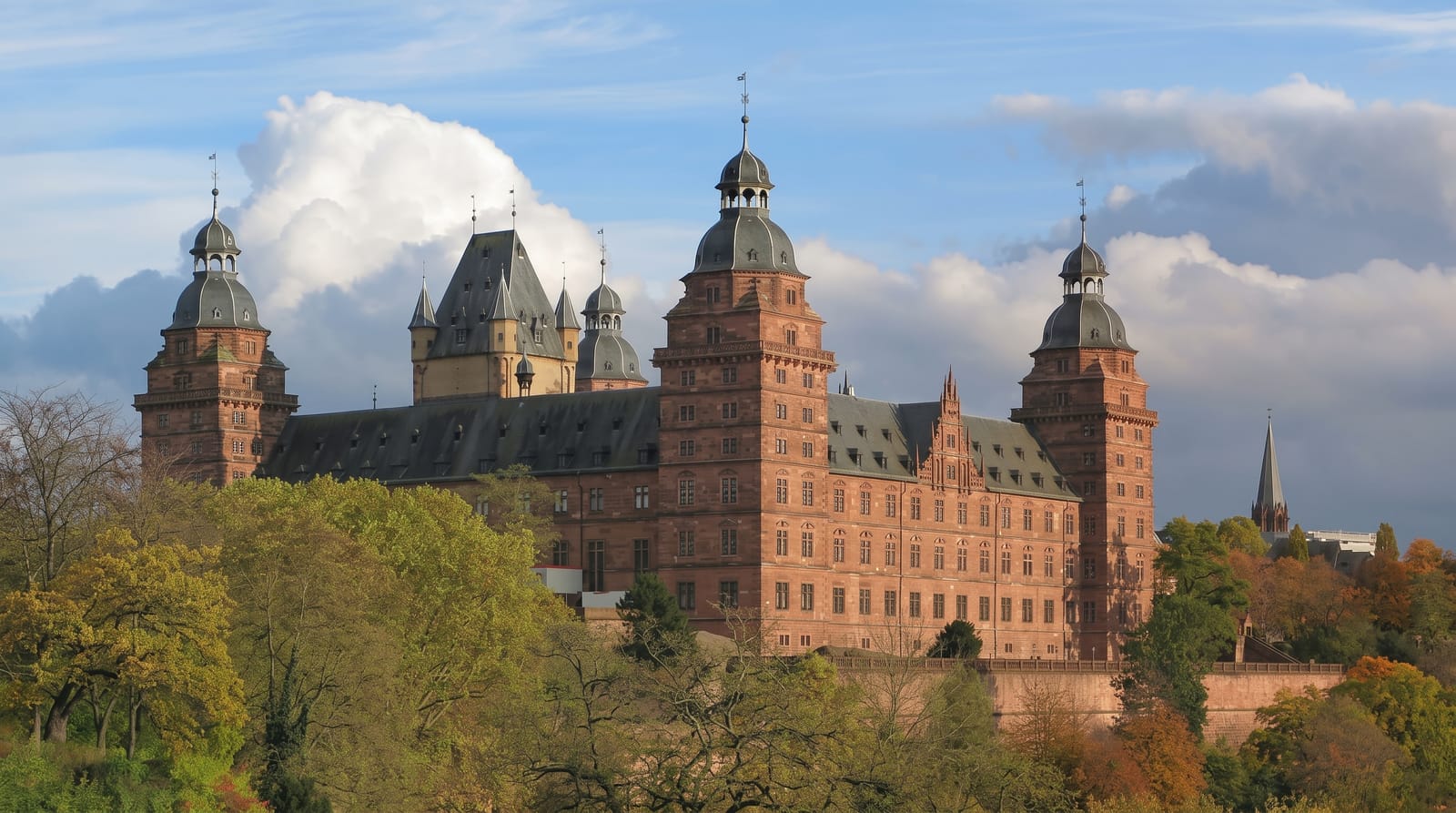
AI illustration
Built between 1605 and 1614 for the archbishop-electors of Mainz in red Main sandstone, the palace is a square block with four corner towers and was one of the most important Renaissance buildings in Germany before being gutted in 1944; reconstruction ran into the 1970s. It holds the largest collection anywhere of architectural models in cork, made from 1792 onward by Carl May and his son as scale reproductions of Roman monuments, the material chosen because its texture reads convincingly as weathered stone at small scale. A separate building nearby, the Pompejanum, is a replica Roman villa built for Ludwig I in the 1840s.
History
The palace was built between 1605 and 1614 by the architect Georg Ridinger for Johann Schweikhard von Kronberg, Archbishop of Mainz, paid for largely by taxes from Eichsfeld, Erfurt and the Mainz Oberstift; it took in the keep of the 14th-century castle that had stood here until troops of Margrave Albert Alcibiades burned it, with most of the town, on 10 August 1552. Until 1803 it was the second residence of the archbishop-electors of Mainz, its interior was remodelled in the neoclassical style by Emanuel Herigoyen at the end of the 18th century, and after a spell in the Principality of Aschaffenburg and the Grand Duchy of Frankfurt, from 1810 to 1813, it passed to Bavaria. King Ludwig I used it as his summer residence, calling Aschaffenburg his "Bavarian Nice", and had the Pompejanum built within sight of it; badly damaged at the end of the Second World War, it was rebuilt from 1951 over more than twenty years (Wikipedia, Schloss Johannisburg).
Highlights
- The cork models - Roman monuments reproduced in cork at scale.
- The sandstone block - a square Renaissance palace with four towers.
- The Pompejanum - a replica Roman house built in the 1840s nearby.
- The Main terrace - the palace front above the river and vineyards.
When to go
April to October; the Pompejanum closes for winter while the palace stays open with reduced hours. Both close Mondays. Allow half a day for the pair.
Good to know
Most of the palace is postwar reconstruction. The Pompejanum is closed for several winter months. Aschaffenburg is otherwise an ordinary working town.
Nearby
Miltenberg lies upriver; Frankfurt is northwest.
Key facts
Source: Wikidata, item Q705848, read on 18 October 2026.
What to pack for Johannisburg Palace
Chosen from what this place is for. Tap a kit for the full checklist.
- Comfortable walking shoes - Sightseeing means kilometres of pavement and cobbles daily. Find on Amazon
- A slim anti-theft daypack - Zips that close properly; keep it in front in crowds and on transit. Find on Amazon
- A refillable water bottle - Many cities have public fountains; save money and plastic. Find on Amazon
- A light layer + compact umbrella - For museum air-con and a sudden shower. Find on Amazon
Some links on this page are Amazon affiliate links - if you buy through them we may earn a small commission at no extra cost to you.
All packing kitsPlan your trip
Where to start if Johannisburg Palace is going on the list.
Booking links on this page are affiliate links - if you book through them we may earn a small commission at no extra cost to you. It never changes what we write about a place.
Opening times, ticket prices and seasonal closures change - check the official source before you go: official site.