Güstrow
A Renaissance ducal palace and the studio of a sculptor whose hovering angel was melted down and recast.
Updated 19 October 2026
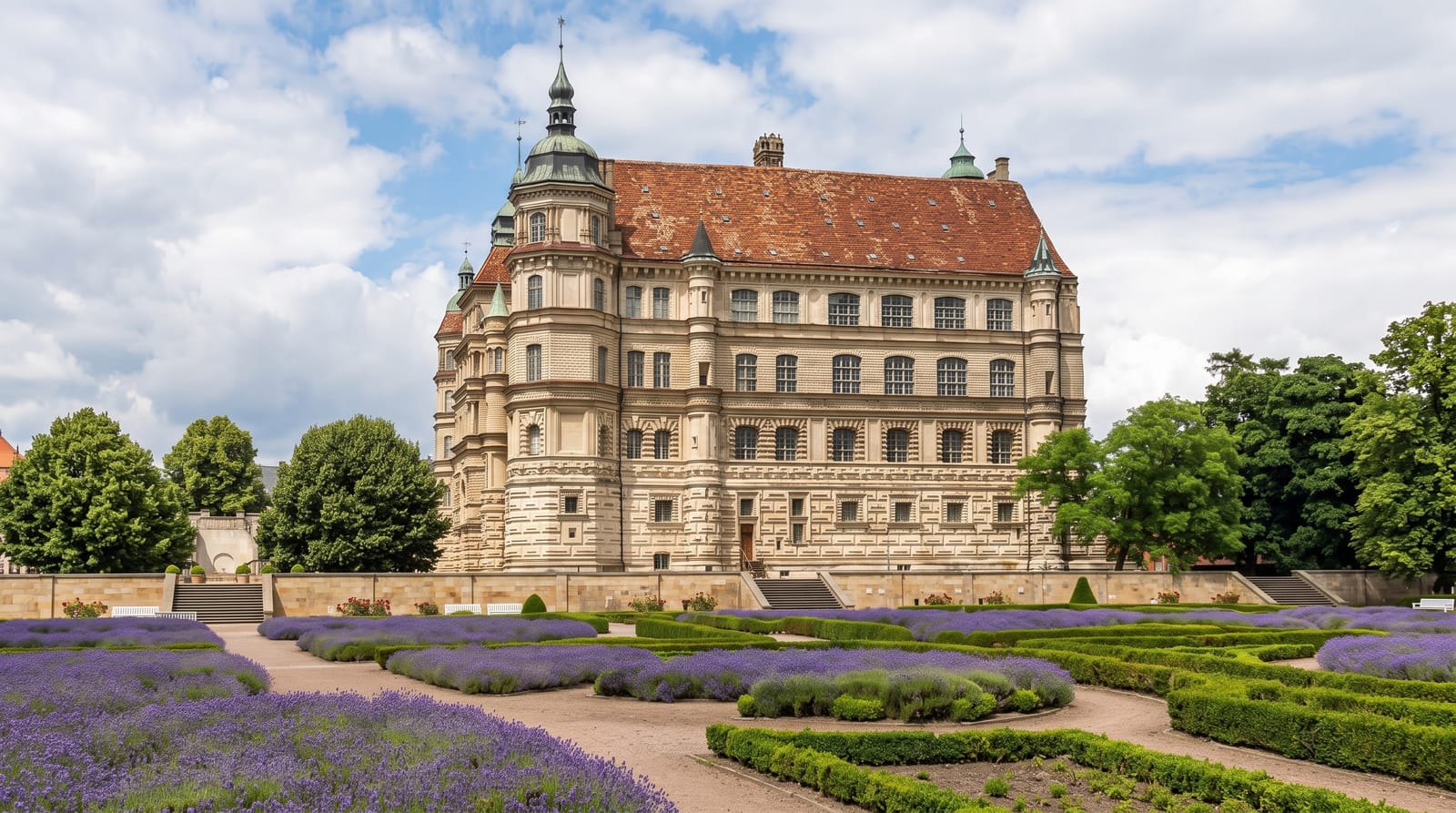
AI illustration
The palace at Güstrow was built from 1558 for the dukes of Mecklenburg in an Italian-influenced Renaissance style unusual this far north, with stucco ceilings of hunting scenes. Ernst Barlach, the sculptor and writer, lived and worked in Güstrow from 1910 until his death in 1938, and his studio on the Inselsee is preserved as a museum. His floating angel, hung in the cathedral in 1927 as a memorial, was removed in 1937 and melted down in 1941; a second cast, made secretly in 1939 and hidden through the war, hangs in the Antoniterkirche in Cologne, and a third, cast from it in 1952, now hangs again in the cathedral.
History
The name comes from the Polabian Guščerov, "place of lizards". In 1219 the Wendish castle of Güstrowe stood where the palace is now, and the town is said to have been founded by Heinrich Borwin II, a grandson of Henry the Lion, between 1219 and 1226; it is first mentioned in 1228, and his sons endowed the cathedral as a collegiate church in 1226. Güstrow was a residence of the lords of Werle from 1229 until 1436, fires destroyed the town in 1503, 1508 and 1512 and the palace burned in 1556, and after the division of Mecklenburg in 1621 it became the capital of the small Duchy of Mecklenburg-Güstrow, which ended with the death of its last duke in 1695. The sculptor Ernst Barlach lived in Güstrow from 1910 until his death in 1938 (Wikipedia, Güstrow).
What to look for
- The Renaissance palace - an Italian-influenced ducal building with stucco ceilings.
- The hovering angel - Barlach's memorial figure, recast after the original was destroyed.
- The Barlach studio - his lakeside workshop kept as a museum.
- The cathedral - a brick Gothic church holding the angel and ducal tombs.
When to go
April to October; museums close Mondays and reduce hours in winter. The studio is outside the town on the lake and needs transport or a walk.
Before you go
The Barlach sites are spread across the town and the lake shore. Museums close Mondays. The palace interior is partly bare.
Nearby
Rostock lies north; the Müritz park is southeast.
Key facts
Source: Wikidata, item Q16147, read on 18 October 2026.
What to pack for Güstrow
Chosen from what this place is for. Tap a kit for the full checklist.
- Comfortable walking shoes - Sightseeing means kilometres of pavement and cobbles daily. Find on Amazon
- Modest clothing - Shoulders and knees covered - the single most common requirement. Find on Amazon
- A slim anti-theft daypack - Zips that close properly; keep it in front in crowds and on transit. Find on Amazon
- A scarf or shawl - To cover the head or shoulders on entry; women especially at mosques. Find on Amazon
Some links on this page are Amazon affiliate links - if you buy through them we may earn a small commission at no extra cost to you.
All packing kitsPlan your trip
Where to start if Güstrow is going on the list.
Booking links on this page are affiliate links - if you book through them we may earn a small commission at no extra cost to you. It never changes what we write about a place.
Opening times, ticket prices and seasonal closures change - check the official source before you go: official site.