Bergpark Wilhelmshohe
A hillside park in Kassel where water released at the top runs down cascades and an aqueduct to a fountain jet below.
Updated 18 October 2026
AI illustration
UNESCO World Heritage
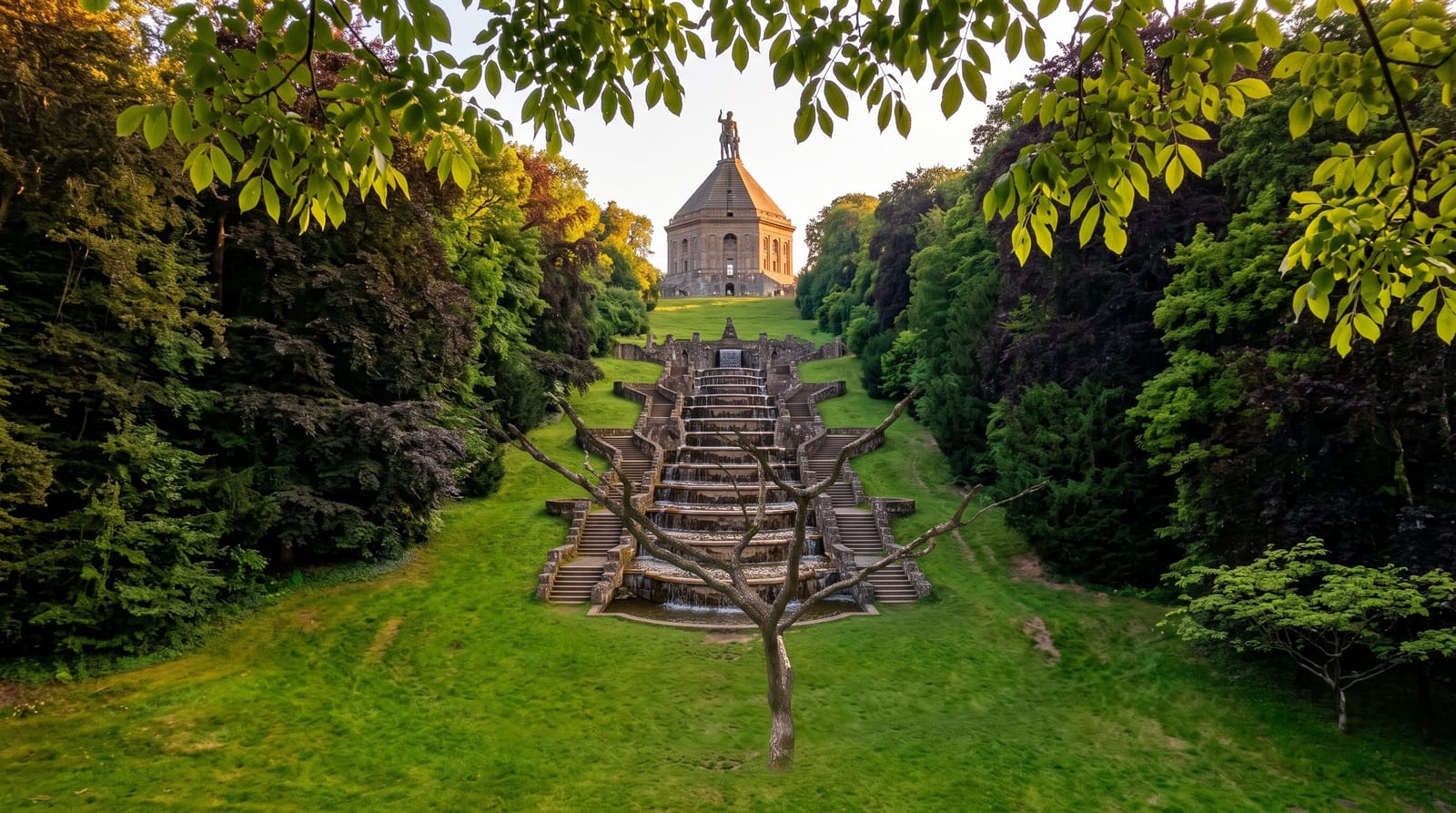
The Bergpark is a landscape built around gravity. At the top of the hill stands a stone octagon crowned by a copper Hercules, and below it a baroque cascade drops in stages towards the palace. On set afternoons in the warm months the water is released and moves downhill under nothing but its own weight, over the cascade, through a mock Roman aqueduct that ends in a broken arch, into a grotto, and finally into a fountain jet that rises high above the lake at the bottom. Visitors walk down alongside it, which takes a couple of hours. Halfway stands the Lowenburg, an artificial medieval castle built as a ruin from the start.
History
In 1143 canons from Mainz founded the Weissenstein monastery where the palace now stands; after the Reformation it became a hunting lodge, rebuilt by Landgrave Maurice in 1606-1610. Work on the park began in 1689 for the Landgraves of Hesse-Kassel and took about 150 years: in 1701 the Italian architect Giovanni Francesco Guerniero began the Hercules monument and the cascades, from 1785 Landgrave Wilhelm IX enlarged the park in the English manner with Heinrich Christoph Jussow's artificial ruins, the Löwenburg and the Roman aqueduct, and in 1826 Elector William II added the Great Waterfall. Jérôme Bonaparte held court at the palace, renamed Napoleonshöhe, until 1813, Napoleon III was held prisoner here after Sedan in 1870, Wilhelm II made it his summer residence from 1899, and in 2013 the park became a World Heritage Site (Wikipedia, Bergpark Wilhelmshöhe).
What to look for
- The Hercules monument - a copper figure on a stone octagon at the summit, with a climb inside it.
- The cascade and aqueduct - stepped water stairs and a Roman style aqueduct ending in a broken arch.
- The Lowenburg - an eighteenth century castle built deliberately as an artificial ruin.
- The great fountain - the final jet beside the lake, timed to the end of the walk down.
When to go
The water displays run on fixed afternoons from early May to early October, and there is little point coming for them outside that window. On some summer evenings the same route is lit. Arrive at the Hercules terrace well before the start, since the sequence begins at the top and the walk down follows the water at its own pace.
Things to know
The full route is a long descent on steps and gravel, hard on knees and impossible with a pushchair, and there is no shortcut once you commit. On display days thousands walk it together and the cascade edges are packed. The bus up fills quickly. Outside display days the channels are dry and the park is a large hillside wood.
Nearby
The old masters gallery inside the palace, the Fulda riverside in Kassel, and the beech woods of the Reinhardswald.
What to pack for Bergpark Wilhelmshohe
Chosen from what this place is for. Tap a kit for the full checklist.
- Head torch + spare batteries - Hands-free light is essential; caves are truly dark. Find on Amazon
- Comfortable walking shoes - Sightseeing means kilometres of pavement and cobbles daily. Find on Amazon
- Modest clothing - Shoulders and knees covered - the single most common requirement. Find on Amazon
- Grippy closed shoes - Cave floors are wet, muddy and slick with formations. Find on Amazon
Some links on this page are Amazon affiliate links - if you buy through them we may earn a small commission at no extra cost to you.
All packing kitsPlan your trip
Where to start if Bergpark Wilhelmshohe is going on the list.
Booking links on this page are affiliate links - if you book through them we may earn a small commission at no extra cost to you. It never changes what we write about a place.
Opening times, ticket prices and seasonal closures change - check the official source before you go: official site.