Hann. Münden
The town where two rivers join to form a third, with seven hundred timber-framed houses around the junction.
Updated 19 October 2026
AI illustration
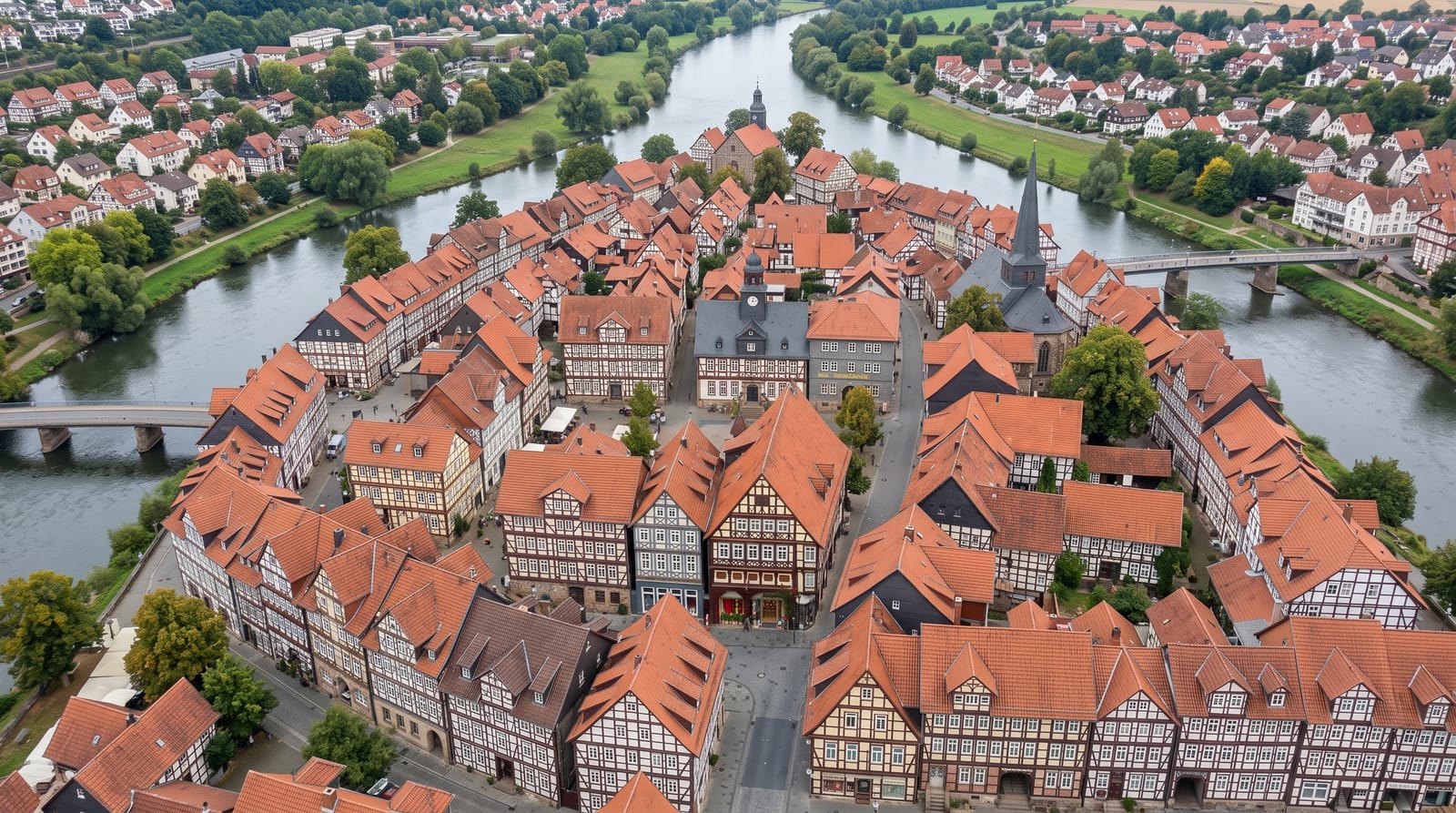
The Werra and the Fulda meet here and the combined river is renamed the Weser, marked by a stone at the point carrying a rhyme recording the fact. The old town between them holds around seven hundred timber-framed buildings from four centuries, one of the densest concentrations in Germany, with a Weser Renaissance town hall of 1618. Johann Andreas Eisenbarth, an itinerant surgeon of the early eighteenth century whose name entered German as a byword for a rough practitioner, died in the town in 1727; a play about him is staged in summer. Three rivers make the town a boating and cycling junction.
History
The town is first mentioned as Gimundi in deeds of gift to the abbey of Fulda in 802, its name meaning "confluence" in old German, and it may have received town rights in the latter half of the 12th century; the prefix Hannoversch was added in the 19th century to tell it apart from Minden. In 1707 the French inventor Denis Papin used a paddle-wheel boat he had built to travel down the Fulda from Kassel to Münden, and the town was later home to the Royal Prussian Academy of Forestry, whose arboretum gardens were laid out for it and which moved to the University of Göttingen in 1970 (Wikipedia, Hann. Münden).
Highlights
- The confluence - the Werra and Fulda joining to become the Weser.
- The timber town - around seven hundred framed houses in the old centre.
- The 1618 town hall - a Weser Renaissance facade on the market square.
- The Eisenbarth connection - the surgeon's grave and a summer play.
When to go
April to October; boat trips run on the rivers in the warm months. The Eisenbarth play is staged on summer weekends. Cycle routes meet in the town.
Good to know
The confluence is a marked point rather than a spectacle. Boat trips are seasonal. The town is small and quiet outside summer.
Nearby
Kassel lies south; Bad Karlshafen is downriver.
Key facts
Source: Wikidata, item Q165380, read on 18 October 2026.
What to pack for Hann. Münden
Chosen from what this place is for. Tap a kit for the full checklist.
- Quick-dry clothing - Board shorts or synthetics that shrug off spray and dry fast. Find on Amazon
- Padded shorts - The one thing that makes a full day in the saddle bearable. Find on Amazon
- Comfortable walking shoes - Sightseeing means kilometres of pavement and cobbles daily. Find on Amazon
- Secure water shoes or reef boots - Grip on slippery launches and protection on rocky shores. Find on Amazon
Some links on this page are Amazon affiliate links - if you buy through them we may earn a small commission at no extra cost to you.
All packing kitsPlan your trip
Where to start if Hann. Münden is going on the list.
Booking links on this page are affiliate links - if you book through them we may earn a small commission at no extra cost to you. It never changes what we write about a place.
Opening times, ticket prices and seasonal closures change - check the official source before you go: official site.