Saint-Martin-du-Canigou
An eleventh-century abbey on a spur reached only on foot, still occupied by a religious community.
Updated 21 October 2026
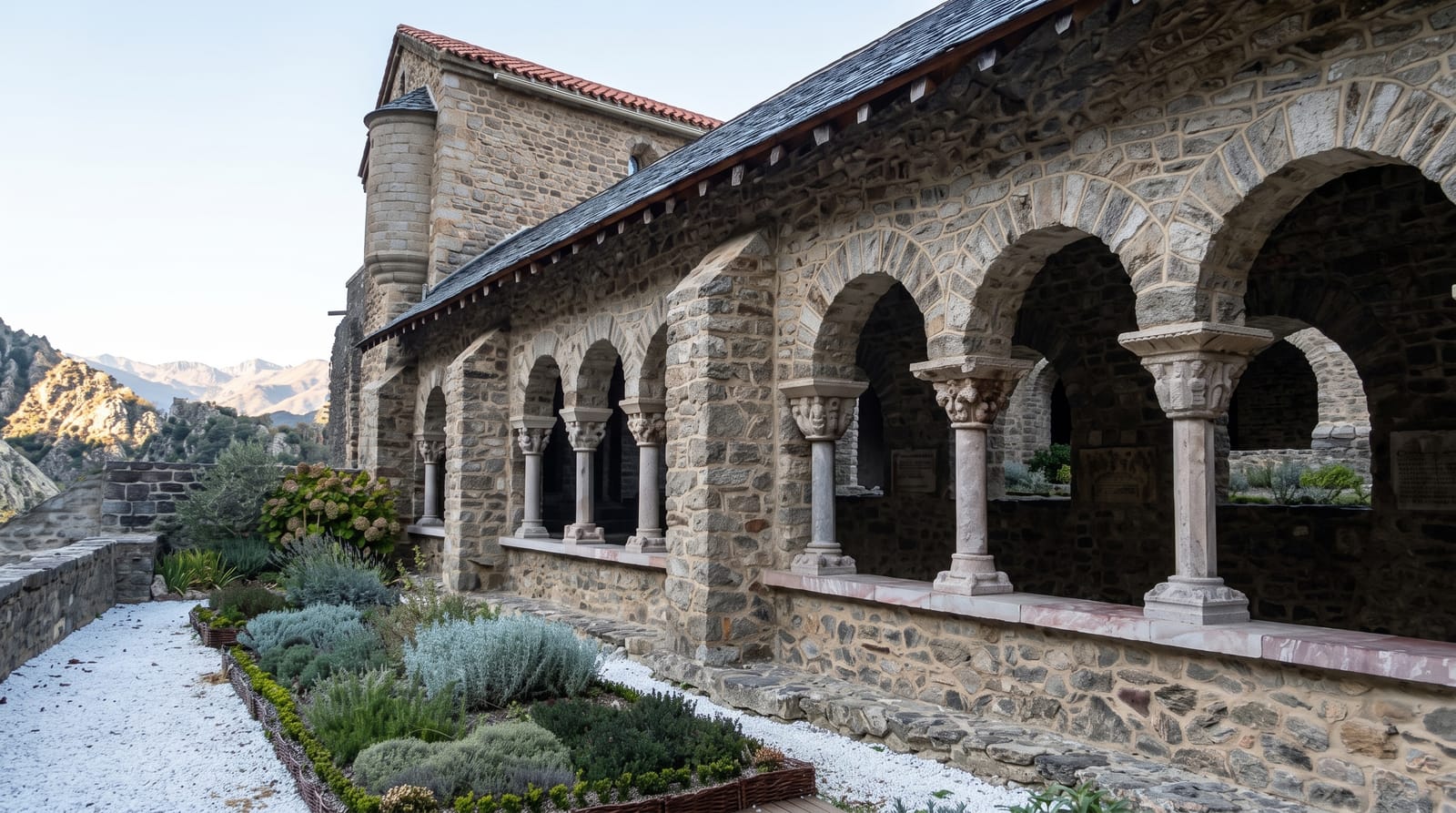
AI illustration
The abbey was founded in 1009 on a rock spur at around a thousand metres on the flank of Canigou, with cliffs on three sides and one narrow approach. It is early Romanesque, two churches stacked one above the other with a small cloister on the edge of the drop, built when the style was still being worked out in Catalonia. Secularised in 1782 and abandoned by its monks soon afterwards, then quarried for stone during the Revolution and left in ruin, it was restored from 1902 under the bishop of Perpignan and again in the 1950s. A religious community lives there now, which is why the visit is guided and silence is asked for. The only way up is a steep walk of about forty-five minutes.
History
The monastery was built from 1005 to 1009 by Guifred II, Count of Cerdanya, in atonement for the murder of his son, and peopled with Benedictine monks; Guifred became a monk here and died in 1050, and in 1051 a messenger carried a mortuary roll around the religious houses of Europe, collecting prayers for him, a document that survives and has been used to compare the cultures of northern and southern Europe in a single year. The abbey was damaged by the Catalan earthquake of 1428, secularised by Louis XVI in 1782 and abandoned by its monks in 1783-1785; during the Terror of 1793-1794 it was closed, its contents scattered, and local people used it as a stone quarry while the cloister capitals were looted. In 1902 the bishop of Elne and Perpignan began a radical restoration, completed in 1932, and the abbey is now home to the Catholic Community of the Beatitudes (Wikipedia, Abbey of Saint-Martin-du-Canigou).
The main sights
- The stacked churches - two early Romanesque churches one above the other.
- The cliff-edge cloister - a small cloister on the lip of the drop.
- The spur setting - the abbey on a rock with cliffs on three sides.
- The mountain view - the Cady valley and Canigou above.
When to go
May to October; the walk up is steep and hot in summer, so early morning is better. The abbey closes some winter periods and to visitors during retreats.
Things to know
There is no vehicle access; the forty-five minute climb is the only way, and it is steep. Visits are guided at set times and the community asks for silence. Numbers per tour are limited.
Nearby
Canigou rises above; Villefranche-de-Conflent lies north.
Key facts
Source: Wikidata, item Q287751, read on 18 October 2026.
What to pack for Saint-Martin-du-Canigou
Chosen from what this place is for. Tap a kit for the full checklist.
- Comfortable walking shoes - Sightseeing means kilometres of pavement and cobbles daily. Find on Amazon
- Modest clothing - Shoulders and knees covered - the single most common requirement. Find on Amazon
- A slim anti-theft daypack - Zips that close properly; keep it in front in crowds and on transit. Find on Amazon
- A scarf or shawl - To cover the head or shoulders on entry; women especially at mosques. Find on Amazon
Some links on this page are Amazon affiliate links - if you buy through them we may earn a small commission at no extra cost to you.
All packing kitsPlan your trip
Where to start if Saint-Martin-du-Canigou is going on the list.
Booking links on this page are affiliate links - if you book through them we may earn a small commission at no extra cost to you. It never changes what we write about a place.
Opening times, ticket prices and seasonal closures change - check the official source before you go: official site.