Train Jaune
A yellow electric railway climbing to sixteen hundred metres, with open carriages and a suspension bridge.
Updated 19 October 2026
AI illustration
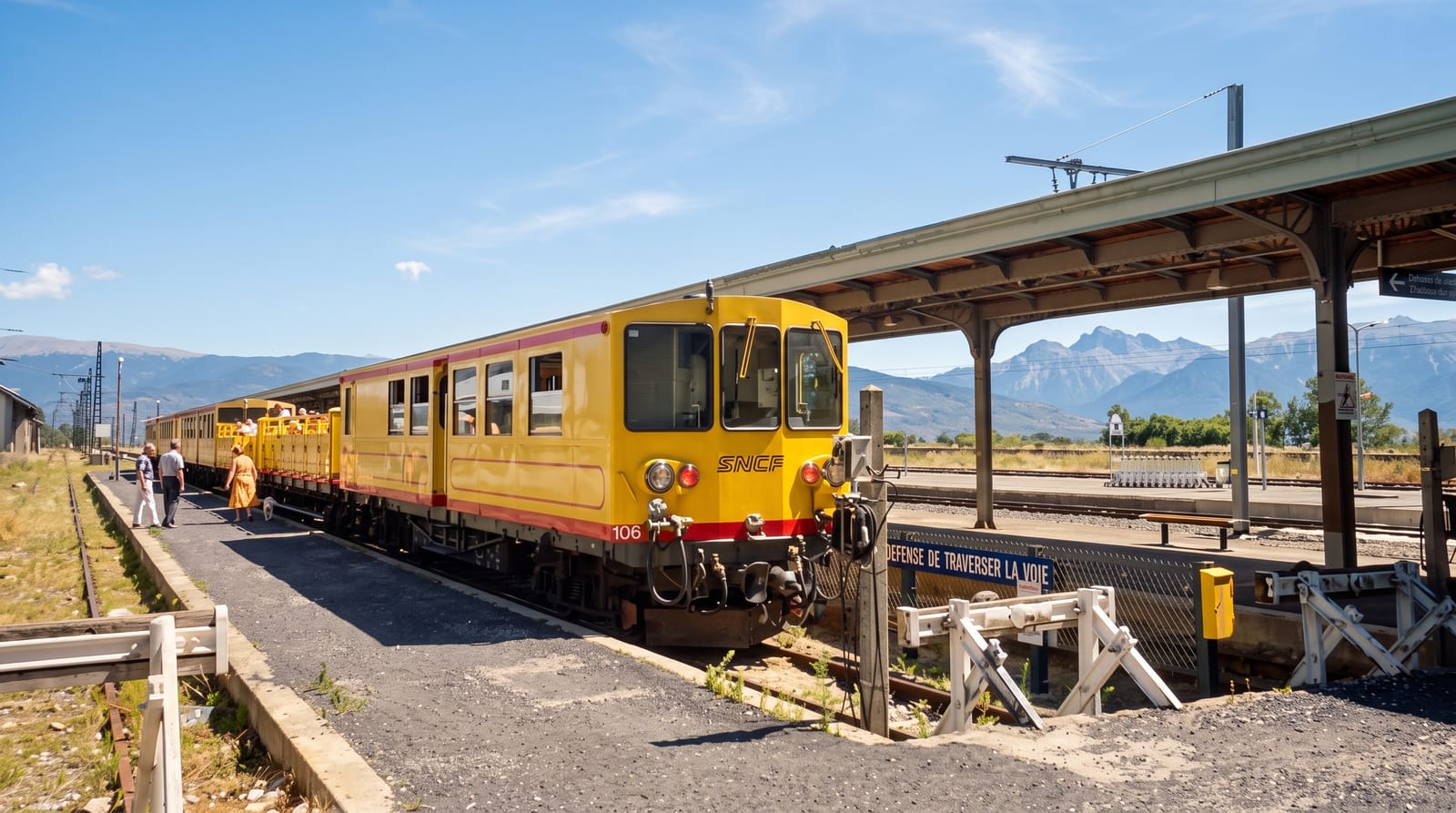
The Train Jaune opened between 1910 and 1927 to link the isolated Cerdagne plateau to the rest of France, and it was electrified from the start using hydropower, drawing current from a third rail. It climbs from about four hundred and twenty-seven metres at Villefranche to one thousand five hundred and ninety-two at Bolquere-Eyne, the highest station in France, over sixty-three kilometres. The line crosses the Sejourne viaduct and the Gisclard bridge, the only suspension railway bridge still in service in France. Some carriages are open-topped in summer. It is painted yellow and red, the Catalan colours.
History
The section from Villefranche-de-Conflent to Bourg-Madame was declared a public utility by a law of 4 March 1903, which also approved the concession signed on 5 December 1902 with the Compagnie des Chemins de Fer du Midi and set aside an earlier standard-gauge plan to Olette that was never built. A second law of 23 March 1914 extended the line from Bourg-Madame to the frontier station of the trans-Pyrenean line, confirmed on 4 September 1922. Construction began in 1903, the line reached Mont-Louis in 1910, and the extension to Latour-de-Carol followed in 1927 (Wikipedia, Ligne de Cerdagne).
What's there
- The Gisclard bridge - the only working suspension railway bridge in France.
- The Sejourne viaduct - a tall stone viaduct in the Tet gorge.
- The open carriages - roofless coaches running in summer.
- Bolquere-Eyne - the highest railway station in France at 1,592 metres.
When to go
May to October, when the open carriages run and the plateau is clear; the service continues in winter for local traffic. Journeys are slow, around three hours end to end.
What to expect
It is a working local service with limited departures, so a return trip needs timetable planning. Open carriages are cold and exposed even in summer at altitude. Sections have been suspended for engineering work in some years.
Nearby
Villefranche-de-Conflent is the lower terminus; the Cerdagne plateau is at the top.
Key facts
Source: Wikidata, item Q2164826, read on 18 October 2026.
What to pack for Train Jaune
Chosen from what this place is for. Tap a kit for the full checklist.
- Comfortable walking shoes - Sightseeing means kilometres of pavement and cobbles daily. Find on Amazon
- A slim anti-theft daypack - Zips that close properly; keep it in front in crowds and on transit. Find on Amazon
- A refillable water bottle - Many cities have public fountains; save money and plastic. Find on Amazon
- A light layer + compact umbrella - For museum air-con and a sudden shower. Find on Amazon
Some links on this page are Amazon affiliate links - if you buy through them we may earn a small commission at no extra cost to you.
All packing kitsPlan your trip
Where to start if Train Jaune is going on the list.
Booking links on this page are affiliate links - if you book through them we may earn a small commission at no extra cost to you. It never changes what we write about a place.
Opening times, ticket prices and seasonal closures change - check the official source before you go: official site.