Pantheon
A church turned national mausoleum, where Foucault hung a pendulum to prove the earth turns.
Updated 19 October 2026
AI illustration
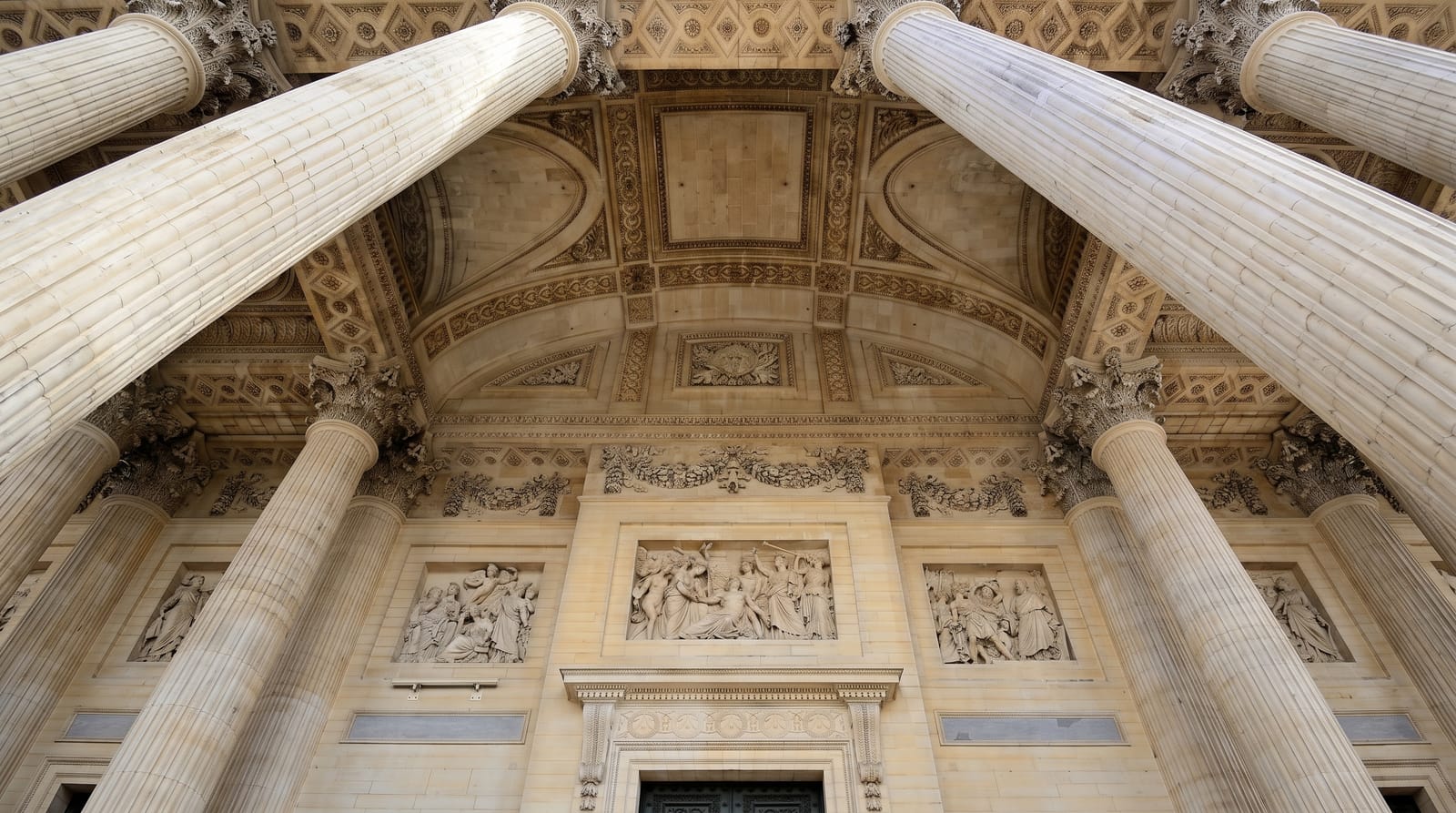
Begun as a church to Sainte-Genevieve and finished in 1790, the building was converted during the Revolution into a mausoleum for those the nation chose to honour, and the crypt now holds Voltaire, Rousseau, Hugo, Zola, Marie Curie, Josephine Baker and around eighty others; entry is by decision of the state, and the composition of the list has been argued about ever since. In 1851 Leon Foucault suspended a sixty-seven metre pendulum from the dome, and its slow rotation over hours demonstrated the earth's rotation directly for the first time in public. A copy hangs there now. The dome is climbed in season for a view down the Latin Quarter.
History
The hill, Mount Lucotitius, held the forum of Roman Lutetia and later the grave of Saint Genevieve, who had led the resistance to the Huns in 451; Clovis built a church here in 508, in which he and his wife were buried, and it became the heart of the Abbey of Saint Genevieve. Louis XV vowed in 1744 to replace the dilapidated abbey church if he recovered from illness, and in 1755 Jacques-Germain Soufflot was chosen to design it, a Greek cross under a great dome, modified several times until 1777; the foundations were laid in 1758, Soufflot died in 1780 and was succeeded by his pupil Jean-Baptiste Rondelet, and the church was completed in 1790. In 1791 the National Constituent Assembly turned it into a mausoleum for distinguished citizens, on the model of the Pantheon in Rome; the building, 110 metres long, 84 wide and 83 high, had its iron reinforcing rods replaced in a restoration of 2010-2020 (Wikipedia, Panthéon).
What to look for
- The crypt - Voltaire, Rousseau, Hugo, Curie and Baker among the tombs.
- Foucault's pendulum - a replica of the 1851 demonstration under the dome.
- The painted nave - nineteenth-century murals of Sainte-Genevieve and French history.
- The dome climb - a seasonal ascent to the colonnade for city views.
When to go
Year-round; the dome climb runs roughly April to October and closes in bad weather. The building is cold inside in winter. Mornings are quietest.
What to expect
The interior is vast, bare and cold, which some find austere. The dome climb is a separate ticket, seasonal, and involves many steps. The pendulum is a replica, not the original.
Nearby
The Luxembourg Gardens lie west; the Sorbonne is north.
Key facts
Source: Wikidata, item Q188856, read on 18 October 2026.
What to pack for Pantheon
Chosen from what this place is for. Tap a kit for the full checklist.
- Comfortable walking shoes - Sightseeing means kilometres of pavement and cobbles daily. Find on Amazon
- A slim anti-theft daypack - Zips that close properly; keep it in front in crowds and on transit. Find on Amazon
- A refillable water bottle - Many cities have public fountains; save money and plastic. Find on Amazon
- A light layer + compact umbrella - For museum air-con and a sudden shower. Find on Amazon
Some links on this page are Amazon affiliate links - if you buy through them we may earn a small commission at no extra cost to you.
All packing kitsPlan your trip
Where to start if Pantheon is going on the list.
Booking links on this page are affiliate links - if you book through them we may earn a small commission at no extra cost to you. It never changes what we write about a place.
Opening times, ticket prices and seasonal closures change - check the official source before you go: official site.