Luxembourg Gardens
A palace garden laid out for a homesick Florentine queen, now the Left Bank's living room.
Updated 19 October 2026
AI illustration
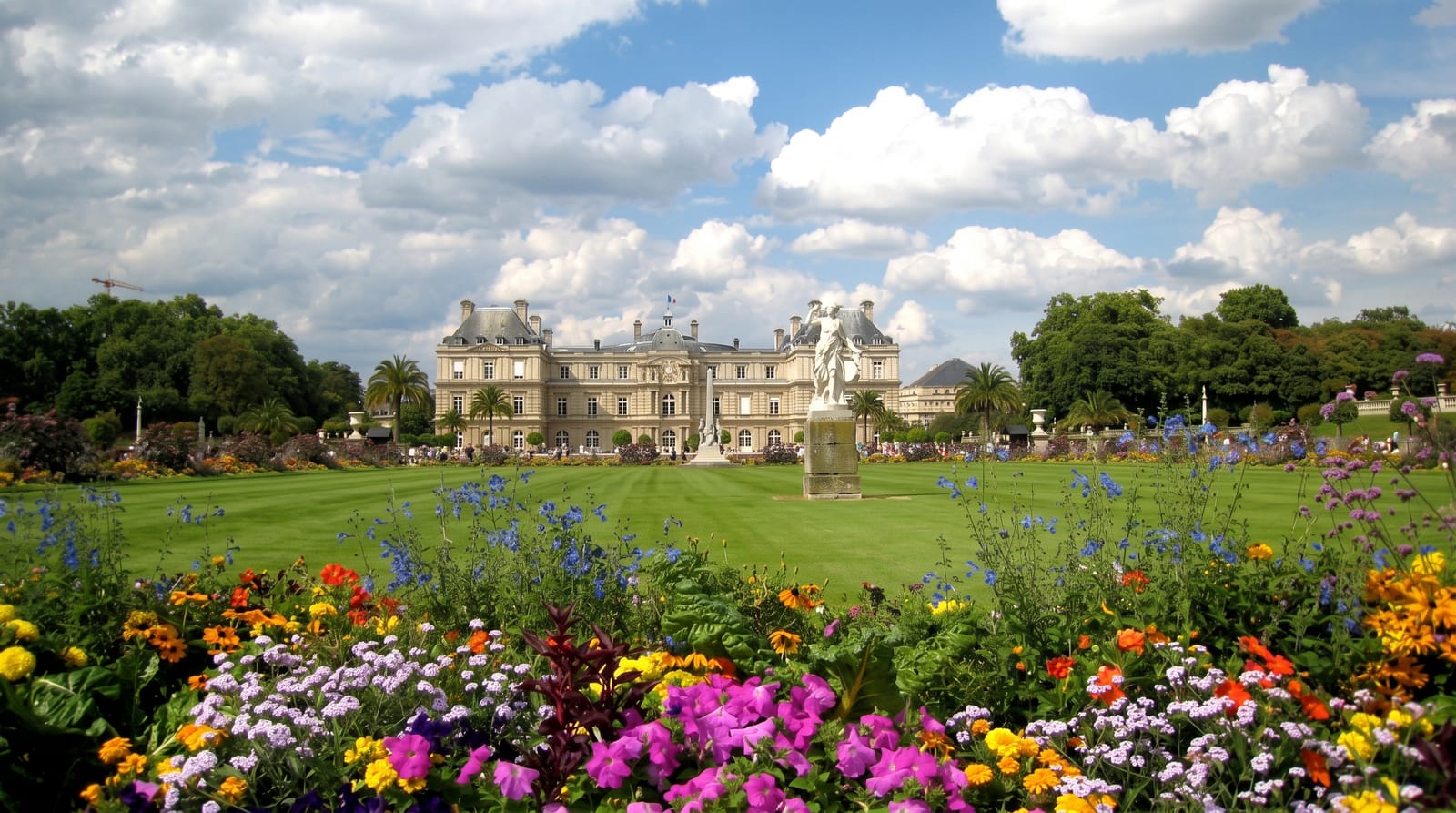
Marie de Medici commissioned the palace and its gardens from 1612, wanting something that recalled the Boboli gardens of her childhood in Florence, and the result is a hybrid: a formal French parterre around an octagonal basin, and a looser wooded English section, with the Medici Fountain in a shaded alley at the eastern edge. The palace now houses the French Senate. What makes the gardens work is use: children sail model boats on the basin with sticks, chess and tennis are played daily, the metal chairs can be dragged anywhere, and an orchard grows heritage apple and pear varieties in the southwest corner.
History
In 1611 Marie de Medici, widow of Henry IV, decided to build a palace recalling the Pitti Palace of her native Florence, bought the Hôtel du Luxembourg and commissioned Salomon de Brosse; in 1612 she had 2,000 elms planted, and Tommaso Francini laid out terraces and parterres around a basin and built the Medici Fountain as a grotto, in a garden of just eight hectares. In 1630 she enlarged it to thirty hectares under Jacques Boyceau, who created formal parterres and the octagonal basin with its view towards the present Observatory. Later neglected, the garden lost its eastern part to building in 1780, but after the Revolution the Directory enlarged it to forty hectares with land taken from the Carthusians, and Jean-François Chalgrin restored it, keeping their nursery garden and vines; from the July Monarchy it filled with statues, among them the queens of France and a small model of Bartholdi's Statue of Liberty, and in 1865 a new street cut off about seven hectares. The 23-hectare garden now belongs to the French Senate (Wikipedia, Jardin du Luxembourg).
Highlights
- The octagonal basin - model sailboats pushed with sticks by children.
- The Medici Fountain - a shaded Italianate fountain in a side alley.
- The movable chairs - green metal seats dragged wherever people want them.
- The orchard and apiary - heritage fruit varieties and beehives in the corner.
When to go
April to October, when the chestnuts are in leaf and the chairs fill; the gardens close at dusk, with the closing time shifting through the year and whistles used to clear them.
Things to know
Lawns are mostly off limits and sitting on the grass is not generally allowed. The gardens close at sunset, earlier than visitors expect in winter. Toilets are limited and charged.
Nearby
The Pantheon lies east; Saint-Germain is north.
Key facts
Source: Wikidata, item Q309458, read on 18 October 2026.
What to pack for Luxembourg Gardens
Chosen from what this place is for. Tap a kit for the full checklist.
- Head torch + spare batteries - Hands-free light is essential; caves are truly dark. Find on Amazon
- Spare batteries + cards - Cold and long shoots drain power; never run out at the good light. Find on Amazon
- Comfortable walking shoes - Sightseeing means kilometres of pavement and cobbles daily. Find on Amazon
- Grippy closed shoes - Cave floors are wet, muddy and slick with formations. Find on Amazon
Some links on this page are Amazon affiliate links - if you buy through them we may earn a small commission at no extra cost to you.
All packing kitsPlan your trip
Where to start if Luxembourg Gardens is going on the list.
Booking links on this page are affiliate links - if you book through them we may earn a small commission at no extra cost to you. It never changes what we write about a place.
Opening times, ticket prices and seasonal closures change - check the official source before you go: official site.