Musee de Cluny
A medieval abbots' mansion built over Roman baths, holding the six unicorn tapestries.
Updated 19 October 2026
AI illustration
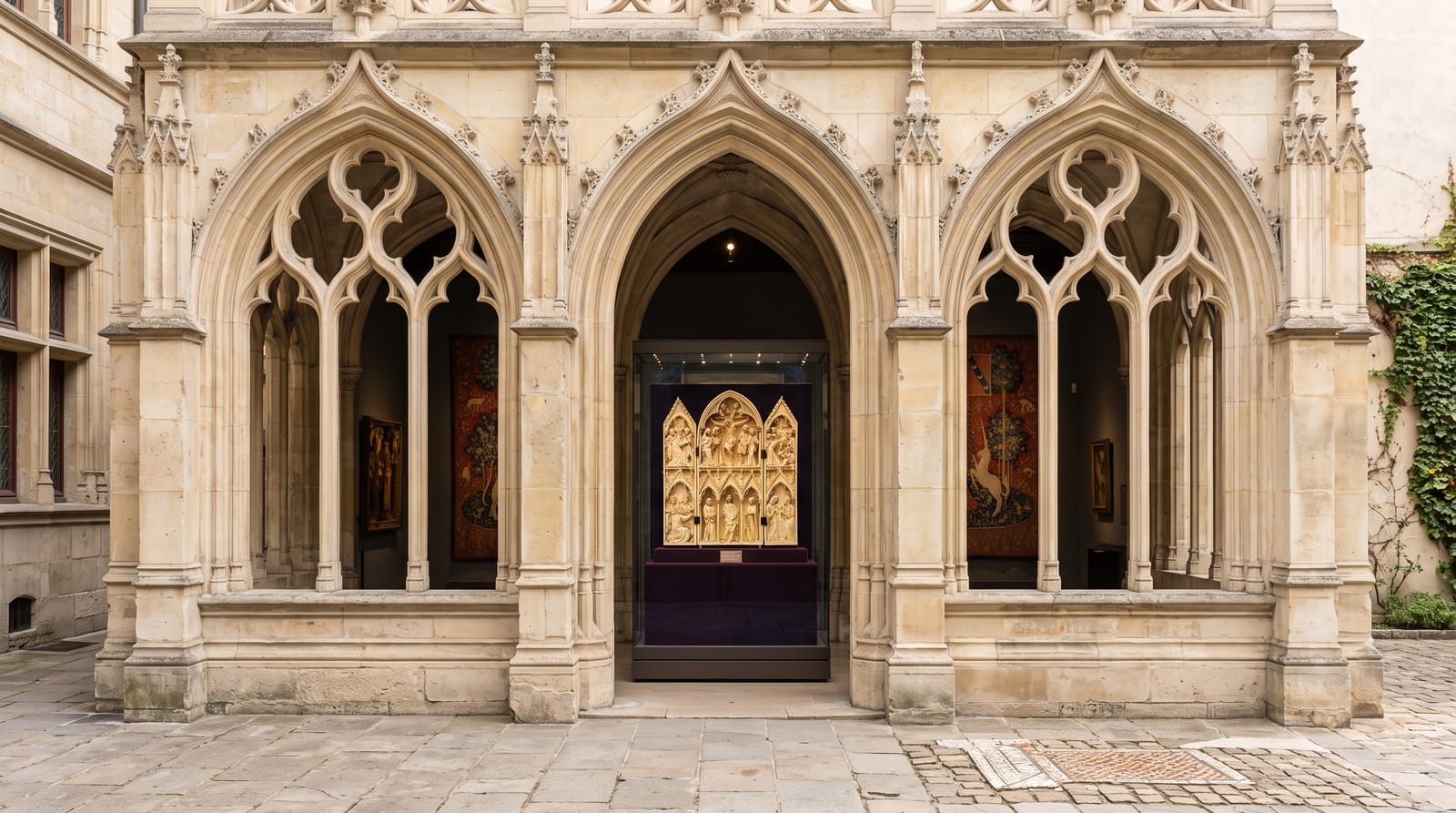
The building is two things at once: the frigidarium and other rooms of a Gallo-Roman bath complex of around the first or second century, among the most substantial Roman remains in Paris, with a late fifteenth-century mansion for the abbots of Cluny built onto and over them. The collection is medieval, and its centrepiece is The Lady and the Unicorn, six tapestries woven around 1500 in which five depict the senses and the sixth carries the inscription A Mon Seul Desir, whose meaning is still argued over. The heads of the kings of Judah, hacked from Notre-Dame in the Revolution and found buried in 1977, are also here.
History
The abbey of Cluny acquired the ancient Roman baths in 1340, and its abbot Jacques d'Amboise, abbot from 1485 to 1510, rebuilt the mansion beside them in a mix of Gothic and early Renaissance styles. Mary Tudor, widow of Louis XII, lived here in 1515 and James V of Scotland stayed in 1537 for his wedding; in the 18th century astronomers including Charles Messier used its tower as an observatory, and after the Revolution it served various purposes, its chapel at one time a dissecting room. In December 1832 the collector Alexandre Du Sommerard bought it to display his medieval and Renaissance objects, the state bought the collection after his death in 1842, and the museum opened in 1843 with his son Edmond as director; the Renaissance collections moved to Écouen in 1977, a room for statues rediscovered from Notre-Dame opened in 1981, and the display of The Lady and the Unicorn was redesigned in 1992 (Wikipedia, Musée de Cluny).
What's there
- The Lady and the Unicorn - six tapestries in a dedicated round room.
- The Roman frigidarium - a vaulted Gallo-Roman bath hall.
- The Notre-Dame kings' heads - sculpture destroyed in 1793 and recovered in 1977.
- The medieval collection - stained glass, ivories, goldwork and altarpieces.
When to go
Year-round; the museum closes on Mondays. It reopened in 2022 after a long renovation with a new entrance and route. Mornings are quietest.
Practical notes
The tapestry room is dim by necessity for conservation, so detail takes time to see. The museum is compact and the route now one-way. Photography rules vary by room.
Nearby
The Sorbonne lies south; Notre-Dame is east.
Key facts
Source: Wikidata, item Q1124095, read on 18 October 2026.
What to pack for Musee de Cluny
Chosen from what this place is for. Tap a kit for the full checklist.
- Spare batteries + cards - Cold and long shoots drain power; never run out at the good light. Find on Amazon
- Comfortable walking shoes - Sightseeing means kilometres of pavement and cobbles daily. Find on Amazon
- A compact tripod - Essential for night skies, aurora, waterfalls and low light. Find on Amazon
- A slim anti-theft daypack - Zips that close properly; keep it in front in crowds and on transit. Find on Amazon
Some links on this page are Amazon affiliate links - if you buy through them we may earn a small commission at no extra cost to you.
All packing kitsPlan your trip
Where to start if Musee de Cluny is going on the list.
Booking links on this page are affiliate links - if you book through them we may earn a small commission at no extra cost to you. It never changes what we write about a place.
Opening times, ticket prices and seasonal closures change - check the official source before you go: official site.