Filitosa
Carved standing stones with faces and weapons, reused as building blocks by the people who came after.
Updated 4 September 2026
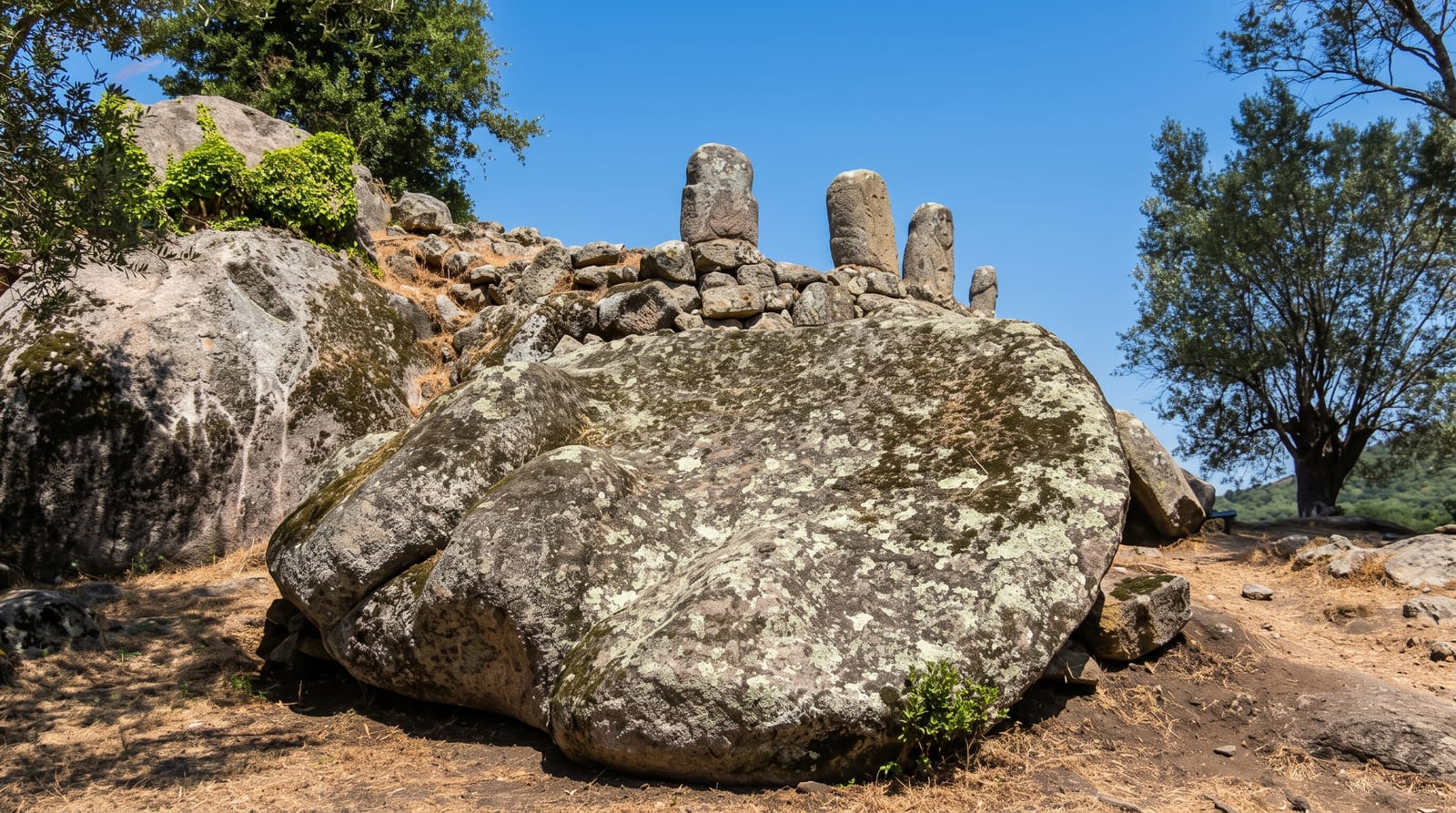
AI illustration
A farmer, Charles-Antoine Cesari, noticed the carved stones on his land in 1946 and archaeologists followed. Filitosa holds the densest group of anthropomorphic menhirs in the Mediterranean: standing stones worked into human form, some with faces, and later ones with swords and daggers cut into them, made roughly between 1500 and 1000 BC. What makes the site unusual is what happened next: the Torreans, who arrived afterwards, broke up many of the statues and used them as building material in their round stone towers, so carved faces appear embedded in walls. An olive tree said to be around a thousand years old stands in the middle.
What you'll find
- The carved menhirs - standing stones with faces, swords and daggers.
- The reused fragments - statue pieces built into later tower walls.
- The Torrean monuments - round dry-stone structures on the spur.
- The ancient olive - a tree of around a thousand years on the site.
When to go
April to October; the site closes over winter. Morning and late afternoon light reads the carvings best. It is compact and takes about an hour and a half.
What to expect
The carvings are weathered and some are faint. The site is small for the ticket price. Interpretation is limited without the audio guide.
Nearby
Sartene lies south; Ajaccio is north.
Key facts
Source: Wikidata, item Q1025950, read on 18 October 2026.
What to pack for Filitosa
Chosen from what this place is for. Tap a kit for the full checklist.
- Comfortable walking shoes - Sightseeing means kilometres of pavement and cobbles daily. Find on Amazon
- A slim anti-theft daypack - Zips that close properly; keep it in front in crowds and on transit. Find on Amazon
- A refillable water bottle - Many cities have public fountains; save money and plastic. Find on Amazon
- A light layer + compact umbrella - For museum air-con and a sudden shower. Find on Amazon
Some links on this page are Amazon affiliate links - if you buy through them we may earn a small commission at no extra cost to you.
All packing kitsPlan your trip
Where to start if Filitosa is going on the list.
Booking links on this page are affiliate links - if you book through them we may earn a small commission at no extra cost to you. It never changes what we write about a place.
Opening times, ticket prices and seasonal closures change - check the official source before you go: official site.