Cluny Abbey
Once the largest church in Christendom, quarried away after the Revolution until about a twelfth remained.
Updated 19 October 2026

AI illustration
The third abbey church at Cluny, begun in 1088, was around a hundred and eighty-seven metres long and remained the largest church in Christendom until the new St Peter's in Rome surpassed it. The order held hundreds of dependent houses across Europe and answered to the pope alone. After the Revolution the abbey was sold and used as a stone quarry for thirty years, so what stands today is roughly a twelfth of the church: one transept arm with its octagonal belfry, some conventual buildings, a granary holding carved capitals. Projections and models on site reconstruct the lost nave, and the scale is only understandable through them.
History
In 910 William I, Duke of Aquitaine, founded the Benedictine abbey of Cluny on a modest scale and chose Berno as its first abbot, stipulating that it should be free of all local authority, lay or church, and subject only to the pope, who himself could not seize its property or impose an abbot. Under Odo, abbot from 926, it gained the right in 931 to reform other monasteries, and Cluny grew into the leader of western monasticism, minting its own coins and opening schools and a library, with a network of houses across western Europe; Majolus directed it from 954 to 994. Three churches were built in succession from the 10th to the early 12th century, the last of them the largest church in the world until St Peter's in Rome, and during the French Revolution, in 1790, the abbey was sacked (Wikipedia, Cluny Abbey).
What's there
- The surviving transept - one arm and the octagonal Eau Benite belfry.
- The reconstruction displays - models and projections of the vanished nave.
- The carved capitals - Romanesque sculpture kept in the granary.
- The abbey town - streets built partly from the abbey's own stone.
When to go
April to October; the site opens year-round with shorter winter hours. Summer brings concerts. The surrounding Maconnais vineyards are good in September.
What to expect
Most of the great church is gone, and visitors expecting a standing abbey are often disappointed. The visit depends on interpretation aids to make sense. Allow time for the augmented reality stops.
Nearby
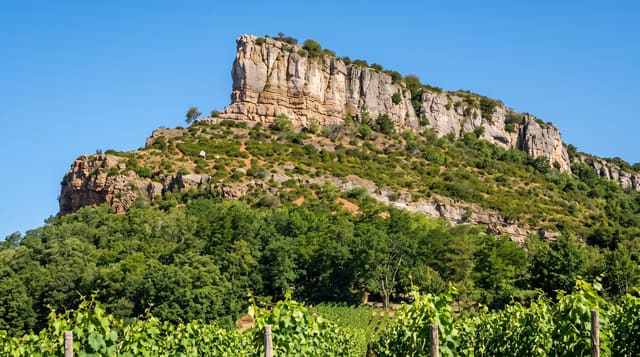
Taize lies north; Macon and the Solutre rock are southeast.
Key facts
Source: Wikidata, item Q220301, read on 18 October 2026.
What to pack for Cluny Abbey
Chosen from what this place is for. Tap a kit for the full checklist.
- Comfortable walking shoes - Sightseeing means kilometres of pavement and cobbles daily. Find on Amazon
- Modest clothing - Shoulders and knees covered - the single most common requirement. Find on Amazon
- A slim anti-theft daypack - Zips that close properly; keep it in front in crowds and on transit. Find on Amazon
- A scarf or shawl - To cover the head or shoulders on entry; women especially at mosques. Find on Amazon
Some links on this page are Amazon affiliate links - if you buy through them we may earn a small commission at no extra cost to you.
All packing kitsPlan your trip
Where to start if Cluny Abbey is going on the list.
Booking links on this page are affiliate links - if you book through them we may earn a small commission at no extra cost to you. It never changes what we write about a place.
Opening times, ticket prices and seasonal closures change - check the official source before you go: official site.