Hospices de Beaune
A fifteenth-century charity hospital under a roof of patterned glazed tiles, funded by wine for six centuries.
Updated 19 October 2026
AI illustration
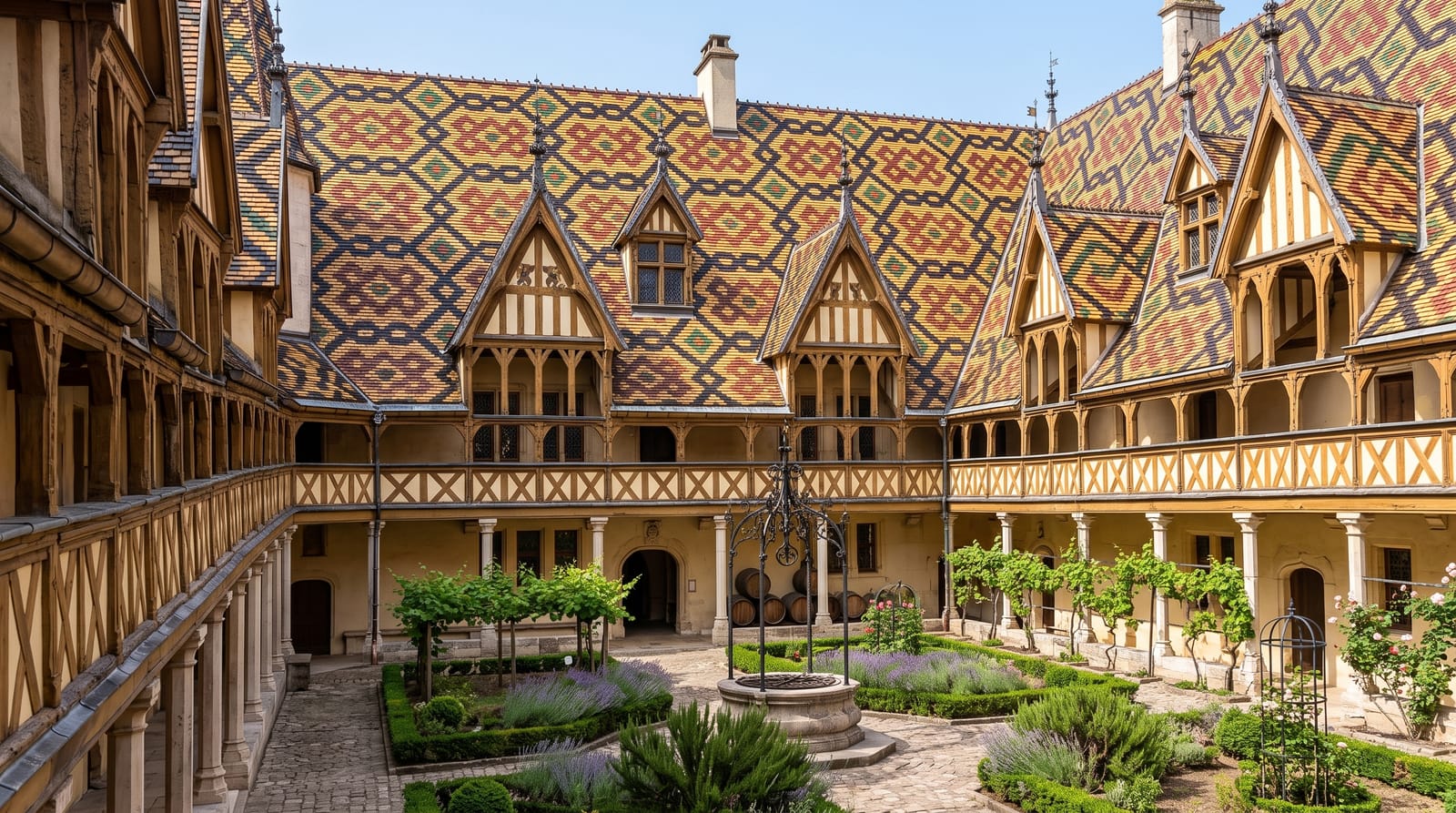
Nicolas Rolin, chancellor to the duke of Burgundy, founded the Hotel-Dieu in 1443 as a hospital for the poor, and its inner courtyard is one of the most photographed roofs in France: steep pitches of glazed tile in green, black, yellow and red laid in geometric patterns, with dormers and a well. The great hall of the poor holds rows of curtained beds under a painted barrel ceiling, and the altarpiece of the Last Judgement by Rogier van der Weyden is displayed in a separate room. Donors gave vineyards, and the charity still owns about sixty hectares of good Burgundy; the annual November auction of its wine sets prices for the vintage.
History
The Hôtel-Dieu was founded on 4 August 1443, under Duke Philip the Good, when the Hundred Years' War had only just ended with the Treaty of Arras of 1435 but bands of écorcheurs still plundered the countryside and most people of Beaune were destitute after an outbreak of plague. The duke's chancellor Nicolas Rolin and his wife Guigone de Salins built it as a hospital and refuge for the poor, with the permission of Pope Eugene IV granted in 1441, and founded an order of nursing sisters to run it; its design was probably overseen by the Flemish architect Jacques Wiscrère, it received its first patient on 1 January 1452 and was consecrated on 31 December 1452. It remained a hospital until 1971, and over the centuries benefactors gave it farms, woodland, works of art and vineyards, whose wine is sold each November at its charity auction (Wikipedia, Hospices de Beaune).
What you'll find
- The tiled courtyard - patterned glazed roofs around a well and gallery.
- The hall of the poor - curtained beds under a painted timber ceiling.
- The van der Weyden altarpiece - a fifteenth-century Last Judgement panel.
- The pharmacy - jars and pestles from the working hospital.
When to go
April to October; the third Sunday of November brings the wine auction and fills Beaune completely. The building opens year-round. Mornings are quieter.
Practical notes
The route is one-way and busy in summer, with queues in the narrow rooms. The hospital moved out in 1971, so this is a museum. Wine tasting is not part of the ticket.
Nearby
The Cote de Beaune vineyards begin outside the walls; Dijon lies north.
Key facts
Source: Wikidata, item Q1284848, read on 18 October 2026.
What to pack for Hospices de Beaune
Chosen from what this place is for. Tap a kit for the full checklist.
- Comfortable walking shoes - Sightseeing means kilometres of pavement and cobbles daily. Find on Amazon
- A slim anti-theft daypack - Zips that close properly; keep it in front in crowds and on transit. Find on Amazon
- A refillable water bottle - Many cities have public fountains; save money and plastic. Find on Amazon
- A light layer + compact umbrella - For museum air-con and a sudden shower. Find on Amazon
Some links on this page are Amazon affiliate links - if you buy through them we may earn a small commission at no extra cost to you.
All packing kitsPlan your trip
Where to start if Hospices de Beaune is going on the list.
Booking links on this page are affiliate links - if you book through them we may earn a small commission at no extra cost to you. It never changes what we write about a place.
Opening times, ticket prices and seasonal closures change - check the official source before you go: official site.

