Aven Armand
A single chamber holding around four hundred stalagmites, one of them close to thirty metres tall.
Updated 21 October 2026

AI illustration
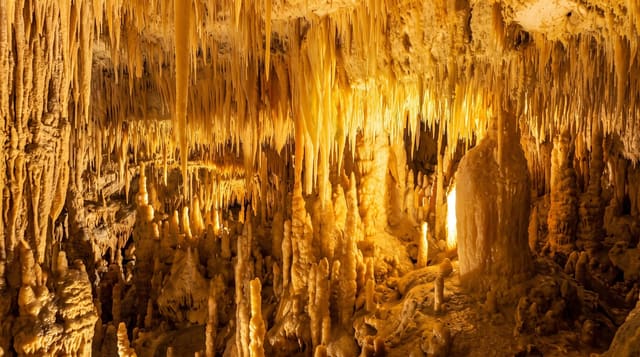
Louis Armand descended the shaft in 1897 with Edouard Martel's team and found a single chamber large enough to hold Notre-Dame de Paris, its floor covered in what has been called a forest of stone: around four hundred stalagmites built up by water falling from the roof about a hundred metres above, some slender and stacked like plates, the tallest close to thirty metres and generally described as the tallest known stalagmite in the world. Visitors now descend by funicular through a tunnel rather than by rope. The cave lies under the Causse Mejean, a bare limestone plateau with almost no surface water.
History
The cave was first explored scientifically in 1897 by Louis Armand and Édouard-Alfred Martel, who descended a narrow shaft of 75 metres into an enormous vaulted chamber, the Grand Salle, close to 100 metres long and 55 metres wide, its floor crowded with fragile formations built up by dripping water over thousands of years, some close to 30 metres high. It has been open to the public since 1927, after a tunnel and walkways were made to let visitors see the hall (Wikipedia, Aven Armand).
What you'll find
- The stone forest - around four hundred stalagmites across one chamber floor.
- The great stalagmite - a column close to thirty metres high.
- The single chamber - a hall large enough to contain a cathedral.
- The funicular descent - a tunnel railway down to the cave floor.
When to go
Year-round in season; the cave closes over winter, roughly November to March. It stays around ten degrees inside. Summer visits should be booked and are busiest midday.
What to expect
Only one chamber is shown, and the visit is about forty-five minutes on a guided route. It is cold and damp. The plateau approach roads are long and empty.
Nearby
The Gorges du Tarn lie north; Montpellier-le-Vieux is southwest.
Key facts
Source: Wikidata, item Q790407, read on 18 October 2026.
What to pack for Aven Armand
Chosen from what this place is for. Tap a kit for the full checklist.
- Broken-in walking shoes or boots - Grip and ankle support matter more than looks; never hike in brand-new boots. Find on Amazon
- Head torch + spare batteries - Hands-free light is essential; caves are truly dark. Find on Amazon
- Modest clothing - Shoulders and knees covered - the single most common requirement. Find on Amazon
- Layers + a waterproof shell - Mountain weather turns fast; a packable rain jacket saves the day. Find on Amazon
Some links on this page are Amazon affiliate links - if you buy through them we may earn a small commission at no extra cost to you.
All packing kitsPlan your trip
Where to start if Aven Armand is going on the list.
Booking links on this page are affiliate links - if you book through them we may earn a small commission at no extra cost to you. It never changes what we write about a place.
Opening times, ticket prices and seasonal closures change - check the official source before you go: official site.