Ankober
A former royal capital on the edge of the Rift escarpment, with palace ruins and a rare endemic bird.
Updated 29 October 2026
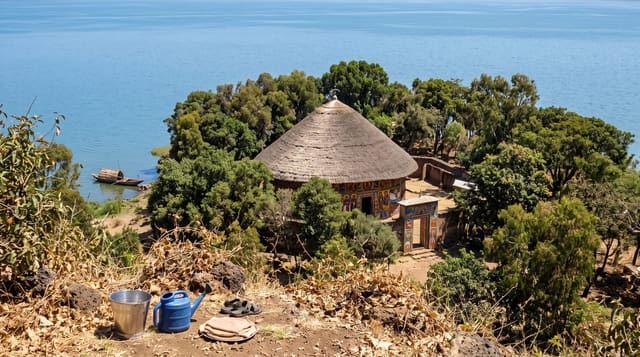
Ankober was the capital of the kingdom of Shewa in the nineteenth century, the seat of Menelik II before he moved his residence to Mount Entoto, above what became Addis Ababa, in 1878, and it sits on a ridge at around 2,500 metres right at the lip of the escarpment, with the ground dropping away thousands of metres toward the Afar lowlands. The palace site on the hilltop is largely ruined, with foundations, a rebuilt church and a view that explains why it was chosen. The escarpment below is where ornithologists first recorded the Ankober serin in 1979, a small seed-eating finch found only in a few scattered areas of the Ethiopian highlands, which brings birdwatchers, along with gelada troops on the cliffs. A lodge on the ridge serves as the base and the drive up from Debre Birhan is short.
History
Ankober may once have been called Gorobela, and its name is said to come from an Oromo queen, Anko, who ruled the town. Meridazmach Amha Iyasus moved the capital of Shewa here from Doqaqit, and it remained the main residence of the Shewan rulers until Menelik II moved to Mount Entoto in 1878. The first Europeans to record a visit were the missionaries Carl Wilhelm Isenberg and Johann Ludwig Krapf in 1839, who found a small colony of Greek craftsmen and traders, and many travellers followed, among them Captain William Cornwallis Harris. In the mid-19th century the town had around 5000 people, rising to 15,000 when the court was in residence, with the stone palace crowning the hill inside a fence of stakes and most people living in thatched round huts across the mountainside, and a market every Saturday. The Kidus Mikael Church built by Sahle Selassie still stands, and of Menelik's palace, raised on the site of his father's, only one long stone wall survives; the town is also where ornithologists first recorded the Ankober serin, in 1979 (Wikipedia, Ankober).
What to look for
- The palace ridge - foundations and church on the hilltop site.
- The escarpment edge - the drop toward the Afar lowlands.
- The Ankober serin - the endemic finch first recorded on these cliffs.
- Gelada troops - highland primates along the escarpment.
When to go
October to March for clear weather and views over the lowlands. Mornings give the best chance of the escarpment view before cloud rises. The serin is resident year round but easier in the dry months.
Before you go
Little of the palace survives beyond foundations and a rebuilt church. The serin is small, drab and hard to find without a specialist guide. It is cold and windy on the ridge. Facilities amount to one lodge and there is little in the village.
Nearby
Debre Birhan lies west; the Afar lowlands drop away east.
Key facts
Source: Wikidata, item Q557397, read on 18 October 2026.
Opening times, ticket prices and seasonal closures change - check the official source before you go: official site.
Plan your trip
Where to start if Ankober is going on the list.
Booking links on this page are affiliate links - if you book through them we may earn a small commission at no extra cost to you. It never changes what we write about a place.
What to pack for Ankober
Chosen from what this place is for. Tap a kit for the full checklist.
- Binoculars - The single best wildlife tool - even a compact pair transforms a sighting. Find on Amazon
- Layers for big temperature swings - Warm sun by day, near-freezing at night, even near the equator. Find on Amazon
- Comfortable walking shoes - Sightseeing means kilometres of pavement and cobbles daily. Find on Amazon
- Shelter suited to the place - Tent, tarp or hut booking - match it to the terrain and rules. Find on Amazon
Some links on this page are Amazon affiliate links - if you buy through them we may earn a small commission at no extra cost to you.
All packing kits