Soomaa National Park
Bog country with a fifth season - every spring the rivers rise over the roads and the standard way to get around becomes a boat.
Updated 29 October 2026
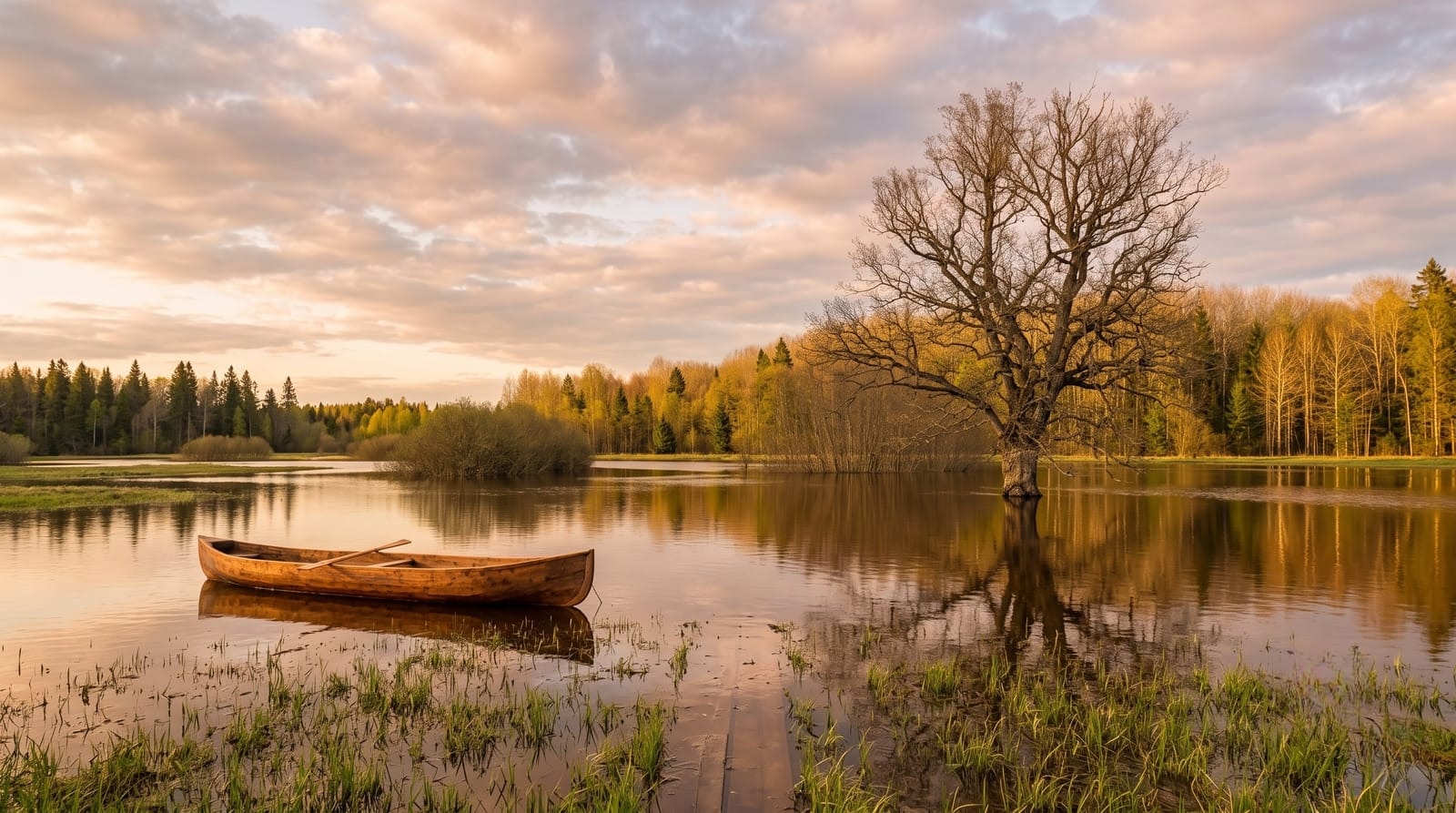
AI illustration
UNESCO Intangible Cultural Heritage
Soomaa means "land of bogs", and it is the one Estonian park where the landscape does something unusual: for a few weeks each spring the snowmelt overwhelms five rivers at once and the water spreads out across the forest and the roads. Locals call it the fifth season, and it is the reason people who have already seen a lot of national parks still make the trip.
Background
Soomaa, "land of bogs", became a national park in 1993 to protect large raised bogs, floodplain grasslands, paludified forests and meandering rivers in south-western Estonia, and it was listed as an Important Bird Area in 1989, a Ramsar wetland in 1997 and a Natura 2000 site in 2004. Kuresoo, its best-known bog, climbs 8 metres over 100 metres on its steep southern slope above the Lemmejõgi. In the high-water season the Riisa flood area can spread over 175 square kilometres, the largest regularly flooded area in Estonia, with the water rising by up to a metre a day for three or four days. The eastern edge holds the highest dunes on the Estonian mainland, a sand ridge 1.2 kilometres long and up to 12 metres high, some 50 kilometres from today's coast.
Source: Wikipedia, "Soomaa National Park"
What you'll find
- The raised bog - a soft brown-and-green surface of sphagnum, stunted pines and small dark pools, crossed by boardwalks.
- The Riisa trail - a short loop out onto the open bog without wet feet, with a viewing tower at the far end.
- The flood - fence posts, road signs and the lower trunks of trees standing in still brown water, with a boat the only sensible transport.
- The haabjas - a dugout canoe cut from a single aspen, still built by a few makers and carried on the UNESCO intangible heritage list.
When to go
Late March to April is the flood, if the winter delivered enough snow; the dates move by weeks from year to year and cannot be booked far ahead with confidence. June to September has dry boardwalks, cloudberries and cranberries in the bog and long light. Winter is for bog-shoe walks across the frozen surface, and is very quiet.
Good to know
The fifth season is a real event, not a marketing line, but it is weather-dependent. Some years the flood is knee-deep and brief, some years it closes roads for a fortnight. If you are travelling specifically for it, plan flexible dates and check with a local operator rather than a calendar.
The bog itself is beautiful in a low-key way. It is flat, the palette is muted, and if you are expecting mountains you will not find them. Mosquitoes are serious from June onwards.
Nearby
Viljandi, with its castle hill and lake, is under an hour east. Pärnu and the coast are a similar distance west, which makes Soomaa an easy inland detour on the way between the two.
Key facts
Source: Wikidata, item Q736682, read on 18 October 2026.
Opening times, ticket prices and seasonal closures change - check the official source before you go: official site.
Plan your trip
Where to start if Soomaa National Park is going on the list.
Booking links on this page are affiliate links - if you book through them we may earn a small commission at no extra cost to you. It never changes what we write about a place.
What to pack for Soomaa National Park
Chosen from what this place is for. Tap a kit for the full checklist.
- Broken-in walking shoes or boots - Grip and ankle support matter more than looks; never hike in brand-new boots. Find on Amazon
- Quick-dry clothing - Board shorts or synthetics that shrug off spray and dry fast. Find on Amazon
- Binoculars - The single best wildlife tool - even a compact pair transforms a sighting. Find on Amazon
- Warm base layers - Merino or synthetic against the skin - never cotton, which chills when damp. Find on Amazon
Some links on this page are Amazon affiliate links - if you buy through them we may earn a small commission at no extra cost to you.
All packing kits