Ingapirca
Ecuador's largest Inca ruin, built over an older Cañari site, with an elliptical sun temple of precisely fitted stone.
Updated 19 October 2026
AI illustration
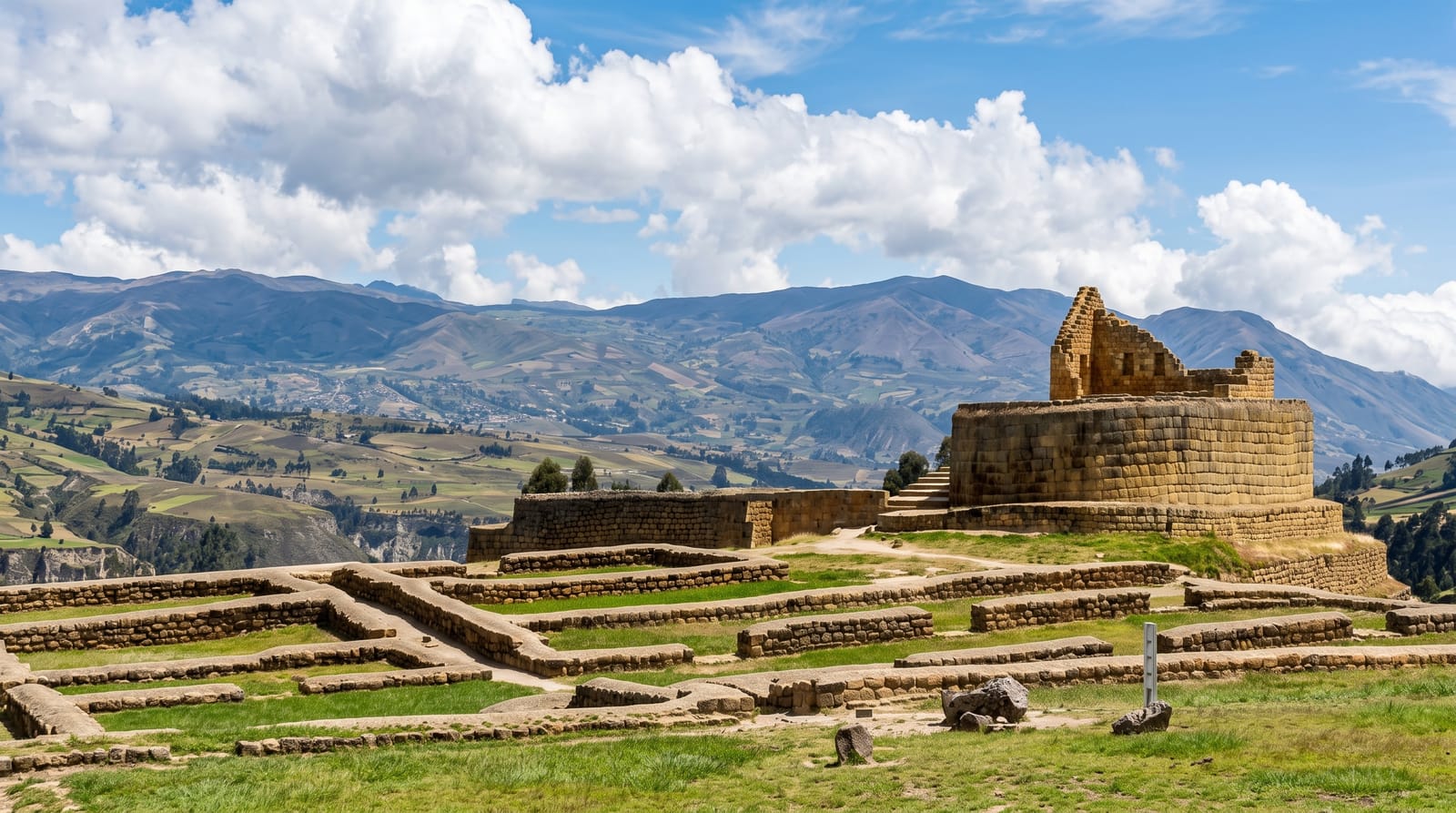
Ingapirca is the most substantial Inca site in Ecuador, though its story is more layered than that suggests: the Cañari people occupied the hill first and their structures remain alongside the later Inca building, an unusual case of the two cultures sharing a site rather than one erasing the other. The centrepiece is the Temple of the Sun, an elliptical platform of mortarless stone laid in the tight polygonal style the Inca used for their most important buildings, oriented so that light falls in a particular way at the solstices. Around it are storehouses, water channels, a ceremonial plaza and Cañari burial areas. At around 3,200 metres, the surrounding páramo grassland is windy and open, with llamas grazing among the walls.
History
The area was long settled by the Cañari, who called it Hatun Cañar. When the Inca Túpac Yupanqui pushed into southern Ecuador he found them hard to conquer and turned to other strategies, marrying a Cañari princess and enlarging the Cañari city of Guapondelig as Tumebamba, today's Cuenca; the Inca and Cañari settled their differences and lived side by side, each keeping their own customs, and the astronomical observatory was built under Huayna Capac. The complex served as a fortress and storehouse supplying Inca troops on the way north, with an underground aqueduct bringing water to the whole site. Its Temple of the Sun, of mortarless stones carefully fitted together, was positioned so that at the solstices sunlight fell through the centre of the doorway of its small upper chamber. Charles Marie de La Condamine, who visited in 1739, was the first European to describe Ingapirca scientifically (Wikipedia, Ingapirca).
What's there
- Temple of the Sun - the elliptical mortarless platform, the finest Inca stonework in Ecuador.
- Cañari structures - earlier buildings and burials preserved alongside the Inca work.
- The site museum - context and finds, worth doing before walking the ruins.
- The Inca trail section - a stretch of the old road running past the site.
When to go
June to September is driest. It is exposed and cold at 3,200 metres, and the wind rarely stops, so a windproof layer matters even in sunshine. Mornings are usually clearer than afternoons.
Things to know
It is small by Peruvian standards and visitors who have seen Machu Picchu often find it modest; judge it on its own terms as the best-preserved Inca site in Ecuador rather than as a rival. Much of the complex is foundations. Guided entry is standard and the guide makes a considerable difference, since the Cañari and Inca layers are hard to distinguish unaided.
Nearby
Cuenca is two hours south; the Cañar market towns are nearby.
Key facts
Source: Wikidata, item Q1478056, read on 18 October 2026.
What to pack for Ingapirca
Chosen from what this place is for. Tap a kit for the full checklist.
- Broken-in walking shoes or boots - Grip and ankle support matter more than looks; never hike in brand-new boots. Find on Amazon
- Head torch + spare batteries - Hands-free light is essential; caves are truly dark. Find on Amazon
- Spare batteries + cards - Cold and long shoots drain power; never run out at the good light. Find on Amazon
- Layers for big temperature swings - Warm sun by day, near-freezing at night, even near the equator. Find on Amazon
Some links on this page are Amazon affiliate links - if you buy through them we may earn a small commission at no extra cost to you.
All packing kitsPlan your trip
Where to start if Ingapirca is going on the list.
Booking links on this page are affiliate links - if you book through them we may earn a small commission at no extra cost to you. It never changes what we write about a place.
Opening times, ticket prices and seasonal closures change - check the official source before you go: official site.