Chimborazo
A glaciated volcano whose summit, measured from the centre of the earth, is the furthest point from it on the planet.
Updated 19 October 2026
AI illustration
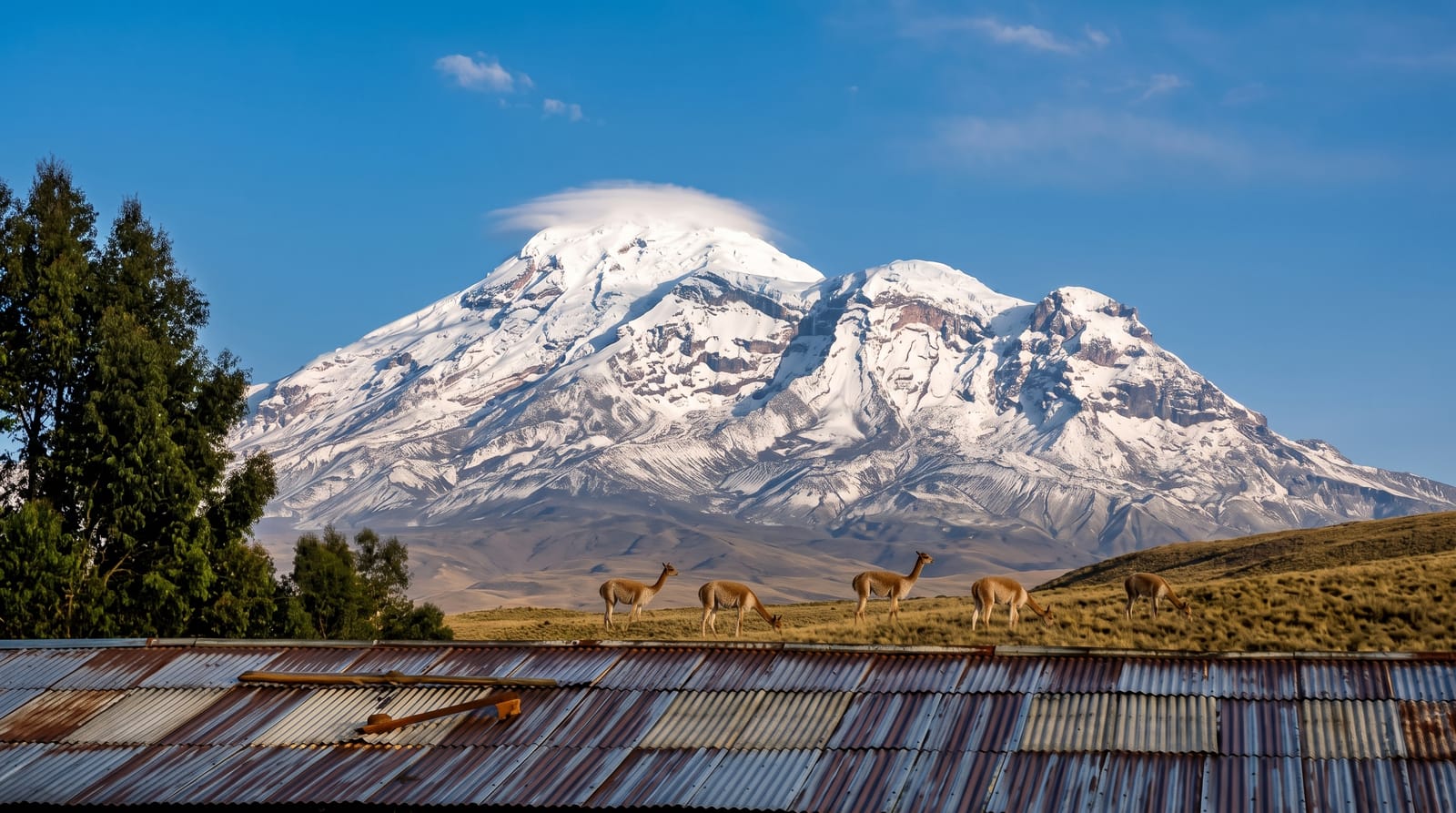
Because the earth bulges at the equator, the summit of Chimborazo at 6,263 metres is further from the planet's centre than Everest, which makes it the closest point on the surface to the sun and the furthest from the core. That is a geometric curiosity rather than a climbing achievement, but it draws people. For non-climbers, a road runs to the first refuge at about 4,800 metres, and a walk of forty-five minutes or so, breathless at that altitude, reaches the second at around 5,000, with the glacier above and a view over the páramo. Vicuñas, reintroduced after near-extermination, graze the surrounding reserve in herds. The summit itself is a serious glaciated climb requiring a guide, technical equipment and an overnight start.
History
Chimborazo's last known eruption is believed to have been around AD 550. Its name has several proposed origins, among them the Quichua chimbarazu, "the snow on the other side", and local people also called it Urcurazu, "mountain of ice". In local Andean belief Chimborazo is Taita, the father, with neighbouring Tungurahua as Mama and Pichincha as Guagua, the child. At 6,263 m it is the highest mountain in Ecuador, and because it stands on the equatorial bulge its summit is the farthest point on the earth's surface from the centre of the planet (Wikipedia, Chimborazo).
What you'll find
- The refuges - drive to the first at 4,800 m, walk to the second at around 5,000 m.
- Vicuña herds - wild camelids grazing the páramo, recovered from near-extinction.
- The glacier front - the ice above the second refuge, visibly retreating.
- The ice merchants' route - the tradition of cutting glacier ice, kept alive into recent decades.
When to go
The driest and clearest windows are roughly December to January and June to September. Mornings are almost always clearer; cloud usually swallows the mountain by early afternoon, so arrive early or see nothing.
Good to know
Altitude is the issue: the refuge walk starts higher than most people have ever been, and visitors who drive straight up from Quito frequently feel very unwell. Acclimatise first. The summit is a technical glacier climb with real objective danger, not a trekking peak, and should only be attempted with a licensed guide. Wind and cold at the refuges are severe.
Nearby
Riobamba is the base city; the Quilotoa loop and Cotopaxi lie north.
Key facts
Source: Wikidata, item Q14081, read on 18 October 2026.
What to pack for Chimborazo
Chosen from what this place is for. Tap a kit for the full checklist.
- Broken-in walking shoes or boots - Grip and ankle support matter more than looks; never hike in brand-new boots. Find on Amazon
- Warm base layers - Merino or synthetic against the skin - never cotton, which chills when damp. Find on Amazon
- Layers for big temperature swings - Warm sun by day, near-freezing at night, even near the equator. Find on Amazon
- Shelter suited to the place - Tent, tarp or hut booking - match it to the terrain and rules. Find on Amazon
Some links on this page are Amazon affiliate links - if you buy through them we may earn a small commission at no extra cost to you.
All packing kitsPlan your trip
Where to start if Chimborazo is going on the list.
Booking links on this page are affiliate links - if you book through them we may earn a small commission at no extra cost to you. It never changes what we write about a place.
Opening times, ticket prices and seasonal closures change - check the official source before you go: official site.