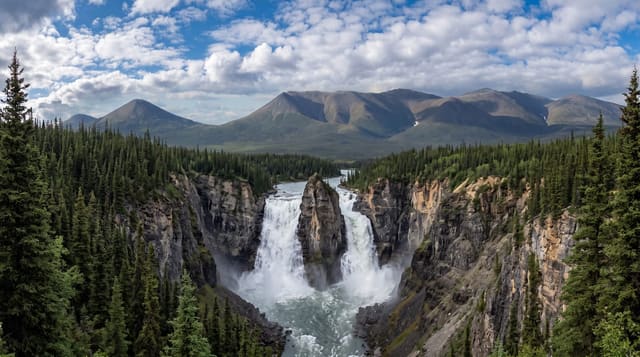
Virunga National Park
Africa's oldest national park, running from Rwenzori glaciers to active volcanoes, with mountain gorillas, a lava lake and a range of habitats no other park matches.
Updated 18 October 2026

AI illustration
UNESCO World Heritage
Virunga was established in 1925, which makes it the oldest national park in Africa, and it covers a strip of the eastern border running some three hundred kilometres from the Rwenzori glaciers in the north to the Virunga volcanoes in the south. In between are savannah, swamp, lowland and montane forest, and lava fields. It holds mountain gorillas in the southern sector, the Nyiragongo lava lake, and one of the largest hippo populations on the continent before the declines of recent decades. It was inscribed in 1979.
History
In April 1925 the Belgian colonial authorities created Albert National Park, the Congo's first, as a science-oriented reserve of about 500 square kilometres around the extinct volcanoes Karisimbi and Mikeno, mapped in 1926 by Jean-Marie Derscheid; it was extended in 1929 over the Virunga Mountains and the plains south of Lake Edward and enlarged step by step, while local people lost their land rights and were evicted, some 85,000 Rwandophone people being moved to Masisi between the late 1930s and 1955. In 1969 the parks were merged as Virunga National Park, which became a World Heritage Site in 1979 and a Ramsar wetland in 1996, and it has been on the List of World Heritage in Danger since 1994 because of civil unrest. In 2014, during the dispute over an oil concession granted to Soco International, the park's chief warden Emmanuel de Mérode was attacked; after international protests the company stopped exploring (Wikipedia, Virunga National Park).
What you'll find
- The mountain gorillas - habituated family groups in the Mikeno sector, trekked with permits.
- Nyiragongo - an active volcano with a persistent lava lake, climbed overnight to the rim.
- The Rwenzori - glaciated peaks at the park's northern end, the highest ground in the range.
- The habitat range - glacier to savannah to lava field within one protected area.
When to go
The drier windows, June to September and December to February, are the practical seasons for trekking and for the volcano climb. Rain falls in most months in the forest sectors. Everything runs to the park's own schedule and permits are arranged well in advance.
What to expect
The park opens and closes sectors at its own discretion and has been shut to visitors for extended periods; nothing here can be planned without checking directly with the park. Both the gorilla trek and the volcano climb are physically demanding. A distance and health rule applies around the gorillas and is enforced. The park has been on the List of World Heritage in Danger since 1994.
Nearby
Goma is at the southern end, Lake Kivu is below it, and Kahuzi-Biega lies further south.
Key facts
Source: Wikidata, item Q223589, read on 18 October 2026.
What to pack for Virunga National Park
Chosen from what this place is for. Tap a kit for the full checklist.
- Broken-in walking shoes or boots - Grip and ankle support matter more than looks; never hike in brand-new boots. Find on Amazon
- Binoculars - The single best wildlife tool - even a compact pair transforms a sighting. Find on Amazon
- Warm base layers - Merino or synthetic against the skin - never cotton, which chills when damp. Find on Amazon
- Shelter suited to the place - Tent, tarp or hut booking - match it to the terrain and rules. Find on Amazon
Some links on this page are Amazon affiliate links - if you buy through them we may earn a small commission at no extra cost to you.
All packing kitsPlan your trip
Where to start if Virunga National Park is going on the list.
Booking links on this page are affiliate links - if you book through them we may earn a small commission at no extra cost to you. It never changes what we write about a place.
Opening times, ticket prices and seasonal closures change - check the official source before you go: official site.