Krkonose National Park
The highest range in the country, where spruce forest gives way to open arctic plateau, peat bog and the summit of Snezka.
Updated 19 October 2026
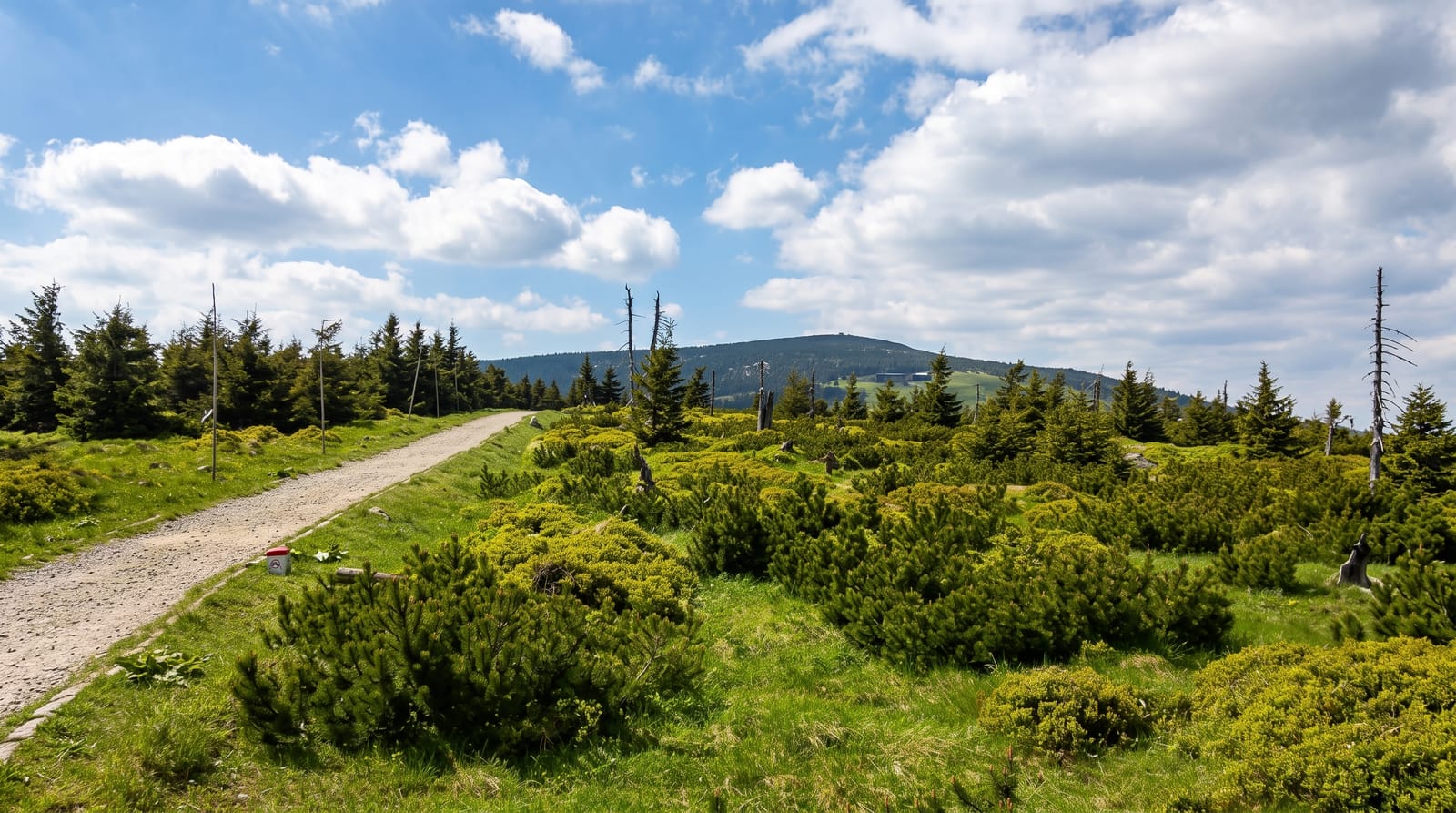
AI illustration
The Krkonose run along the Polish border and hold the highest ground in the country. What makes them unusual is not their height but what sits on top of them: above roughly 1,250 metres the spruce forest gives out and the ridges flatten into open plateau of dwarf pine, peat bog and stone fields, a cold relic landscape carrying arctic and alpine plants that stayed here after the ice ages. The Elbe rises on one of these plateaux from a spring marked with a stone. Snezka, 1,603 metres, stands on the border ridge and is the highest point in the country. Marked paths link mountain huts, and Spindleruv Mlyn and Pec pod Snezkou sit in the valleys below.
History
The first steps to protect nature in the Giant Mountains came in 1952, when state nature reserves were declared, among them Kotelní jámy, Pančavská louka and Labský důl, watched over by conservationists such as Zdeněk Pilous, Jindřich Ambrož and Josef Šourek, who had to deal with the pressure of intensive tourism and economic use of the landscape. Krkonoše National Park was proclaimed on 17 May 1963, four years after the Polish Karkonosze National Park, established on 16 January 1959. A protective zone was added in 1986, the park's statute was proclaimed again in 1991 with the mission of preserving and improving its natural environment, and the latest legal re-proclamation came in 2017. The park covers most of the range, the highest in the country, and is also listed as a UNESCO Biosphere Reserve (Wikipedia, Krkonoše National Park).
What you'll find
- Snezka - the 1,603 metre border summit, reached on foot from either side or by cable car from Pec.
- The source of the Elbe - a marked spring on the Labska louka plateau where the country's main river starts.
- Pancava Falls - a long staged waterfall dropping off the plateau edge into the Labsky dul valley.
- The boudy - the mountain huts scattered along the ridges, serving soup, beer and beds to walkers.
When to go
June to September for the ridge walks, when the plateau paths are clear and the huts are all open. Snow lingers on northern slopes into May. Winter turns the valleys into ski resorts and closes some ridge routes for avalanche risk. Ridge weather changes fast, so check the forecast and carry a windproof layer even in July.
What to expect
The tops are exposed and often in cloud, so a fine forecast matters more than the season. Snezka's summit is crowded in good weather and its buildings are functional rather than pretty. Spindleruv Mlyn is a resort town with resort prices and heavy weekend traffic. Many ridge paths are paved with stone slabs and are hard on the feet.
Nearby
The Adrspach rock towns lie east, and the range continues into Poland as the Karkonosze.
Key facts
Source: Wikidata, item Q2043817, read on 18 October 2026.
What to pack for Krkonose National Park
Chosen from what this place is for. Tap a kit for the full checklist.
- Broken-in walking shoes or boots - Grip and ankle support matter more than looks; never hike in brand-new boots. Find on Amazon
- Binoculars - The single best wildlife tool - even a compact pair transforms a sighting. Find on Amazon
- Warm base layers - Merino or synthetic against the skin - never cotton, which chills when damp. Find on Amazon
- Shelter suited to the place - Tent, tarp or hut booking - match it to the terrain and rules. Find on Amazon
Some links on this page are Amazon affiliate links - if you buy through them we may earn a small commission at no extra cost to you.
All packing kitsPlan your trip
Where to start if Krkonose National Park is going on the list.
Booking links on this page are affiliate links - if you book through them we may earn a small commission at no extra cost to you. It never changes what we write about a place.
Opening times, ticket prices and seasonal closures change - check the official source before you go: official site.