Frantiskovy Lazne
The smallest of the West Bohemian spa towns, a grid of yellow and white Empire-style houses around drinking pavilions and parks.
Updated 18 October 2026
AI illustration
UNESCO World Heritage
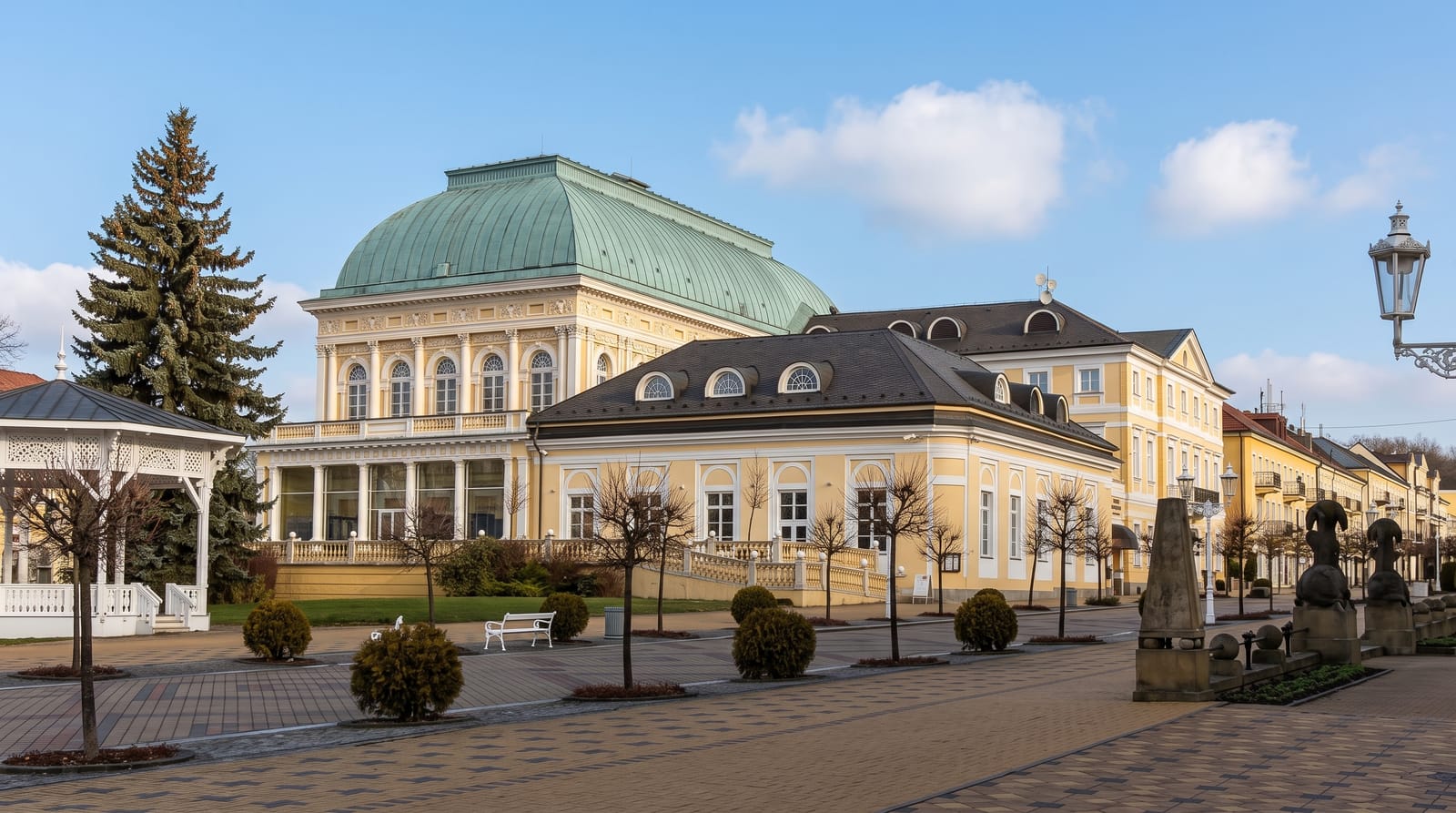
Frantiskovy Lazne is the tidiest and least dramatic of the three West Bohemian spa towns, and that is its character. Founded at the end of the 18th century, it was built almost entirely to one recipe: pale yellow walls, white pilasters and window frames, low neoclassical blocks along straight streets, with parks filling the gaps. The oldest spring sits under a domed rotunda at the head of the main axis, and around it stand colonnades, a bathhouse and a theatre in the same yellow livery. The waters here come with mineral peat and natural gas from the marshy ground nearby, which is why the treatment tradition developed. Everything is walkable in an afternoon.
History
The healing springs here were known from the late 14th century, and around 1700 the water, shipped in earthenware bottles, reportedly sold more than that of all the other spas in the Empire together. When the Cheb doctor Bernhard Adler put up a pavilion and basin at the Franzensquelle in 1791, the women of Cheb who lived by carrying and selling the water tore it down, but the town council backed him, and on 27 April 1793 the spa was founded as Kaiser Franzensdorf, after Emperor Francis II, laid out on an orthogonal plan around 24 springs. Goethe, Beethoven and Johann Strauss II came to take the waters, Franzensbad offered one of the first peat baths in Europe, Emperor Franz Joseph made it a town in 1865, and in 2021 it became part of the Great Spa Towns of Europe World Heritage Site (Wikipedia, Františkovy Lázně).
What's there
- Frantiskuv pramen - the founding spring under its domed pavilion at the top of the main axis.
- The yellow Empire streets - uniform neoclassical blocks with white pilasters making up almost the whole town.
- The colonnades and bathhouses - the spa buildings strung through the central parks.
- The Frantisek statue - the small bronze figure that visitors rub for luck.
When to go
May to September, when the parks and flowerbeds that carry the town are in order and the outdoor spa areas open. The place is quiet year-round and never crowded the way Karlovy Vary is, and midweek is quietest of all. Winter strips it back to bare trees and shuttered pavilions.
Practical notes
There is very little to do beyond walking, drinking the water and using a spa, and most visitors exhaust the town in three hours. The uniformity that makes it a coherent piece of planning also makes it monotonous. Restaurants are few and close early, and the mood skews strongly towards long-stay medical guests.
Nearby
Cheb with its medieval square is six kilometres south, and Marianske Lazne is half an hour away.
Key facts
Source: Wikidata, item Q756581, read on 18 October 2026.
What to pack for Frantiskovy Lazne
Chosen from what this place is for. Tap a kit for the full checklist.
- Comfortable walking shoes - Sightseeing means kilometres of pavement and cobbles daily. Find on Amazon
- A slim anti-theft daypack - Zips that close properly; keep it in front in crowds and on transit. Find on Amazon
- A refillable water bottle - Many cities have public fountains; save money and plastic. Find on Amazon
- A light layer + compact umbrella - For museum air-con and a sudden shower. Find on Amazon
Some links on this page are Amazon affiliate links - if you buy through them we may earn a small commission at no extra cost to you.
All packing kitsPlan your trip
Where to start if Frantiskovy Lazne is going on the list.
Booking links on this page are affiliate links - if you book through them we may earn a small commission at no extra cost to you. It never changes what we write about a place.
Opening times, ticket prices and seasonal closures change - check the official source before you go: official site.