Sanctuary of Aphrodite at Kouklia
The ruins of Old Paphos, the island's main sanctuary of Aphrodite for over a thousand years, with a museum in a Lusignan manor.
Updated 18 October 2026
UNESCO World Heritage
Palaepaphos, Old Paphos, was the principal sanctuary of Aphrodite in the ancient Greek world and drew pilgrims from across the Mediterranean from the twelfth century BC until the Roman period. The goddess was worshipped here not as a statue but as a conical black stone, which is now in the site museum. What survives on the ground is foundations, a Roman-era hall, and the remains of the great enclosure; the museum occupies a Lusignan manor house of the thirteenth century built over part of it. The site is included in the Paphos World Heritage inscription.
History
The city of Paphos, later called Palaepaphos, was founded around 1700 BC as a coastal trading port exporting copper, and the monumental ashlar enclosure of its sanctuary of Aphrodite, at the goddess's mythical birthplace, was built around 1200 BC in the aftermath of the Late Bronze Age collapse. When silting robbed the city of its harbour some time before the 4th century BC, Nea Paphos became the main port, and pilgrims of the Ptolemaic and Roman periods reached the sanctuary on foot; it operated for more than fifteen centuries, becoming a major religious centre of the whole Mediterranean, before its decline in the late 4th century AD. Excavations began with the British Cyprus Exploration Fund in 1887-1888 and continued from 1950 under Terence B. Mitford, and the site was inscribed as a World Heritage Site in 1980 (Wikipedia, Sanctuary of Aphrodite Paphia).
What to look for
- The conical stone - the aniconic cult object the goddess was worshipped as, in the museum.
- The sanctuary foundations - the enclosure and hall of the Roman-period rebuilding.
- The Lusignan manor - a thirteenth-century hall now housing the museum.
- The setting - the site on a rise above the coastal plain.
When to go
March to May and September to November are the comfortable months. Summer is very hot on the open site. The museum keeps shorter hours in winter.
Good to know
The remains above ground are modest and require imagination; the museum carries most of the visit. Interpretation is limited relative to the site's importance. Parking in the village is tight.
Nearby
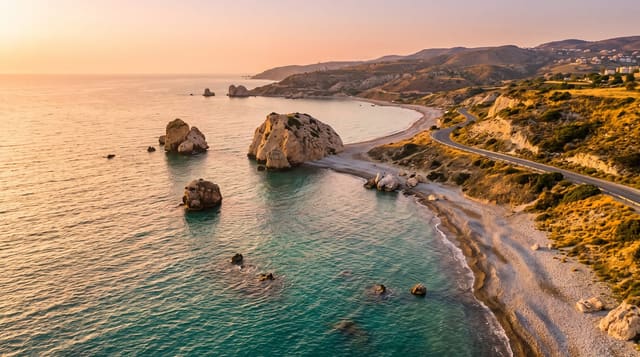
Aphrodite's Rock is south-east along the coast, and Paphos is fifteen kilometres away.
Key facts
Source: Wikidata, item Q53556453, read on 18 October 2026.
What to pack for Sanctuary of Aphrodite at Kouklia
Chosen from what this place is for. Tap a kit for the full checklist.
- Comfortable walking shoes - Sightseeing means kilometres of pavement and cobbles daily. Find on Amazon
- Modest clothing - Shoulders and knees covered - the single most common requirement. Find on Amazon
- A slim anti-theft daypack - Zips that close properly; keep it in front in crowds and on transit. Find on Amazon
- A scarf or shawl - To cover the head or shoulders on entry; women especially at mosques. Find on Amazon
Some links on this page are Amazon affiliate links - if you buy through them we may earn a small commission at no extra cost to you.
All packing kitsPlan your trip
Where to start if Sanctuary of Aphrodite at Kouklia is going on the list.
Booking links on this page are affiliate links - if you book through them we may earn a small commission at no extra cost to you. It never changes what we write about a place.
Opening times, ticket prices and seasonal closures change - check the official source before you go: official site.