Derinkuyu Underground City
A town carved downwards through soft volcanic rock beneath a Cappadocian village, with ventilation shafts and stone doors that rolled shut from inside.
Updated 21 October 2026
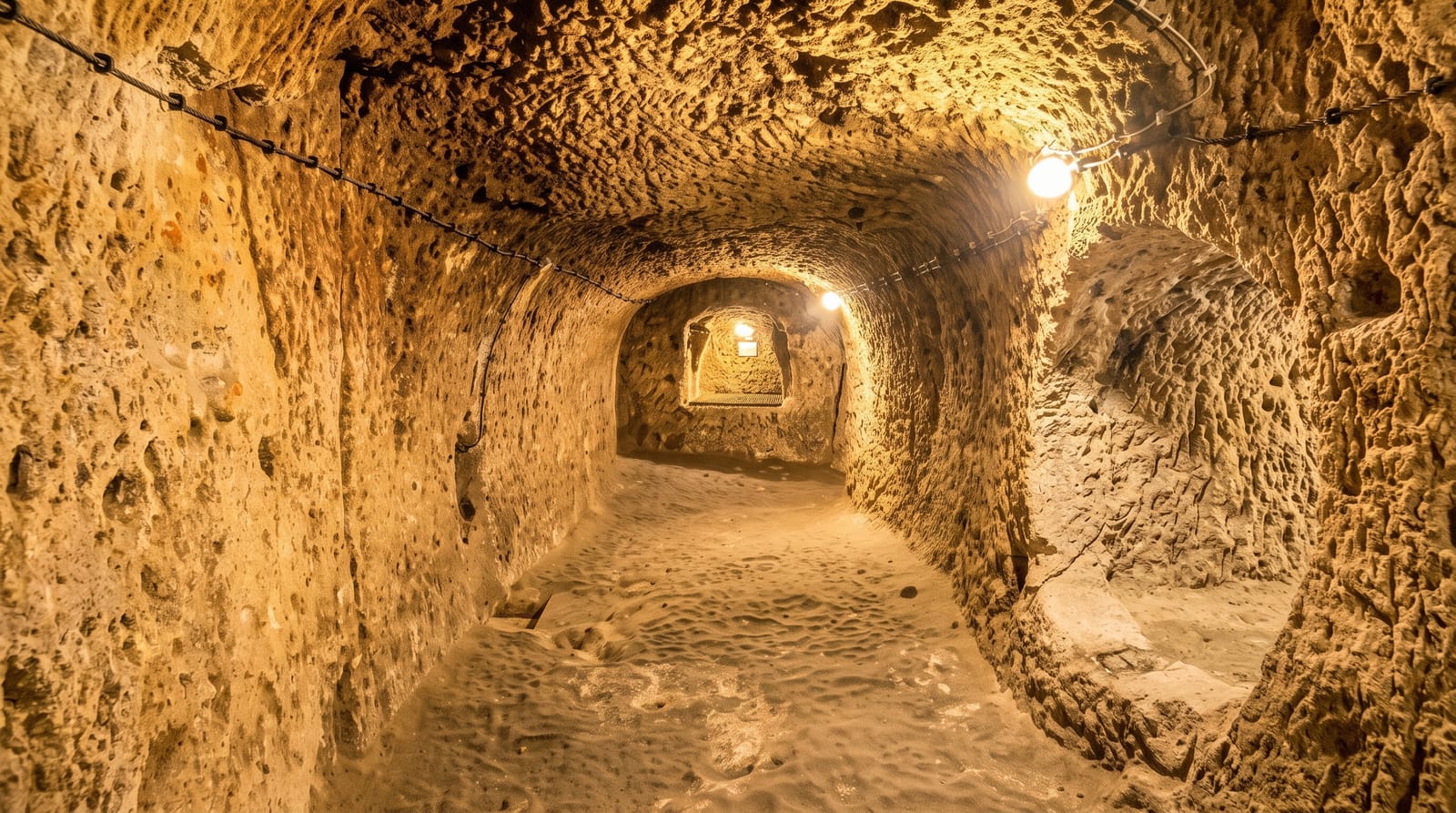
AI illustration
UNESCO World Heritage
From the street, Derinkuyu is an ordinary Cappadocian village with a doorway in it. Inside, the ground opens into level after level cut down through soft tuff: stables and wine presses near the surface, kitchens with ceilings still black from smoke, storage rooms, a barrel-vaulted hall far below usually described as a church, and shafts running the full depth to bring air down and water up. Circular stone discs the size of millstones sit in slots beside passages, designed to be rolled across from the inside. People used these places seasonally over many centuries. Only part of the complex is open, and the route is one way, narrow, and in stretches low enough that you walk bent double.
History
The first tunnels and rooms may have been cut into the soft tuff by the Phrygians in the 8th to 7th century BC, and in the Christian period of the late Roman Empire the inhabitants dug them into deep multi-level structures with chapels and Greek inscriptions; the city was fully formed in Byzantine times, linked to the underground city of Kaymaklı by tunnels 8 to 9 km long, and could shelter up to 20,000 people with their animals and stores. Its Greek name, Malakopia, probably refers to the soft rock. After centuries of use as a refuge it was abandoned and forgotten until 1963, when a local man renovating his house broke through a basement wall into a room behind it; more than 600 entrances have been found since (Wikipedia, Derinkuyu underground city).
What you'll find
- The rolling stone doors - carved discs set in slots beside the passages.
- The ventilation shafts - vertical wells dropping through every level.
- The vaulted hall - the long barrel-roofed room on the lowest open level.
- The kitchens - soot-blackened ceilings and rock-cut storage niches.
When to go
Any month works since the temperature underground barely changes, but the surface is best in spring and autumn. Go at opening time or in the last hour: the single-file route jams badly when several tour groups arrive together, and passing is close to impossible. Allow an hour underground.
Practical notes
If you are claustrophobic, skip it. Passages are narrow, low and occasionally steep, the air gets stale when it is busy, and a queue can leave you standing bent over in a tunnel. Visually there is not much to photograph. It is an engineering visit rather than a scenic one, and it is over quickly.
Nearby
The Ihlara valley to the west and the Cappadocian valleys around Goreme to the north.
Key facts
Source: Wikidata, item Q1328958, read on 18 October 2026.
What to pack for Derinkuyu Underground City
Chosen from what this place is for. Tap a kit for the full checklist.
- Head torch + spare batteries - Hands-free light is essential; caves are truly dark. Find on Amazon
- Comfortable walking shoes - Sightseeing means kilometres of pavement and cobbles daily. Find on Amazon
- Grippy closed shoes - Cave floors are wet, muddy and slick with formations. Find on Amazon
- A slim anti-theft daypack - Zips that close properly; keep it in front in crowds and on transit. Find on Amazon
Some links on this page are Amazon affiliate links - if you buy through them we may earn a small commission at no extra cost to you.
All packing kitsPlan your trip
Where to start if Derinkuyu Underground City is going on the list.
Booking links on this page are affiliate links - if you book through them we may earn a small commission at no extra cost to you. It never changes what we write about a place.
Opening times, ticket prices and seasonal closures change - check the official source before you go: official site.


