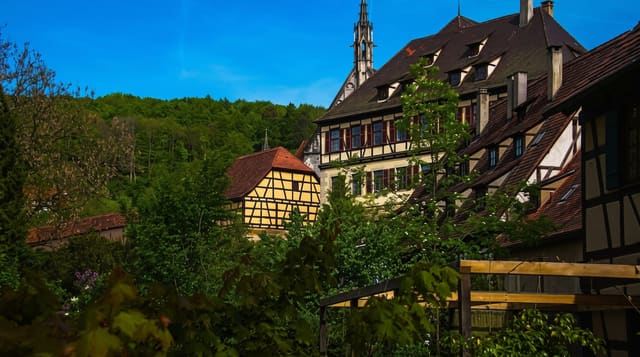
Krupa Monastery
A Serbian Orthodox monastery under Velebit, by tradition founded in 1317, on a river of travertine pools.
Updated 21 October 2026
Krupa stands on the river of the same name below the southern slope of Velebit; tradition dates it to 1317 and to monks from Bosnia, though it was probably built around 1642, and it is among the oldest Serbian Orthodox monasteries in Croatia. The iconostasis holds icons painted around 1600 by the Cretan Ioannis Apakas, the walls were painted in 1620-22, and the complex has a cloister and arcaded ranges around a courtyard. The monastery was damaged in the Second World War and again in the 1990s, and it has been repaired since with a small community in residence. The setting - a wooded gorge, clear water and travertine steps - accounts for a good share of the visits.
History
Folk tradition says Krupa was built in 1317 by monks from Bosnia with the support of the Serbian king Milutin, later restored by Stefan Dečanski and Emperor Dušan and endowed in the 15th and 16th centuries by Saint Angelina; its Gothic windows, unusual for an Orthodox church, suggest instead that it was built by incoming monks around 1642. About 1600 the Cretan priest Ioannis Apakas painted four throne icons for the iconostasis, and Georgije Mitrofanović painted the walls in 1620-22. The monastery was a place of learning: the writer and educator Dositej Obradović lived and worked here in the 1760s, Gerasim Zelić in the 18th century and the novelist Simo Matavulj was educated here in the 1860s, and its history was written down in the 18th-century chronicles of Bishop Simeon Končarević. It was completely renovated in 1855, a large bell tower was begun in the 1950s and never finished, and partial reconstruction has gone on since 2000 (Wikipedia, Krupa monastery).
The main sights
- A monastery dated by tradition to 1317 - among the oldest Orthodox houses in Croatia.
- Icons of around 1600 - on the iconostasis, by Ioannis Apakas.
- Arcaded ranges round a courtyard - the monastic complex.
- A travertine river below - clear water in a wooded gorge.
When to go
April to October. Two hours.
Practical notes
This is a working monastery with a small community; visiting hours and dress rules apply. The area is thinly populated and services are almost non-existent. The road in is narrow and partly unsurfaced.
Nearby
Kudin Bridge is downstream; the Zrmanja canyon is north.
Key facts
Source: Wikidata, item Q1273522, read on 18 October 2026.
What to pack for Krupa Monastery
Chosen from what this place is for. Tap a kit for the full checklist.
- Comfortable walking shoes - Sightseeing means kilometres of pavement and cobbles daily. Find on Amazon
- Modest clothing - Shoulders and knees covered - the single most common requirement. Find on Amazon
- A slim anti-theft daypack - Zips that close properly; keep it in front in crowds and on transit. Find on Amazon
- A scarf or shawl - To cover the head or shoulders on entry; women especially at mosques. Find on Amazon
Some links on this page are Amazon affiliate links - if you buy through them we may earn a small commission at no extra cost to you.
All packing kitsPlan your trip
Where to start if Krupa Monastery is going on the list.
Booking links on this page are affiliate links - if you book through them we may earn a small commission at no extra cost to you. It never changes what we write about a place.
Opening times, ticket prices and seasonal closures change - check the official source before you go: official site.