Yungang Grottoes
A sandstone cliff near Datong cut with more than 250 caves of Buddhist sculpture, including a seated Buddha open to the sky.
Updated 19 October 2026
AI illustration
UNESCO World Heritage
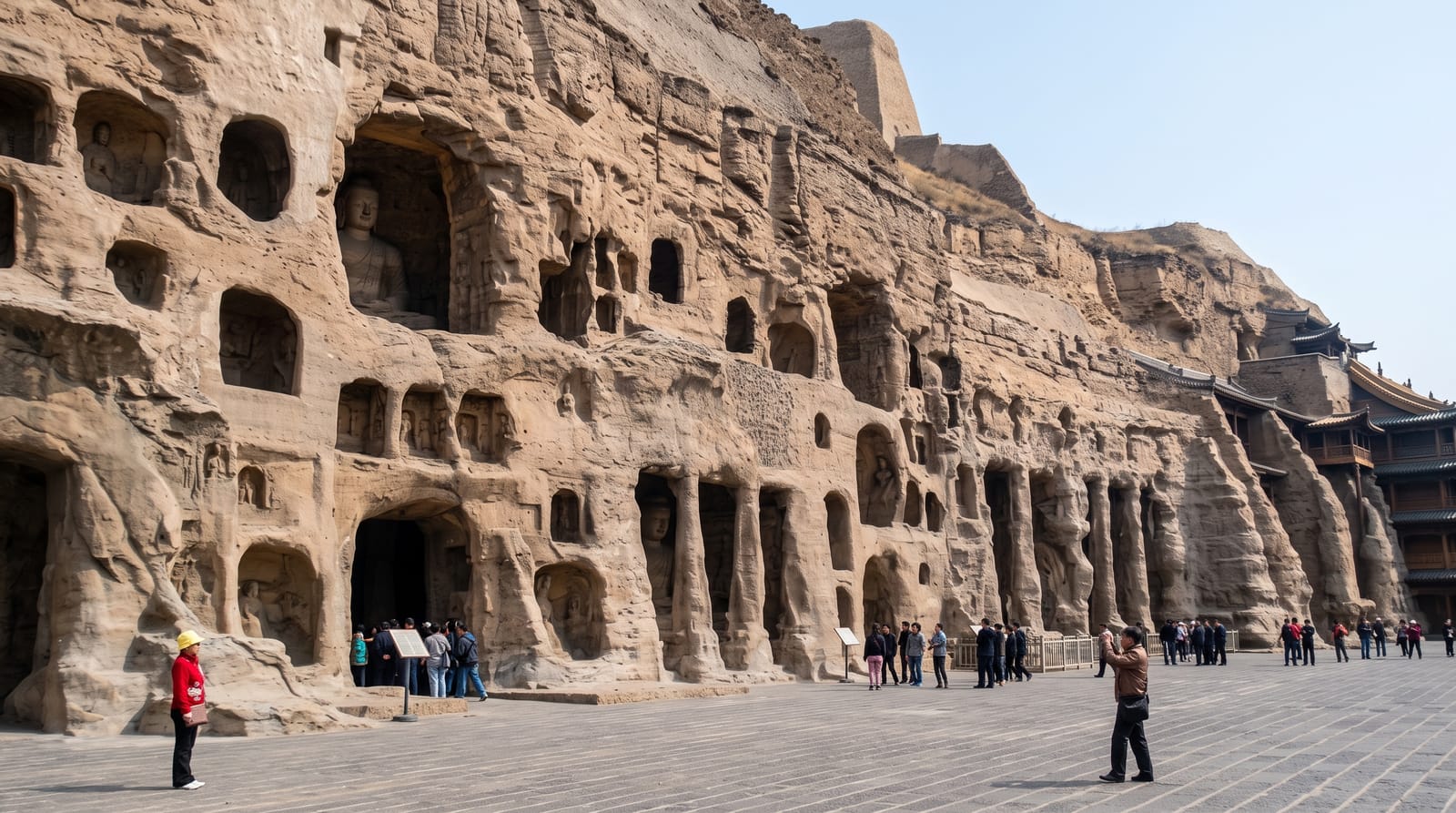
The Yungang caves were cut into a soft sandstone ridge west of Datong when the Northern Wei court had its capital here, and the carving covers roughly a kilometre of cliff. There are more than two hundred and fifty caves and niches, from shallow recesses the size of a hand to chambers you walk into, their walls packed floor to ceiling with Buddhas, attendants, musicians and flying figures. The best known image is the seated Buddha of cave 20, about fourteen metres high, left exposed when the wooden hall in front of it fell centuries ago. Traces of pigment survive in the sheltered caves, and the earliest groups show clear Central Asian influence in the faces and drapery.
History
The Tuoba-ruled Northern Wei made Pingcheng, today's Datong, their capital and adopted Buddhism early as a state religion, and the first phase of carving, which lasted until 465, produced what are now caves 16-20. A second phase from about 471 to 494, under the supervision and with the support of the imperial court, added the twin caves 5/6, 7/8 and 9/10 and caves 11-13; court patronage ended when the Wei moved their capital to Luoyang in 494, and work under private patrons went on until uprisings stopped it in 525. The Liao built ten temples in front of the main caves in 1049-1060, which a fire wrecked some 60 years later, the wooden buildings before caves 5 and 6 date from 1621, and since the 1950s cracks have been grouted and trees planted against sandstorms (Wikipedia, Yungang Grottoes).
Highlights
- Cave 20 - the great seated Buddha, now open to the weather after its timber hall collapsed.
- The painted caves - interiors where original pigment still shows on ceilings and niches.
- The pillar caves - chambers with a carved central pillar you can walk around.
- The cliff walk - the full run of niches and small caves along the sandstone face.
When to go
Late spring to early autumn is easiest; Datong winters are cold and windy and the site is largely outdoors. Morning light falls on the cliff face, and coach groups build up from mid-morning. Allow half a day, or longer if you want to look at individual caves properly rather than walk the line.
What to expect
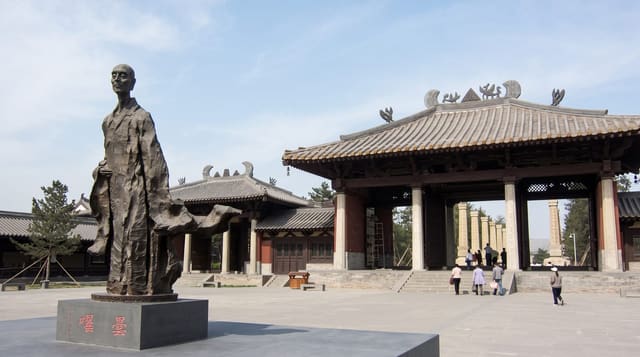
The approach now runs through a large new ceremonial avenue and temple complex that has nothing to do with the ancient carving. Several important caves are closed, screened or lit dimly, and photography is restricted inside some of them. Weathering has flattened a lot of detail on the outer niches, and there is little shade on the walkway.
Nearby
Datong's rebuilt old town, the Huayan and Shanhua temples, and the Hanging Temple south of the city.
What to pack for Yungang Grottoes
Chosen from what this place is for. Tap a kit for the full checklist.
- Head torch + spare batteries - Hands-free light is essential; caves are truly dark. Find on Amazon
- Comfortable walking shoes - Sightseeing means kilometres of pavement and cobbles daily. Find on Amazon
- Modest clothing - Shoulders and knees covered - the single most common requirement. Find on Amazon
- Grippy closed shoes - Cave floors are wet, muddy and slick with formations. Find on Amazon
Some links on this page are Amazon affiliate links - if you buy through them we may earn a small commission at no extra cost to you.
All packing kitsPlan your trip
Where to start if Yungang Grottoes is going on the list.
Booking links on this page are affiliate links - if you book through them we may earn a small commission at no extra cost to you. It never changes what we write about a place.
Opening times, ticket prices and seasonal closures change - check the official source before you go: official site.