Yuncheng Salt Lake
An inland salt lake worked for four thousand years, its evaporation ponds turning pink, green and orange in summer.
Updated 4 September 2026
AI illustration
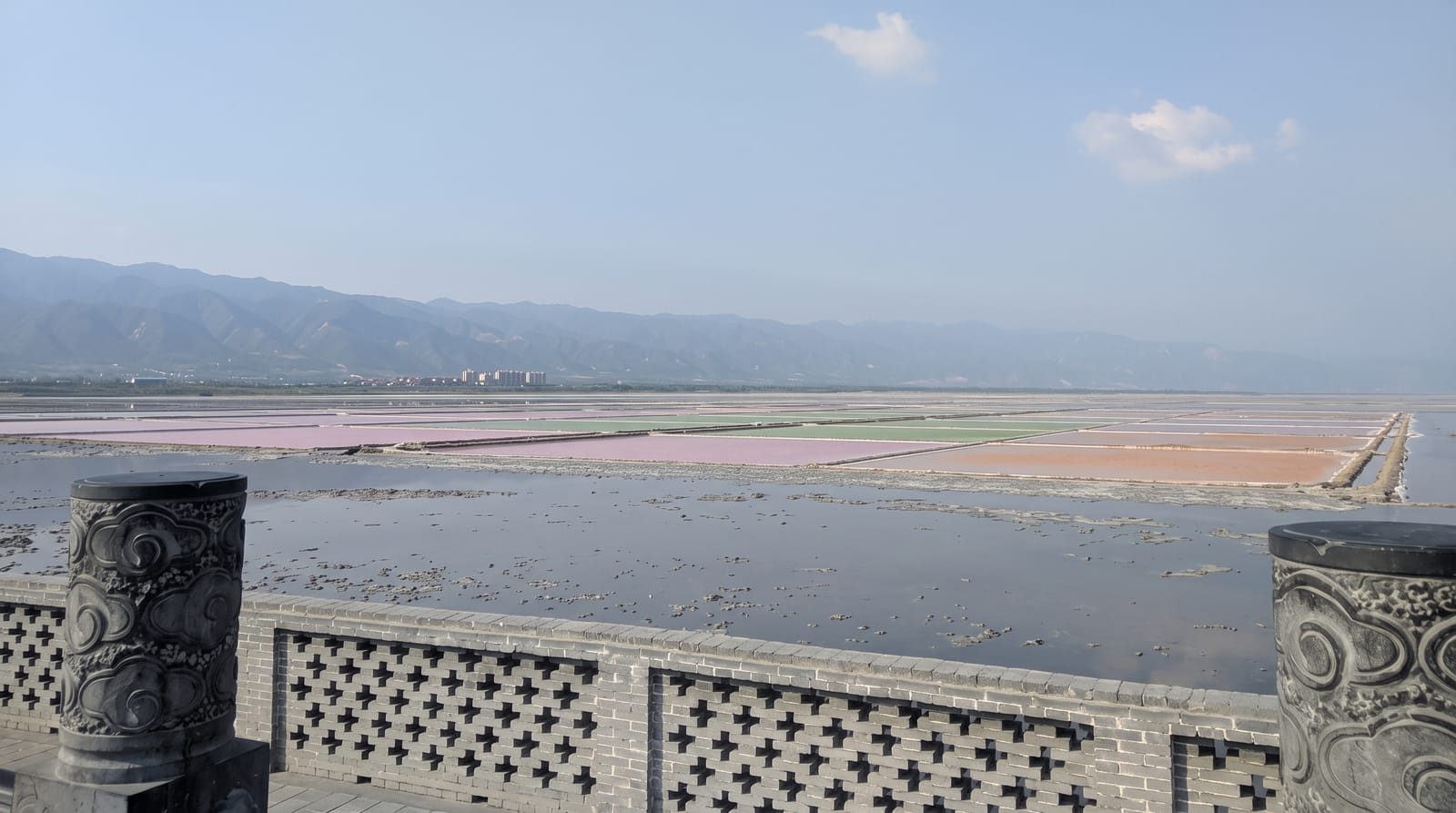
The Yuncheng salt lake covers around one hundred and thirty square kilometres and has been worked since at least the Neolithic, with control of its salt a factor in the earliest Chinese states; the ancient extraction method of wind and sun evaporation, recorded here, was formalised in the Tang. The lake is divided into evaporation ponds by dykes, and through the warm months algae and salt-tolerant microorganisms colour the water in bands of pink, red, green and orange that shift with temperature and salinity, producing an effect often compared with the Dead Sea and photographed heavily. Production continues, mainly of sodium sulphate. Roads and paths run along the dykes for viewing.
The landscape
- The coloured ponds - bands of pink, green and orange between the dykes.
- The dyke paths - routes across the lake giving views along the ponds.
- The working extraction - the industry still operating on the lake.
- The ancient salt history - four thousand years of production interpreted locally.
When to go
June to September, when heat and evaporation bring out the strongest colours; the effect fades in cooler months. Midday sun gives the most saturated colour from above, and aerial or elevated views show the pattern best.
Good to know
This is a working industrial site, not a scenic park, and access is limited in places. Colours vary considerably by pond and by week. Yuncheng is an industrial city with modest visitor facilities.
Nearby
The Guandi Temple at Haizhou is a few kilometres away; Yuncheng city is north.
Key facts
Source: Wikidata, item Q1687163, read on 18 October 2026.
What to pack for Yuncheng Salt Lake
Chosen from what this place is for. Tap a kit for the full checklist.
- Broken-in walking shoes or boots - Grip and ankle support matter more than looks; never hike in brand-new boots. Find on Amazon
- Modest clothing - Shoulders and knees covered - the single most common requirement. Find on Amazon
- Layers + a waterproof shell - Mountain weather turns fast; a packable rain jacket saves the day. Find on Amazon
- A scarf or shawl - To cover the head or shoulders on entry; women especially at mosques. Find on Amazon
Some links on this page are Amazon affiliate links - if you buy through them we may earn a small commission at no extra cost to you.
All packing kitsPlan your trip
Where to start if Yuncheng Salt Lake is going on the list.
Booking links on this page are affiliate links - if you book through them we may earn a small commission at no extra cost to you. It never changes what we write about a place.
Opening times, ticket prices and seasonal closures change - check the official source before you go: official site.