Suzhou Museum
I. M. Pei's last major building, a modern reading of Suzhou garden architecture beside the city's greatest garden.
Updated 19 October 2026

AI illustration
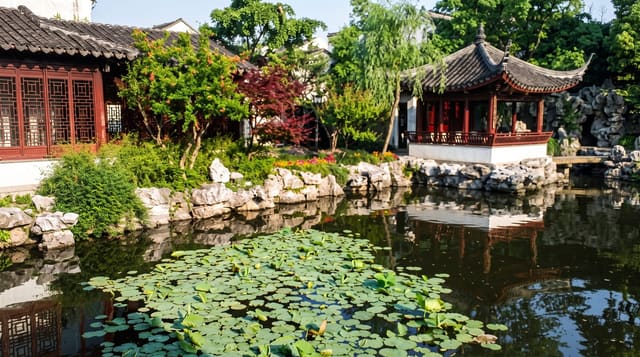
I. M. Pei was born to a Suzhou family whose ancestral home is the Lion Grove Garden nearby, and he designed this museum, completed in 2006, as the last major work of his career and a deliberate response to the city: white walls, dark grey granite edging in place of tile, geometric forms drawn from garden architecture, and a courtyard garden with a rock composition arranged as a sliced stone landscape against a white wall, made rather than collected. Inside are Suzhou-related antiquities, including Ming and Qing craft, jade, ceramics and calligraphy, and a Song pagoda reliquary of pearl-encrusted gold. The building is treated by many visitors as the exhibit.
History
The Suzhou Museum was founded in 1960 in the former mansion of Zhong Wang, a leading general of the Taiping era, and the Suzhou Folk Museum opened in 1986 for the 2,500th anniversary of the city's founding. In 2006 the museum moved into its present building beside the old mansion, designed by the Suzhou-born architect I. M. Pei, and it is now one of the most visited museums in the world (Wikipedia, Suzhou Museum).
What's there
- Pei's architecture - the geometry of white wall and grey stone against water.
- The stone garden - a rock composition sliced and set against a white wall.
- The Song reliquary - the pearl and gold pagoda from a nearby temple.
- The Suzhou craft collection - jade, ceramics and calligraphy of the region.
When to go
Year-round; the museum closes on Mondays. Free entry requires advance booking online, and slots are limited and go quickly, especially at weekends. Early slots are quietest.
What to expect
Booking is compulsory and can be difficult without a Chinese app; the queue for same-day places is unreliable. The museum is popular and the courtyards crowded. The collection is modest next to Nanjing or Shanghai.
Nearby
The Humble Administrator's Garden is next door; the Lion Grove Garden is a short walk.
Key facts
Source: Wikidata, item Q998042, read on 18 October 2026.
What to pack for Suzhou Museum
Chosen from what this place is for. Tap a kit for the full checklist.
- Comfortable walking shoes - Sightseeing means kilometres of pavement and cobbles daily. Find on Amazon
- Modest clothing - Shoulders and knees covered - the single most common requirement. Find on Amazon
- A slim anti-theft daypack - Zips that close properly; keep it in front in crowds and on transit. Find on Amazon
- A scarf or shawl - To cover the head or shoulders on entry; women especially at mosques. Find on Amazon
Some links on this page are Amazon affiliate links - if you buy through them we may earn a small commission at no extra cost to you.
All packing kitsPlan your trip
Where to start if Suzhou Museum is going on the list.
Booking links on this page are affiliate links - if you book through them we may earn a small commission at no extra cost to you. It never changes what we write about a place.
Opening times, ticket prices and seasonal closures change - check the official source before you go: official site.