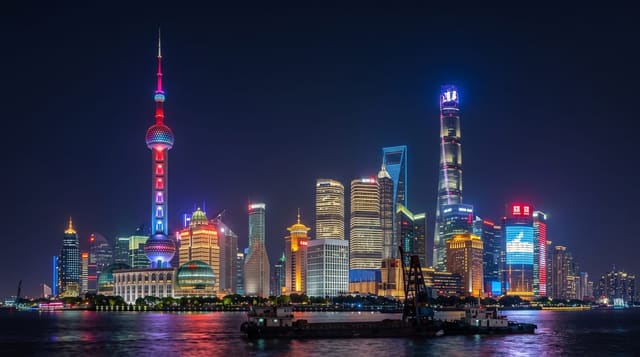
The Shanghai Museum
A free museum of ancient Chinese art on People's Square, strongest on bronzes and ceramics, in a building shaped like a ritual vessel.
Updated 19 October 2026

AI illustration
The Shanghai Museum opened on People's Square in 1996 in a building whose round top and square base echo an ancient bronze ding, the vessel that fills its best gallery. The collection is arranged by material rather than by dynasty, so you move through bronzes, ceramics, painting, calligraphy, seals, jade, coins, furniture and the crafts of China's minority peoples, each in its own room. The bronze gallery is the one that justifies the trip: ritual vessels from the Shang and Zhou, green with corrosion, covered in animal masks and cast inscriptions. Entry is free with an online booking, and a much larger second site has opened across the river in Pudong.
History
The museum was founded in 1952 in the former Shanghai Racecourse club house on West Nanjing Road and moved in 1959 to the Zhonghui Building on South Henan Road. Ma Chengyuan, its director from 1985 to 1999, won it a site on People's Square, raising money by leasing the old building and from Shanghai families abroad; building began in August 1993 to a design by Xing Tonghe in the shape of an ancient bronze ding, and the new museum opened on 12 October 1996 (Wikipedia, Shanghai Museum).
What to look for
- The bronze gallery - Shang and Zhou ritual vessels, the strongest holding in the museum.
- The ceramics rooms - a run from neolithic pots to Ming and Qing imperial porcelain.
- Painting and calligraphy - scrolls shown in rotation under deliberately low light.
- The minority crafts hall - textiles, silver and masks from the southwest and northwest.
When to go
Open year round and busiest at weekends and through the national holidays in early May and early October. Book the free timed ticket online before you go, since walk-up entry is limited. Mornings are calmer. Half a day covers two or three galleries, which is as much as most people absorb.
Good to know
Free entry means queues and school groups, and the painting and calligraphy rooms are kept dark, which frustrates some visitors. Scrolls rotate, so a particular famous work may not be out. English labels are short on context. The building is dated inside, and the newer Pudong site now takes much of the temporary programme.
Nearby
People's Park and Nanjing Road are next door; the Bund is fifteen minutes on foot.
Key facts
Source: Wikidata, item Q1051293, read on 18 October 2026.
What to pack for The Shanghai Museum
Chosen from what this place is for. Tap a kit for the full checklist.
- Comfortable walking shoes - Sightseeing means kilometres of pavement and cobbles daily. Find on Amazon
- A slim anti-theft daypack - Zips that close properly; keep it in front in crowds and on transit. Find on Amazon
- A refillable water bottle - Many cities have public fountains; save money and plastic. Find on Amazon
- A light layer + compact umbrella - For museum air-con and a sudden shower. Find on Amazon
Some links on this page are Amazon affiliate links - if you buy through them we may earn a small commission at no extra cost to you.
All packing kitsPlan your trip
Where to start if The Shanghai Museum is going on the list.
Booking links on this page are affiliate links - if you book through them we may earn a small commission at no extra cost to you. It never changes what we write about a place.
Opening times, ticket prices and seasonal closures change - check the official source before you go: official site.