Yu Garden
A Ming scholar's garden of rockeries and pavilions in old Shanghai, wrapped in a bazaar of shops and dumpling queues.
Updated 19 October 2026
AI illustration
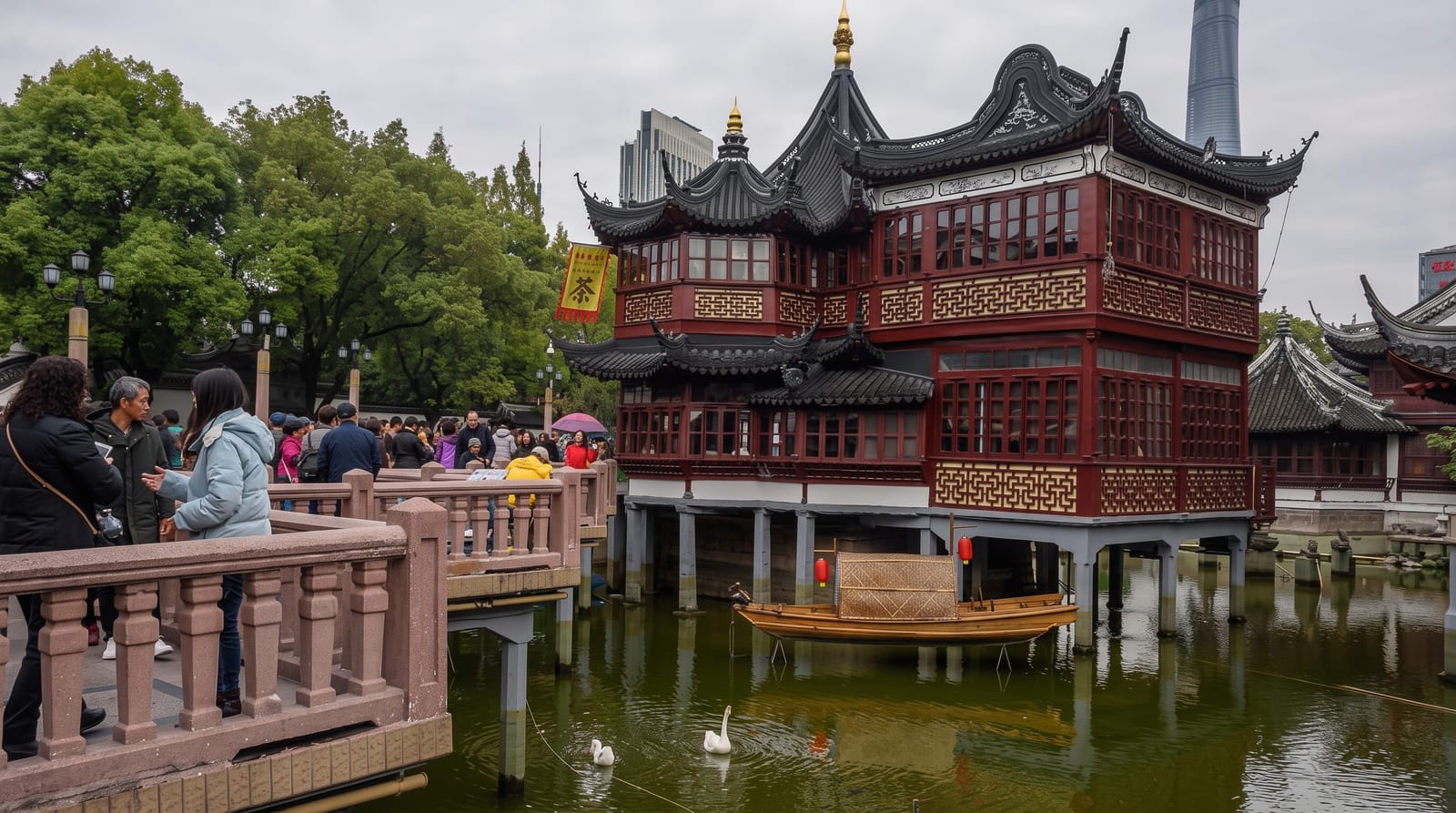
Yu Garden was laid out from 1559 by the official Pan Yunduan for his father, a classical Jiangnan garden of two hectares divided by dragon-topped walls into six areas of rockeries, ponds, halls and covered walkways, arranged so that views open and close as you move. Its centrepiece is the Exquisite Jade Rock, a perforated Taihu limestone said to have been intended for an imperial collection and lost in transit. Outside the garden wall, the bazaar is a dense commercial quarter of shops in traditional style, teahouses and food stalls, with the Nanxiang steamed bun shop's queues an institution in themselves. The Huxinting teahouse sits on the zigzag bridge over the pond.
History
Pan Yunduan began the garden in 1559 for his father, the minister Pan En, naming it Yu, pleasing to one's parents, but his posting as governor of Sichuan held the work up until 1577; the Leshou Hall at its heart was the stage for many of the performances recorded in his diaries, and the cost of the garden helped ruin the family. It passed through several owners, its eastern part was bought by local leaders in 1709, merchants restored it in 1760 and opened the western garden to the public in 1780, and after damage in the 19th and 20th centuries it was repaired from 1956 to 1961, opened in 1961 and declared a national monument in 1982 (Wikipedia, Yu Garden).
Highlights
- The Exquisite Jade Rock - the perforated Taihu stone at the garden's heart.
- The dragon walls - undulating walls topped with dragon ridges dividing the garden.
- The zigzag bridge and teahouse - the Huxinting on the pond outside.
- The bazaar - shops, snacks and dumpling queues around the garden.
When to go
March to May and September to November; the garden is small and crowds concentrate, so early morning at opening is much better than midday. Chinese New Year brings a lantern festival that fills the bazaar completely.
Practical notes
The garden is compact and can feel packed within an hour of opening. The surrounding bazaar is thoroughly commercial and prices are tourist-level. Some visitors find the reconstructed shop architecture inauthentic.
Nearby
The Bund lies north; the old city streets surround the garden.
Key facts
Source: Wikidata, item Q1328025, read on 18 October 2026.
What to pack for Yu Garden
Chosen from what this place is for. Tap a kit for the full checklist.
- Comfortable walking shoes - Sightseeing means kilometres of pavement and cobbles daily. Find on Amazon
- A slim anti-theft daypack - Zips that close properly; keep it in front in crowds and on transit. Find on Amazon
- A refillable water bottle - Many cities have public fountains; save money and plastic. Find on Amazon
- A light layer + compact umbrella - For museum air-con and a sudden shower. Find on Amazon
Some links on this page are Amazon affiliate links - if you buy through them we may earn a small commission at no extra cost to you.
All packing kitsPlan your trip
Where to start if Yu Garden is going on the list.
Booking links on this page are affiliate links - if you book through them we may earn a small commission at no extra cost to you. It never changes what we write about a place.
Opening times, ticket prices and seasonal closures change - check the official source before you go: official site.