Jiuzhaigou Valley
A UNESCO-listed valley in the Sichuan mountains famous for lakes of astonishing turquoise and blue, tiered waterfalls and forests, fed by mineral-rich water.
Updated 18 October 2026
AI illustration
UNESCO World Heritage
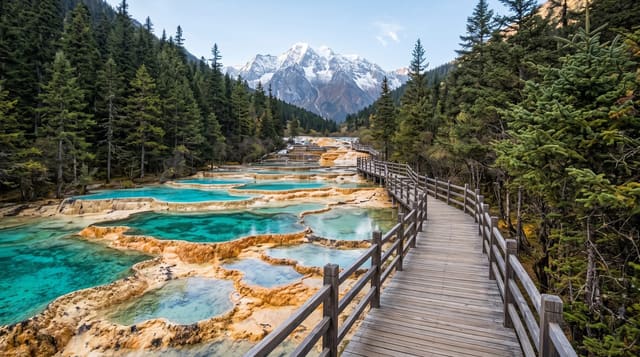
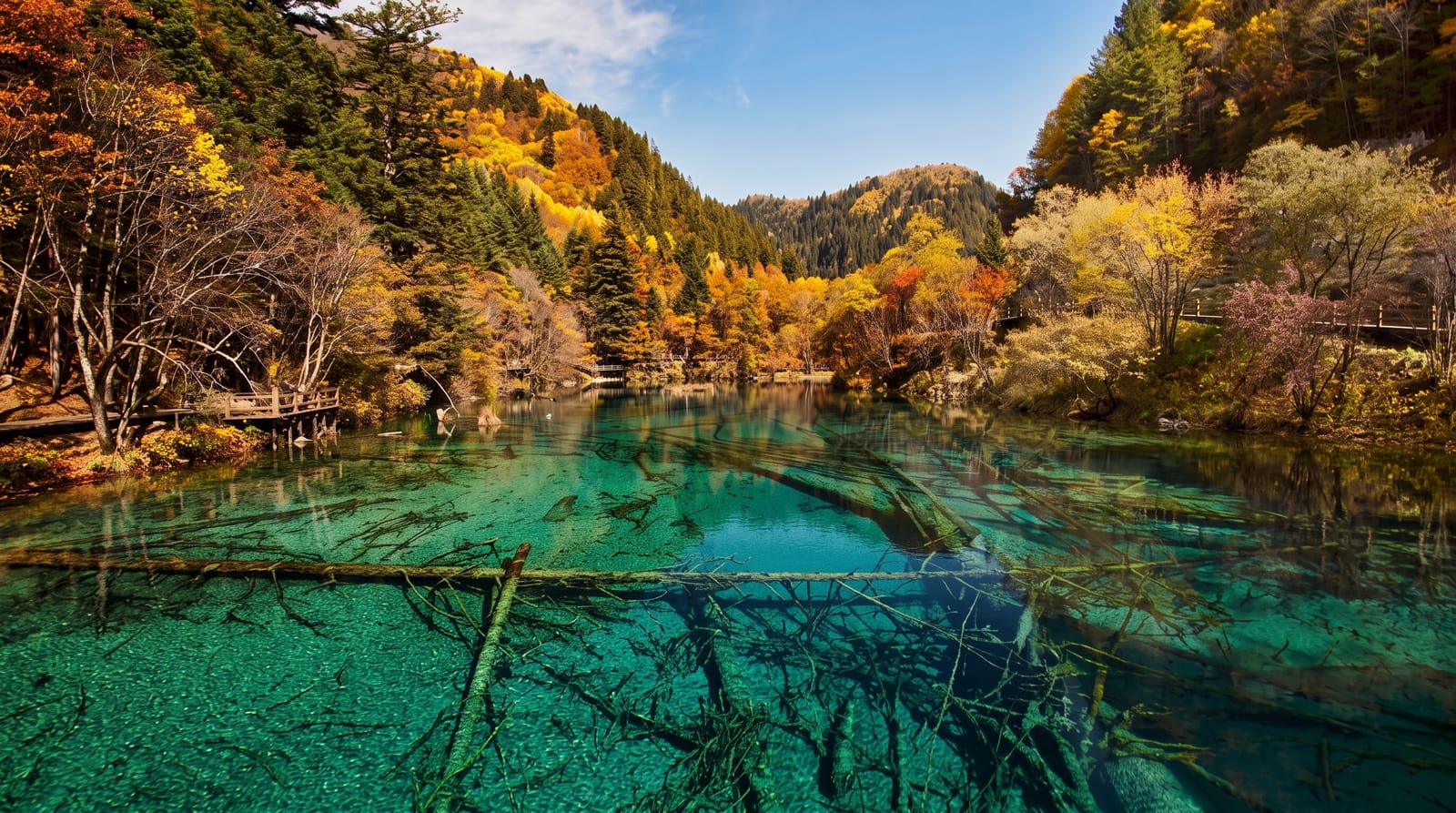
Jiuzhaigou, a Y-shaped valley high in the mountains of northern Sichuan, is one of China's most beautiful natural places and a World Heritage Site, celebrated for water of almost unreal colour. Mineral-rich, crystal-clear pools and lakes shade from deep blue through turquoise to green, so vivid that submerged fallen trees and travertine terraces glow beneath the surface, linked by tiered waterfalls and set against forested slopes and snow peaks. Boardwalks and a shuttle-bus system carry visitors up the valley from lake to lake, past the Five Flower Lake, the Nuorilang Falls and the Long Lake at the head. The area is also home to Tibetan villages that give it its name, meaning valley of nine villages. It is at its most magical in autumn, when the reflected colours of the turning forest double the intensity of the water, and after a major earthquake in 2017 the park was repaired and reopened.
History
The valley takes its name from the nine Tibetan settlements along it, and Tibetan and Qiang peoples lived here for centuries while the area stayed little known outside. In 1975 the forestry scientist Wu Zhonglun surveyed it and urged the Sichuan authorities to protect it, logging was halted, and in 1980 the Jiuzhaigou Nature Reserve was established; the site opened to tourism in 1984, was inscribed as a World Heritage Site in 1992 and a World Biosphere Reserve in 1997. Visitors rose from 5,000 in 1984 to 5.11 million in 2024, and after a magnitude 7.0 earthquake in August 2017 damaged the valley, it stayed shut to tourists until 3 March 2018 and then reopened with limited access (Wikipedia, Jiuzhaigou).
Highlights
- The coloured lakes - the turquoise and blue pools with submerged trees glowing beneath.
- Nuorilang and Pearl Shoal Falls - the wide tiered waterfalls linking the lakes.
- Five Flower Lake - the multi-hued lake, one of the most photographed spots.
- The autumn forests - the turning leaves reflected in the water in October and November.
When to go
September to November, when the autumn colour peaks, is the most spectacular but also the most crowded; summer is green and busy, spring gentle, and winter quiet and frozen into ice formations. Numbers are capped, so buy tickets ahead in peak season. The high altitude means cold mornings even in summer.
Good to know
It is very popular and, in the autumn peak, extremely crowded, with capped ticket numbers that sell out, so book ahead and expect queues for the shuttle buses that are the only way up the valley; walking the full length is not permitted. The altitude, around 2,000 to 3,000 metres, affects some visitors. It is remote, a long mountain drive or a flight from Chengdu. The colours depend on light and season.
Nearby
The Huanglong travertine terraces are a few hours away; Chengdu and its pandas are the gateway city.
Key facts
Source: Wikidata, item Q4111, read on 18 October 2026.
What to pack for Jiuzhaigou Valley
Chosen from what this place is for. Tap a kit for the full checklist.
- Broken-in walking shoes or boots - Grip and ankle support matter more than looks; never hike in brand-new boots. Find on Amazon
- Binoculars - The single best wildlife tool - even a compact pair transforms a sighting. Find on Amazon
- Warm base layers - Merino or synthetic against the skin - never cotton, which chills when damp. Find on Amazon
- Layers for big temperature swings - Warm sun by day, near-freezing at night, even near the equator. Find on Amazon
Some links on this page are Amazon affiliate links - if you buy through them we may earn a small commission at no extra cost to you.
All packing kitsPlan your trip
Where to start if Jiuzhaigou Valley is going on the list.
Booking links on this page are affiliate links - if you book through them we may earn a small commission at no extra cost to you. It never changes what we write about a place.
Opening times, ticket prices and seasonal closures change - check the official source before you go: official site.