St John's
North America's oldest city, a harbour town of jellybean-coloured houses under a signal hill, with icebergs and whales offshore in season.
Updated 19 October 2026
AI illustration
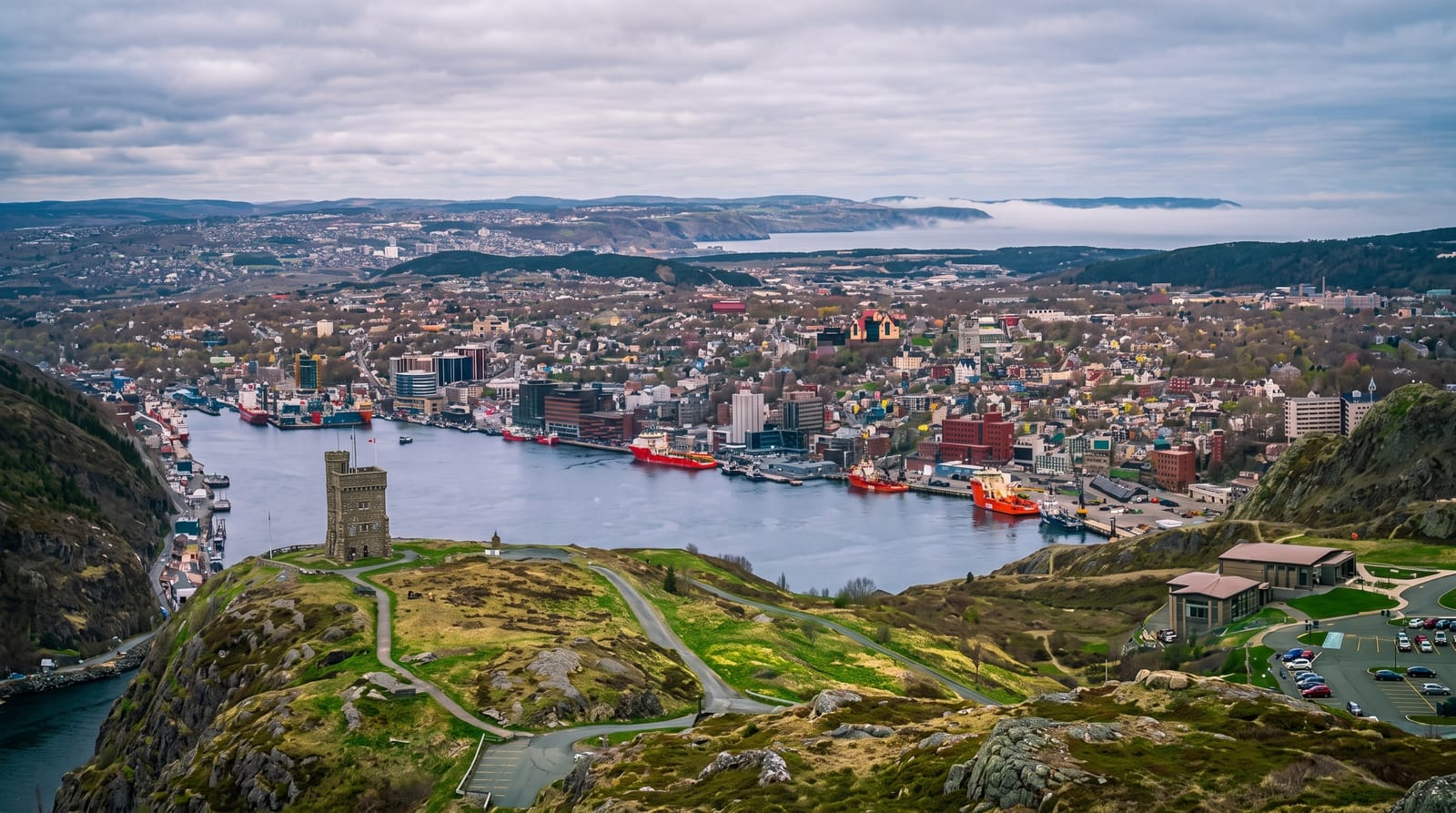
St John's claims to be the oldest city in North America, built round a narrow harbour entered through a gap in the cliffs called the Narrows, and its steep streets are lined with wooden row houses painted in improbable colours, a habit that gave Jellybean Row its name. Signal Hill stands above the entrance, where the first transatlantic wireless signal was received in 1901 and where a path called the North Head Trail runs along the cliff edge back down to town. Cape Spear, the easternmost point in North America, is twenty minutes away. From May into July icebergs drift down Iceberg Alley past the coast, and humpbacks arrive to feed on capelin. George Street has more bars per length than anywhere in the country.
History
Fishermen set up seasonal camps here in the early 1500s, the harbour appears as São João on Pedro Reinel's Portuguese map of 1519, and when the English mariner John Rut called in 1527 he found Norman, Breton and Portuguese ships, writing to Henry VIII on 3 August the first known letter sent from North America. On 5 August 1583 Sir Humphrey Gilbert claimed the area for England, by 1620 West Country fishermen controlled most of the east coast, and some time after 1630 St. John's became a permanent community, the largest in Newfoundland when English naval officers began taking censuses around 1675 (Wikipedia, St. John's, Newfoundland and Labrador).
What's there
- Jellybean Row - the brightly painted wooden row houses on the hills.
- Signal Hill and the North Head Trail - the clifftop walk above the Narrows.
- Cape Spear - the easternmost point in North America, twenty minutes away.
- Icebergs and whales - drifting past the coast from May into July.
When to go
June to September is the season, with icebergs typically from May into June and humpbacks from June into August; the two overlap in early summer, which is the best time to come. Fog is frequent on this coast at any time and can hide everything for days.
Practical notes
Fog is a genuine feature rather than a footnote here, and it can obscure Signal Hill, Cape Spear and the icebergs for a whole visit. The weather is cold and wet by mainland standards even in July. Iceberg numbers vary hugely year to year and cannot be promised. George Street is a serious drinking street rather than a quiet evening out.
Nearby
Cape Spear and Petty Harbour are minutes away; the Avalon puffin colonies are an hour south.
Key facts
Source: Wikidata, item Q2082, read on 18 October 2026.
What to pack for St John's
Chosen from what this place is for. Tap a kit for the full checklist.
- Broken-in walking shoes or boots - Grip and ankle support matter more than looks; never hike in brand-new boots. Find on Amazon
- Binoculars - The single best wildlife tool - even a compact pair transforms a sighting. Find on Amazon
- Warm base layers - Merino or synthetic against the skin - never cotton, which chills when damp. Find on Amazon
- Comfortable walking shoes - Sightseeing means kilometres of pavement and cobbles daily. Find on Amazon
Some links on this page are Amazon affiliate links - if you buy through them we may earn a small commission at no extra cost to you.
All packing kitsPlan your trip
Where to start if St John's is going on the list.
Booking links on this page are affiliate links - if you book through them we may earn a small commission at no extra cost to you. It never changes what we write about a place.
Opening times, ticket prices and seasonal closures change - check the official source before you go: official site.