Joggins Fossil Cliffs
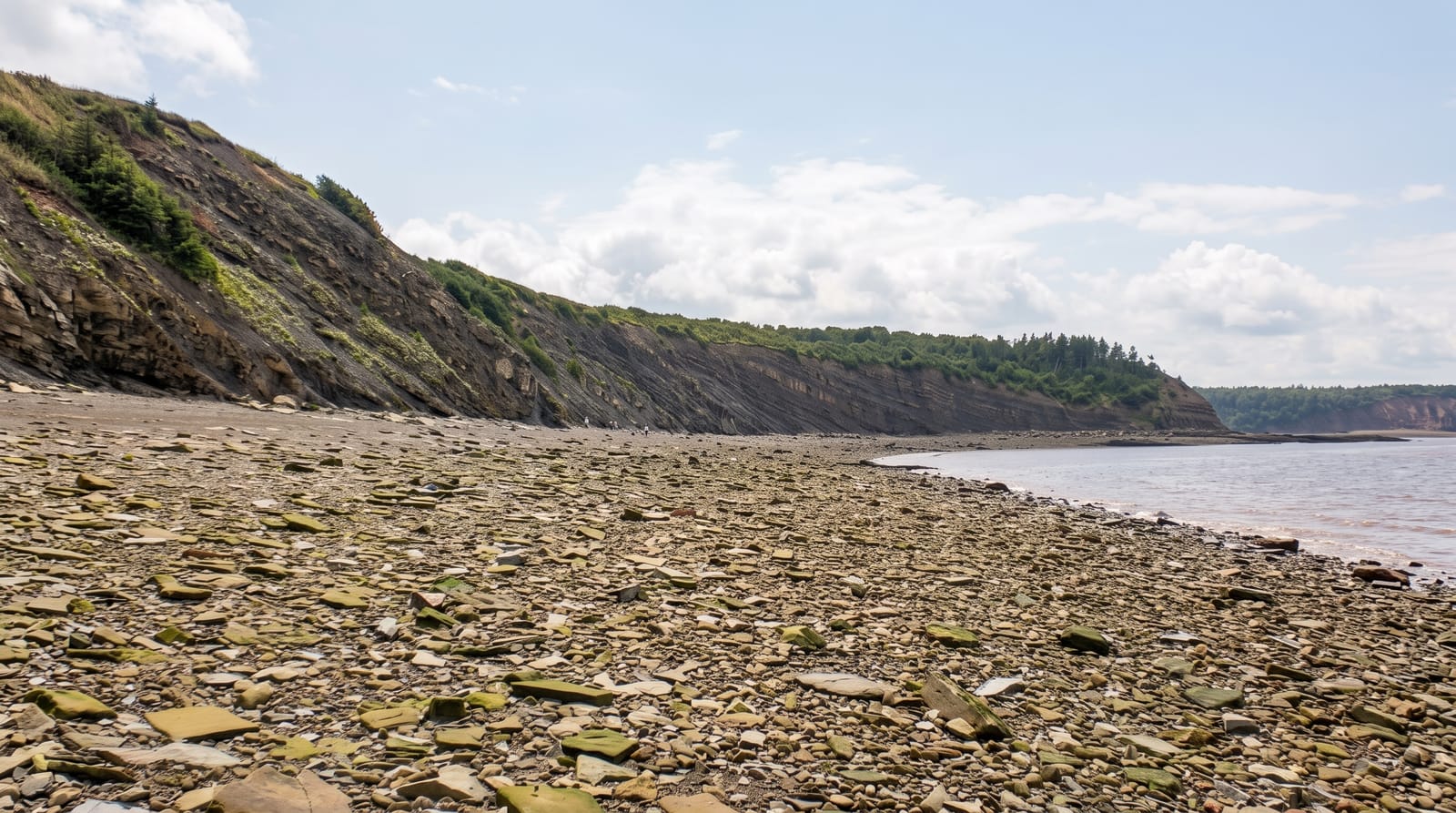
Cliffs that erode a little with every tide, exposing a coal-age forest with trees still standing upright.
Updated 18 October 2026
AI illustration
UNESCO World Heritage
The Joggins cliffs expose about fifteen kilometres of rock from the Pennsylvanian period, around three hundred and ten million years ago, when this was equatorial swamp forest; lycopsid trees are preserved standing upright where they grew, filled with sediment, and inside some of them are the remains of Hylonomus lyelli, the earliest known reptile. Charles Lyell visited in 1842 and Darwin cited the site in On the Origin of Species. Because the Fundy tides scour the cliff face twice a day, new fossils appear constantly, which is why it was inscribed by UNESCO in 2008 and why collecting is prohibited without a permit.
History
The Mi'kmaq called the place Chegoggins, the place of the large fish weir, and its coal seams, exposed along the shore of the Cumberland Basin, were worked as early as 1686 by Acadian settlers; the first commercial mine opened in 1731, and large-scale mining began under the General Mining Association in 1847 and grew with the railways of the 1870s and 1887. Joggins was incorporated as a town in 1919, kept that status until 1949 as the mines declined, and the last mines shut shortly after the Springhill mining disaster of 1958; old workings still erode out of the sea cliffs, with pit props dated by tree rings mostly to the 1860s and 1870s. On 7 July 2008 a 15-kilometre stretch of the coast, the Joggins Fossil Cliffs, was inscribed on the World Heritage List (Wikipedia, Joggins).
The landscape
- The upright fossil trees - lycopsids preserved standing where they grew.
- The constantly renewing face - tides exposing new fossils daily.
- The Darwin connection - a site cited in On the Origin of Species.
- The guided beach walks - fossil identification on the shore at low tide.
When to go
May to October for guided walks and the centre; beach access depends on the tide and the guided programme times around it. The centre closes in winter.
What to expect
Beach access is tide-dependent and the cliffs are actively falling, so unguided wandering is dangerous. Collecting fossils is illegal without a permit. The centre closes for winter.
Nearby
Cape Chignecto lies southwest; Amherst is northeast.
What to pack for Joggins Fossil Cliffs
Chosen from what this place is for. Tap a kit for the full checklist.
- Broken-in walking shoes or boots - Grip and ankle support matter more than looks; never hike in brand-new boots. Find on Amazon
- Layers + a waterproof shell - Mountain weather turns fast; a packable rain jacket saves the day. Find on Amazon
- Daypack with rain cover - 20-30 litres holds water, snacks, layers and a first-aid kit. Find on Amazon
- Offline maps + a power bank - Download the trail before you lose signal; carry backup charge. Find on Amazon
Some links on this page are Amazon affiliate links - if you buy through them we may earn a small commission at no extra cost to you.
All packing kitsPlan your trip
Where to start if Joggins Fossil Cliffs is going on the list.
Booking links on this page are affiliate links - if you book through them we may earn a small commission at no extra cost to you. It never changes what we write about a place.
Opening times, ticket prices and seasonal closures change - check the official source before you go: official site.