Phnom Bakheng
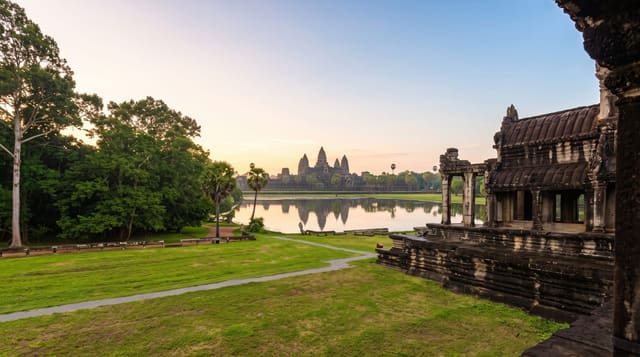
The first great temple-mountain at Angkor, on a hill with a distant view of Angkor Wat that draws the sunset crowd.
Updated 18 October 2026
UNESCO World Heritage
Phnom Bakheng was built around 900 under Yasovarman I as the state temple of the first city at Angkor, predating Angkor Wat by two centuries, and it sits on a natural hill sixty metres above the plain. The plan is a five-tier pyramid that originally carried 108 towers arranged so that only thirty-three were visible from any one point, a cosmological scheme now largely ruined. The reason most people climb it today is the view: Angkor Wat rising out of forest to the southeast, the West Baray to the west, and Phnom Kulen on the horizon. Sunset here became so crowded that the authorities cap numbers on the upper terrace and issue timed access, so arriving early is necessary.
History
Built at the end of the 9th century under King Yasovarman (889-910) as a Hindu temple to Shiva, Phnom Bakheng was the centrepiece of his new capital Yasodharapura, to which he moved the court from Hariharalaya in the Roluos area, and a Sanskrit inscription of 1052 found at Sdok Kak Thom is thought to describe its consecration by his guru Vamasiva. A moat surrounded the hill, avenues ran out from it in four directions, and a raised road linked the old capital with the temple's east entrance. Later it became a Buddhist temple, with a monumental seated Buddha on its upper tier, now lost, and a reclining Buddha whose outline can still be seen on the west side; since 2004 the World Monuments Fund has worked with APSARA to conserve it, as heavy visitor numbers make it one of the most threatened monuments of Angkor (Wikipedia, Phnom Bakheng).
What to look for
- The tiered pyramid - the earliest state temple-mountain at Angkor.
- The Angkor Wat view - the towers rising from forest to the southeast.
- Ruined tower rows - remains of the original 108-tower scheme.
- The hill climb - a track or steps up sixty metres to the base.
When to go
November to March. For sunset, arrive well before the numbers cap fills, typically an hour or more ahead. Sunrise and mid-morning are almost empty and the view is often clearer.
Before you go
Sunset access is capped and queues form early; many people are turned away. The upper stairs are steep and worn. The view of Angkor Wat is distant and often hazy. The temple itself is heavily ruined.
Nearby
Angkor Wat lies southeast; Angkor Thom is north.
Key facts
Source: Wikidata, item Q578075, read on 18 October 2026.
What to pack for Phnom Bakheng
Chosen from what this place is for. Tap a kit for the full checklist.
- Comfortable walking shoes - Sightseeing means kilometres of pavement and cobbles daily. Find on Amazon
- Modest clothing - Shoulders and knees covered - the single most common requirement. Find on Amazon
- A slim anti-theft daypack - Zips that close properly; keep it in front in crowds and on transit. Find on Amazon
- A scarf or shawl - To cover the head or shoulders on entry; women especially at mosques. Find on Amazon
Some links on this page are Amazon affiliate links - if you buy through them we may earn a small commission at no extra cost to you.
All packing kitsPlan your trip
Where to start if Phnom Bakheng is going on the list.
Booking links on this page are affiliate links - if you book through them we may earn a small commission at no extra cost to you. It never changes what we write about a place.
Opening times, ticket prices and seasonal closures change - check the official source before you go: official site.