Guarapari
An Espirito Santo resort whose black monazite sands are among the most naturally radioactive beaches on earth.
Updated 18 October 2026
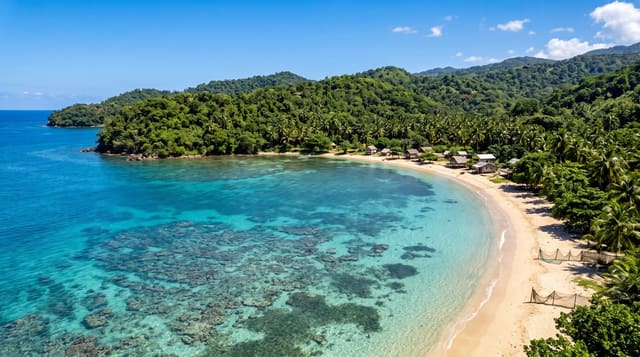
Guarapari's beaches carry monazite, a phosphate mineral rich in thorium that weathers out of the surrounding rock and concentrates in dark patches on the sand, particularly at Areia Preta. The result is a background radiation level far above the world average - among the highest recorded on any inhabited beach - and for much of the twentieth century this was marketed as therapeutic, with visitors coming to bury themselves in the sand for supposed relief from arthritis and other complaints. There is no evidence for the benefit, and modern advice is simply not to spend prolonged periods lying on the darkest patches. The town is otherwise a straightforward Brazilian beach resort with a long seafront, and Praia do Morro is the main strand.
History
Around the year 1000 the peoples of this coast were driven inland by Tupi peoples arriving from the Amazon, and in the 16th century, when the first Europeans came, the area belonged to one of them, the Temiminó. In 1585 the Jesuit José de Anchieta founded a mission village here, Rio Verde or Santa Maria de Guaraparim, with a convent and a church of Saint Anne, and wrote the Auto Tupi for its inauguration; the church of Our Lady of the Conception followed in 1677, and the village became a town in 1679. Emperor Pedro II visited in 1860, Guarapari became a municipality in 1878 and a city in 1891, and at the end of the 19th century mostly Italian settlers founded coffee-growing villages in the interior. National fame came in the mid-1960s and 1970s, when the supposed healing properties of its monazite sands drew a wave of tourists (Wikipedia, Guarapari).
What to look for
- Black monazite sand - thorium-bearing mineral concentrated in dark patches.
- Very high background radiation - among the highest on any inhabited beach.
- A discredited health claim - the sand baths once sold as treatment.
- A standard beach resort - Praia do Morro and the long seafront.
When to go
October to March. Two days.
What to expect
The radiation is real and unusual but is not a reason to lie on the black sand for hours; the historical health claims have no support. The town is crowded and loud in summer and quiet out of season. Beaches near the centre are not the cleanest.
Nearby
Vitoria and Vila Velha are north; Anchieta is south down the coast.
What to pack for Guarapari
Chosen from what this place is for. Tap a kit for the full checklist.
- Reef-safe sunscreen - High SPF that will not bleach the coral you are swimming over. Find on Amazon
- Quick-dry towel - A microfibre towel packs small and dries in minutes. Find on Amazon
- Water shoes - Protect your feet on rocky entries, hot sand and sea-urchin spines. Find on Amazon
- Dry bag - Keeps phone, cash and keys safe while you are in the water. Find on Amazon
Some links on this page are Amazon affiliate links - if you buy through them we may earn a small commission at no extra cost to you.
All packing kitsPlan your trip
Where to start if Guarapari is going on the list.
Booking links on this page are affiliate links - if you book through them we may earn a small commission at no extra cost to you. It never changes what we write about a place.
Opening times, ticket prices and seasonal closures change - check the official source before you go: official site.