Palacio Barolo
A 1923 office tower built as an architectural version of Dante's Divine Comedy, crowned by a lighthouse that once signalled to Montevideo.
Updated 18 October 2026
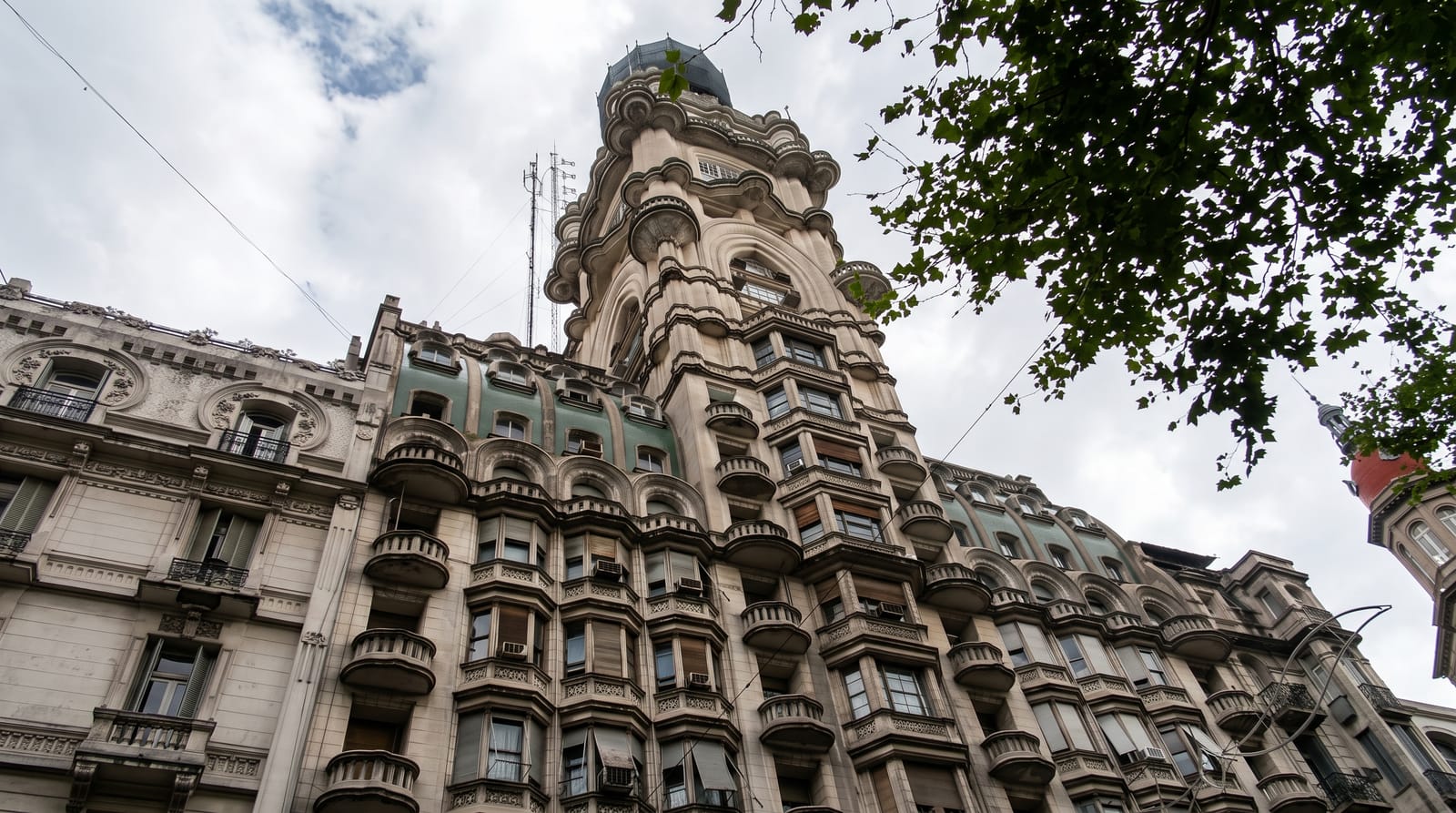
AI illustration
Palacio Barolo was completed in 1923 for the Italian textile magnate Luis Barolo to a design by Mario Palanti, and both men were devotees of Dante: the building encodes the Divine Comedy in its structure, with a hundred metres of height for the hundred cantos, twenty-two floors matching the verses of each canto, a basement and ground floor representing hell, the middle floors purgatory, and a lighthouse at the summit standing for paradise, its beam once visible from Montevideo across the estuary. It was the tallest building in South America when it opened. Tours climb through the levels, explaining the symbolism and the Neo-Gothic and Indian-influenced ornament, and end at the lighthouse with a wide view over the avenue and rooftops.
History
Luis Barolo, an Italian immigrant who arrived in 1890 and made a fortune in knitted fabrics, commissioned the Italian architect Mario Palanti, who designed it together with its twin, the Palacio Salvo in Montevideo, and laid it out after Dante's Divine Comedy: 22 floors in three sections, with the basement and ground floor as hell, floors 1-14 as purgatory and 15-22 as heaven, and 100 metres of height, one for each canto. When it was finished in 1923 it was the tallest building in South America, and it stayed the tallest in the city until the Kavanagh Building overtook it in the 1930s; it was declared a national historic monument in 1997 (Wikipedia, Palacio Barolo).
What's there
- The Dante symbolism - the hell, purgatory and paradise structure explained floor by floor.
- The central atrium - the ornate lobby with its Latin inscriptions and vaulting.
- The lighthouse - the working beacon at the summit, climbed on tours.
- The rooftop view - Avenida de Mayo, the Congress and the city skyline.
When to go
Year-round; tours run at set times most days and in the evening on some, with the night tour offering the lit skyline. Booking ahead is sensible as group sizes are limited by the narrow stairs.
Practical notes
The building is still a working office block, so access is only on tours and only to certain areas. The final climb to the lighthouse is up tight spiral stairs and unsuitable for anyone with mobility or claustrophobia concerns. Tours are mostly in Spanish, with fewer English slots.
Nearby
Plaza de Mayo lies east along the avenue; the Congress building is at the western end.
Key facts
Source: Wikidata, item Q571763, read on 18 October 2026.
What to pack for Palacio Barolo
Chosen from what this place is for. Tap a kit for the full checklist.
- Comfortable walking shoes - Sightseeing means kilometres of pavement and cobbles daily. Find on Amazon
- A slim anti-theft daypack - Zips that close properly; keep it in front in crowds and on transit. Find on Amazon
- A refillable water bottle - Many cities have public fountains; save money and plastic. Find on Amazon
- A light layer + compact umbrella - For museum air-con and a sudden shower. Find on Amazon
Some links on this page are Amazon affiliate links - if you buy through them we may earn a small commission at no extra cost to you.
All packing kitsPlan your trip
Where to start if Palacio Barolo is going on the list.
Booking links on this page are affiliate links - if you book through them we may earn a small commission at no extra cost to you. It never changes what we write about a place.
Opening times, ticket prices and seasonal closures change - check the official source before you go: official site.