Antigonea
A Hellenistic city founded around 295 BC on a ridge above the Drino, burned by Rome and never rebuilt.
Updated 18 October 2026
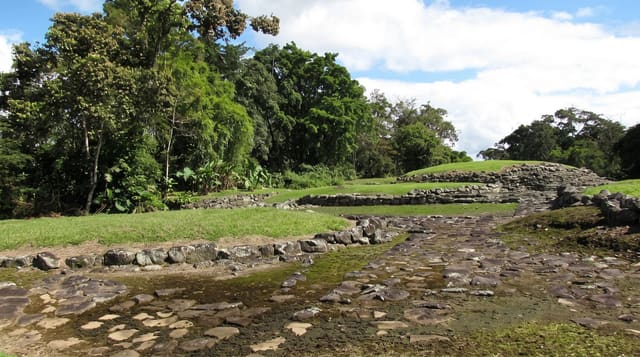
Antigonea was founded around 295 BC, most probably by Pyrrhus of Epirus, who would then have named it for his wife Antigone, laid out on a long ridge above the Drino valley with walls of about four kilometres, a grid of streets, an agora, houses with mosaic floors and a stoa. It lasted about a century and a half: Roman forces destroyed it in 167 BC in the campaign that devastated Epirus, and it was never reoccupied, which means the plan is uncomplicated by later building. Excavation has exposed streets, house foundations, mosaics under shelters and stretches of wall, in an archaeological park on open ground with pine planted through it. The ridge position gives a long view down the Drino valley toward Gjirokastra.
History
The city was founded in the 3rd century BC, perhaps by Antigonus II Gonatas but more probably by Pyrrhus of Epirus, who would then have named it after his wife Antigone, stepdaughter of Ptolemy I of Egypt, and it became the chief inland city of the Chaonians. It sided with Macedon against Rome, and after the Roman victory of 167 BC the consul Aemilius Paullus had 70 towns in Epirus set on fire, Antigonia among them; it was never rebuilt, though a church with a mosaic of Saint Christopher, wrecked in Slavic raids of the 6th century AD, shows that people still lived here in early Christian times. The Albanian archaeologist Dhimosten Budina identified and excavated the site, finds such as a bronze sphinx and a statue of Poseidon are shown in Tirana, and an Albanian-Greek team has worked here more recently (Wikipedia, Antigonia - Chaonia).
What you'll find
- A Hellenistic street grid - streets and house plots on the ridge.
- Mosaic floors under shelters - pavements from the houses.
- Four kilometres of wall - the circuit around the ridge.
- The Drino valley view - the plain toward Gjirokastra below.
When to go
April to October. Two hours. Mornings are cooler for walking the ridge, which has little shade. The site is quiet at almost any time. The final road is rough.
What to expect
The site is at foundation level and needs interpretation, which is limited. There is very little shade on the ridge. The access road is rough and there is no public transport. Mosaics are covered outside the main season.
Nearby
Gjirokastra is south-west; the Drino valley runs below.
Key facts
Source: Wikidata, item Q959799, read on 18 October 2026.
What to pack for Antigonea
Chosen from what this place is for. Tap a kit for the full checklist.
- Comfortable walking shoes - Sightseeing means kilometres of pavement and cobbles daily. Find on Amazon
- A slim anti-theft daypack - Zips that close properly; keep it in front in crowds and on transit. Find on Amazon
- A refillable water bottle - Many cities have public fountains; save money and plastic. Find on Amazon
- A light layer + compact umbrella - For museum air-con and a sudden shower. Find on Amazon
Some links on this page are Amazon affiliate links - if you buy through them we may earn a small commission at no extra cost to you.
All packing kitsPlan your trip
Where to start if Antigonea is going on the list.
Booking links on this page are affiliate links - if you book through them we may earn a small commission at no extra cost to you. It never changes what we write about a place.
Opening times, ticket prices and seasonal closures change - check the official source before you go: official site.