Khiva
A desert oasis frozen in time - a remarkable, perfectly preserved walled city on the edge of the Kyzylkum desert, a UNESCO open-air museum of turquoise-tiled minarets, madrasas and mud-brick walls.
Updated 18 October 2026
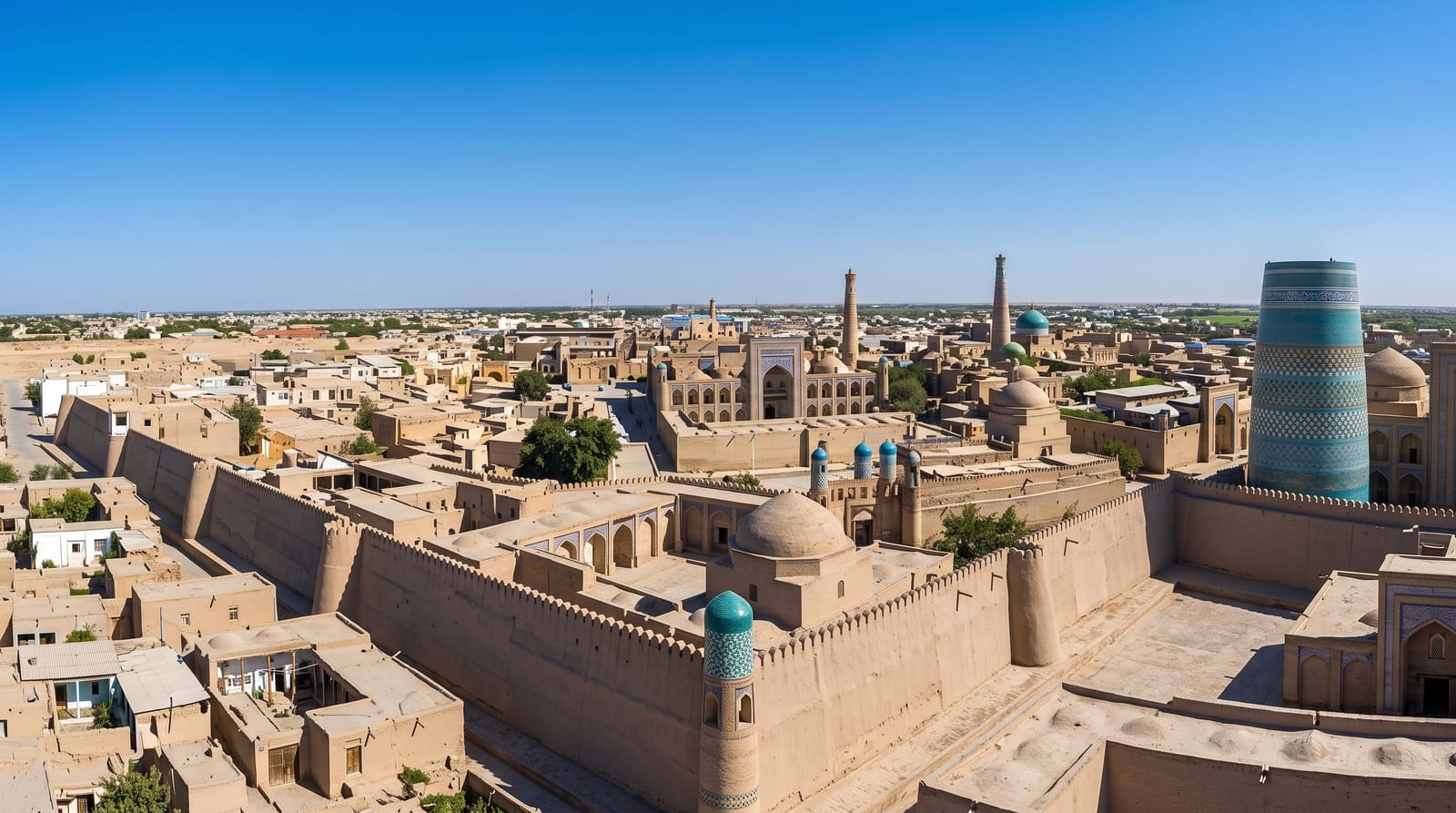
AI illustration
UNESCO World Heritage
Khiva, a remote desert oasis in the far west of Uzbekistan on the edge of the Kyzylkum desert, is one of the most remarkable and complete walled cities in the world. Its UNESCO inner town, Itchan Kala, enclosed within towering mud-brick walls, is an astonishing, perfectly preserved ensemble of turquoise-tiled minarets, madrasas, mosques, palaces and caravanserais, so intact it feels like an open-air museum, evoking the Silk Road and its darker history as a slave-trading khanate.
History
Archaeologists date the settlement back some 2,500 years, an anniversary the city marked in 1997, though it first appears in Muslim travel accounts of the 10th century; Khwarezmian, an Eastern Iranian language, was spoken here until Turkic rulers took over in the 10th century, and legend credits its founding to Shem, son of Noah, who dug the Kheyvak well that can still be seen in Itchan Kala. By the early 17th century Khiva was capital of the Khanate of Khiva, and from that century it grew into a notorious slave market, where in the first half of the 19th century some 30,000 Persians and an unknown number of Russians were held, many of them made to build the walled inner town. Russian troops took the city on 28 May 1873, leaving the khanate a protectorate, it became part of the Khorezm People's Soviet Republic in 1920-1924 and then of Soviet Uzbekistan, and in 1991 Itchan Kala became the first World Heritage Site in Central Asia (Wikipedia, Khiva).
Highlights
- Itchan Kala - the walled inner city, an open-air museum.
- The Kalta Minor - the fat, turquoise-tiled unfinished minaret.
- The Islam Khoja minaret - the tall minaret climbed for city views.
- The city walls - the towering mud-brick ramparts.
When to go
Spring and autumn for the mildest weather, as the desert location makes summers extremely hot and winters cold; the walled city glows beautifully in the low light of morning and evening, and is magical when quiet at either end of the day.
What to expect
It is remote, in the far west, so reaching it takes a longer journey by train, road or a flight, often as part of a Silk Road loop. The perfectly preserved walled city can feel almost too museum-like and, in the day, touristy with souvenir stalls; early morning and evening reveal its quiet magic. Its intact, otherworldly old town, though, is unlike anywhere else.
Nearby
The desert fortresses of Khorezm and the road to Bukhara are within reach.
Key facts
Source: Wikidata, item Q486195, read on 18 October 2026.
What to pack for Khiva
Chosen from what this place is for. Tap a kit for the full checklist.
- Loose, light, long clothing - Covering up beats bare skin in the desert - and locals dress this way for a reason. Find on Amazon
- Comfortable walking shoes - Sightseeing means kilometres of pavement and cobbles daily. Find on Amazon
- Modest clothing - Shoulders and knees covered - the single most common requirement. Find on Amazon
- A wide-brim hat + sunglasses - Shade for your face and eyes where there is none overhead. Find on Amazon
Some links on this page are Amazon affiliate links - if you buy through them we may earn a small commission at no extra cost to you.
All packing kitsPlan your trip
Where to start if Khiva is going on the list.
Booking links on this page are affiliate links - if you book through them we may earn a small commission at no extra cost to you. It never changes what we write about a place.
Opening times, ticket prices and seasonal closures change - check the official source before you go: official site.