Glacier Bay
A UNESCO-listed Alaskan fjord system where tidewater glaciers calve into the sea, reached almost entirely by ship.
Updated 18 October 2026
AI illustration
UNESCO World Heritage
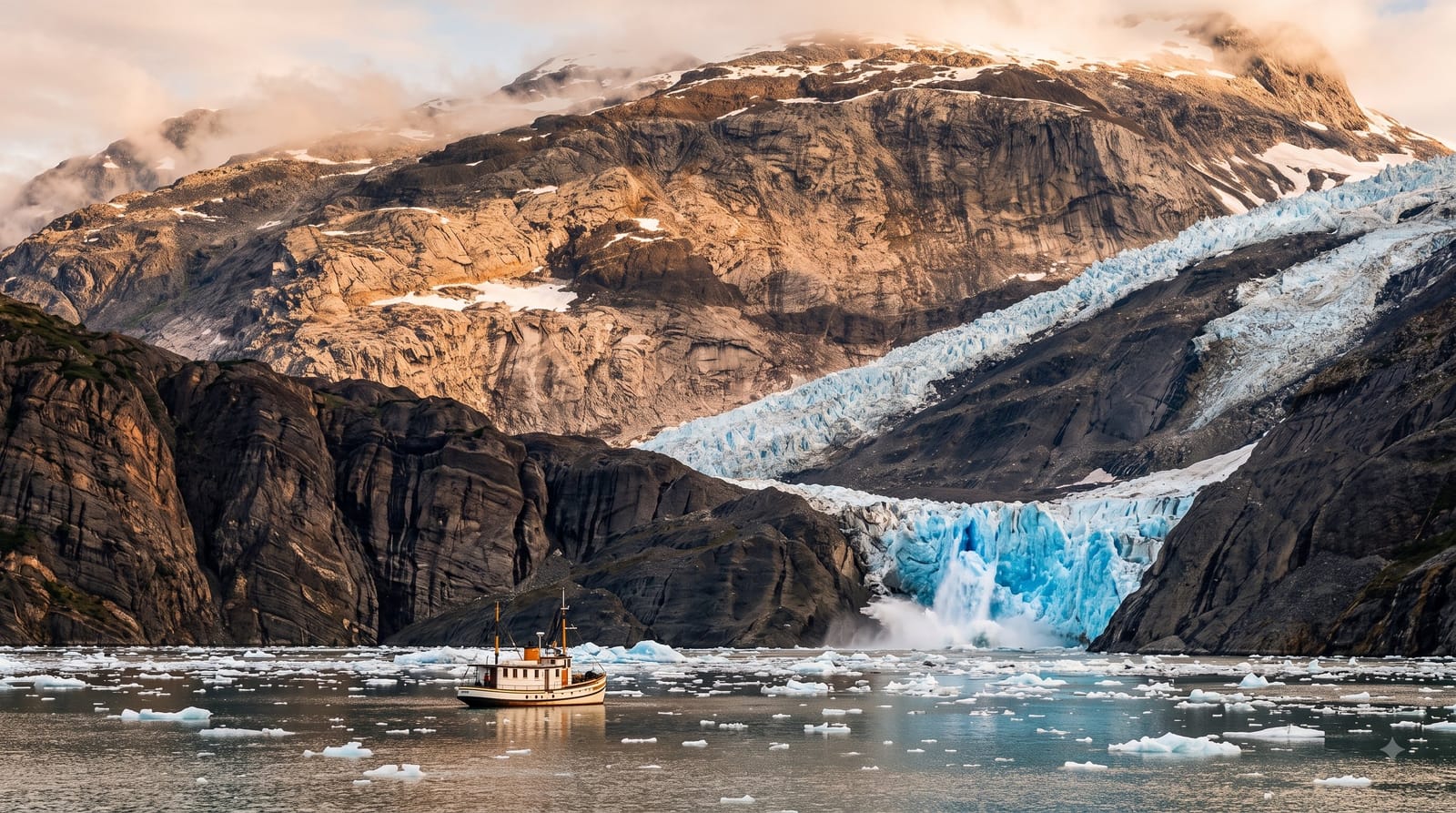
Two hundred and fifty years ago Glacier Bay did not exist: the whole inlet was filled by a single glacier that has since retreated more than a hundred kilometres, one of the fastest documented retreats anywhere, leaving a branching fjord system behind it. That makes the bay a living demonstration of succession, with bare rock and pioneer plants at the head and mature spruce forest near the mouth. Several tidewater glaciers still reach the sea and calve, most reliably Margerie, where ships hold position while ice falls off a face about seventy-five metres high with a noise like artillery. Humpback whales feed here in summer, along with sea otters, seals hauled out on ice, mountain goats on the cliffs and brown bears on the shore. It forms part of a vast World Heritage area shared with Canada.
History
President Calvin Coolidge proclaimed the area around Glacier Bay a national monument on 26 February 1925, Jimmy Carter enlarged it in 1978, and on 2 December 1980 the Alaska National Interest Lands Conservation Act added 523,000 acres and created Glacier Bay National Park and Preserve, with a preserve to the north-west where sport hunting is allowed. Glacier Bay became part of a World Heritage Site shared with Canada in 1979 and a Biosphere Reserve in 1986 (Wikipedia, Glacier Bay National Park and Preserve).
The landscape
- Margerie Glacier - the tidewater face that calves while ships hold position.
- Humpback whales - feeding in the bay through the summer.
- The succession - bare rock at the head, mature forest at the mouth.
- Wildlife on the shore - brown bears, mountain goats, otters and seals.
When to go
May to September is the season; June to August has the most wildlife and the longest days, while May can be clearer. The number of ships allowed in daily is capped, which is why cruise itineraries either include the bay or do not, and that is worth checking before booking a cruise.
Practical notes
There is no road, so almost everyone sees it from a cruise ship deck without going ashore, and entry permits for vessels are strictly limited. Weather is frequently grey and wet, and the glaciers can be hidden. Independent visits mean flying to Gustavus and using the day boat or the single lodge, which is expensive. Calving is unpredictable and cannot be promised.
Nearby
Gustavus and Bartlett Cove have the lodge and kayak launches; Juneau is a short flight away.
Key facts
Source: Wikidata, item Q4389292, read on 18 October 2026.
What to pack for Glacier Bay
Chosen from what this place is for. Tap a kit for the full checklist.
- Broken-in walking shoes or boots - Grip and ankle support matter more than looks; never hike in brand-new boots. Find on Amazon
- Quick-dry clothing - Board shorts or synthetics that shrug off spray and dry fast. Find on Amazon
- Binoculars - The single best wildlife tool - even a compact pair transforms a sighting. Find on Amazon
- Warm base layers - Merino or synthetic against the skin - never cotton, which chills when damp. Find on Amazon
Some links on this page are Amazon affiliate links - if you buy through them we may earn a small commission at no extra cost to you.
All packing kitsPlan your trip
Where to start if Glacier Bay is going on the list.
Booking links on this page are affiliate links - if you book through them we may earn a small commission at no extra cost to you. It never changes what we write about a place.
Opening times, ticket prices and seasonal closures change - check the official source before you go: official site.