St Dunstan in the East
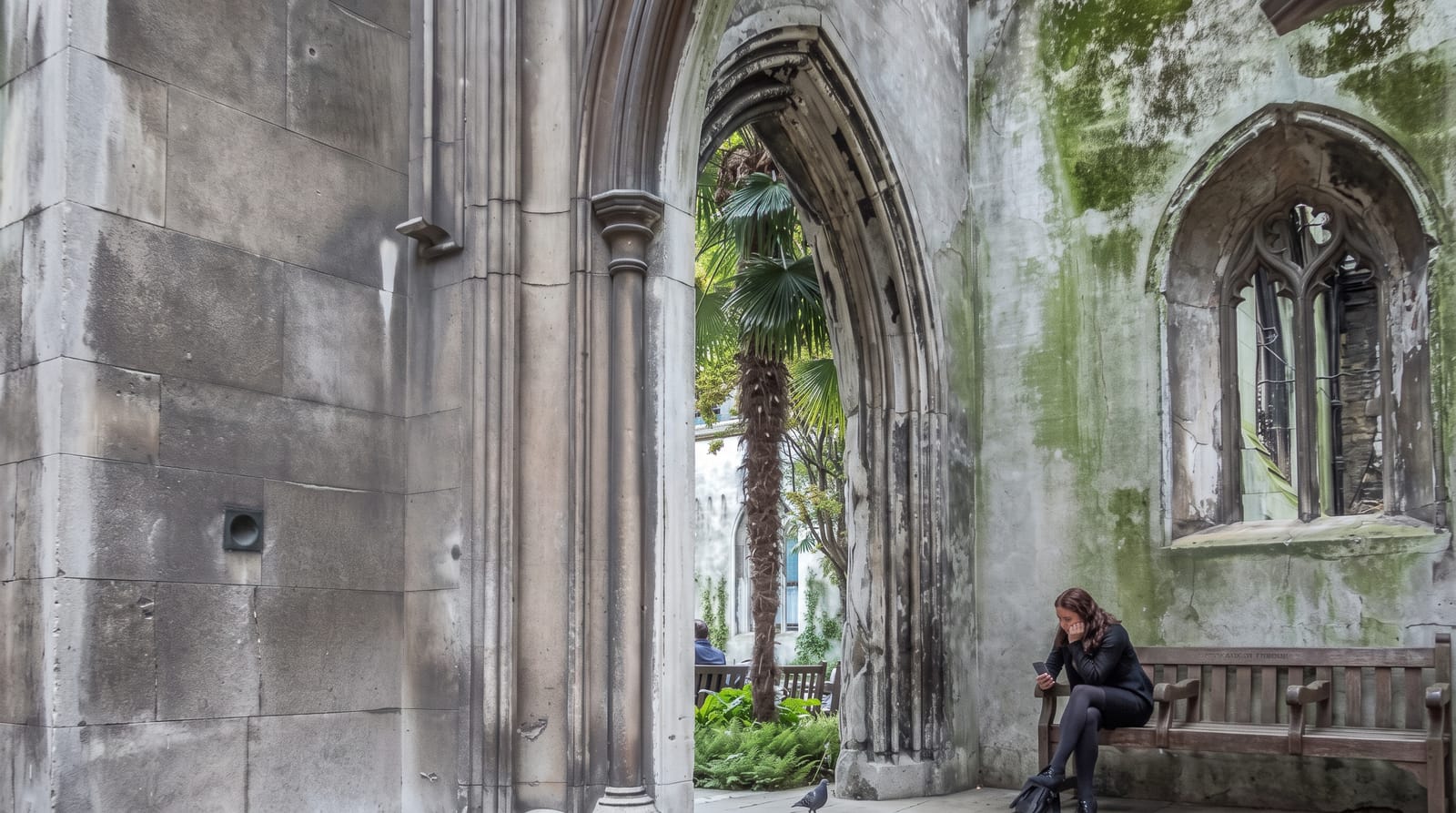
A Wren church left as a bombed shell and planted as a public garden, with vines climbing the empty window tracery.
Updated 20 October 2026
AI illustration
A church stood here from around 1100, was damaged in the Great Fire of 1666 and patched up, and Christopher Wren added a steeple in 1695-1701 whose needle spire on flying buttresses was said to be his own favourite; when a storm in 1703 brought down other City steeples he is reported to have said he had no fear for that one, and it stood. The body of the church was rebuilt between 1817 and 1821 and gutted in the Blitz in 1941, leaving the tower, the outer walls and the window openings. Rather than rebuild, the City decided in 1967 to plant the shell as a public garden, which opened in 1971, and it is now filled with a lawn, a fountain, and climbers running up through the empty tracery. It is free, unstaffed and open through the day.
What's there
- The Wren steeple - the spire of 1695-1701 on flying buttresses, still standing.
- The planted shell - climbers growing through empty window openings.
- The Blitz ruin - walls left as they were after 1941.
- The City setting - a quiet garden between office towers.
When to go
April to September, when the planting is at its fullest; the garden is open daily through daylight hours and closes in the evening. Lunchtime brings City workers, and early mornings are the quietest.
Things to know
It is small, walked in fifteen minutes, and it has become well known enough through photographs that a queue sometimes forms for the best angle. Access is down a steep lane. There are no facilities.
Nearby
The Monument and Tower Bridge are minutes away; the Tower of London lies east.
Key facts
Source: Wikidata, item Q12408518, read on 18 October 2026.
What to pack for St Dunstan in the East
Chosen from what this place is for. Tap a kit for the full checklist.
- Comfortable walking shoes - Sightseeing means kilometres of pavement and cobbles daily. Find on Amazon
- A slim anti-theft daypack - Zips that close properly; keep it in front in crowds and on transit. Find on Amazon
- A refillable water bottle - Many cities have public fountains; save money and plastic. Find on Amazon
- A light layer + compact umbrella - For museum air-con and a sudden shower. Find on Amazon
Some links on this page are Amazon affiliate links - if you buy through them we may earn a small commission at no extra cost to you.
All packing kitsPlan your trip
Where to start if St Dunstan in the East is going on the list.
Booking links on this page are affiliate links - if you book through them we may earn a small commission at no extra cost to you. It never changes what we write about a place.
Opening times, ticket prices and seasonal closures change - check the official source before you go: official site.