Caernarfon Castle
The imperial statement in banded stone - polygonal towers echoing Constantinople's walls, and the investiture stage of Princes of Wales.
Updated 18 October 2026
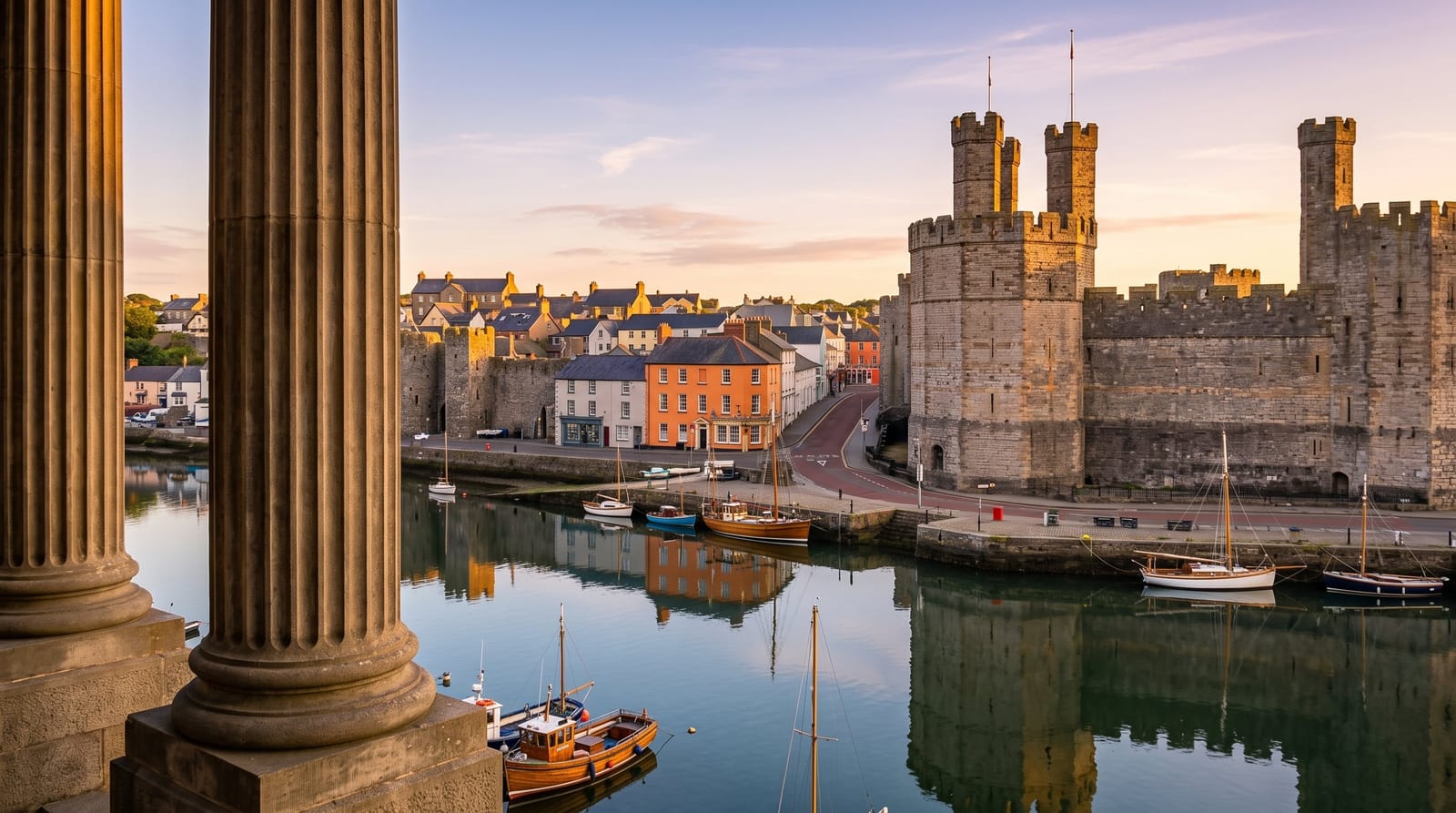
AI illustration
UNESCO World Heritage
Caernarfon was never just a fortress - begun in 1283, it was Edward I's propaganda in stone, its polygonal towers and bands of coloured masonry deliberately echoing the Theodosian walls of Constantinople to dress the English king in imperial Roman clothes. The great Eagle Tower, once crowned with carved eagles, anchors a curtain wall that still presents one of medieval Europe's most formidable silhouettes, mirrored in the water where the River Seiont meets the Menai Strait. Edward's son - the future Edward II - was born here in 1284 and became the first English Prince of Wales, and the castle has staged the investiture ceremony in modern times, most famously in 1911 and 1969. Inscribed by UNESCO in 1986 with Conwy, Harlech and Beaumaris, it pairs battlement walks and tower climbs with the Royal Welch Fusiliers Museum inside, and the walled town at its feet keeps a salty, Welsh-speaking everyday life.
History
The Romans built the first fort here, Segontium, which gave Caernarfon its name, the stronghold in the land facing Anglesey; a motte-and-bailey castle followed in the late 11th century. In 1283 Edward I began to replace it with the present stone castle as the administrative centre of north Wales, its banded walls deliberately recalling the walls of Constantinople and the Roman past, and walls were built around the new town at the same time. Work cost between £20,000 and £25,000 until it ended in 1330, many parts were never finished, and the interior buildings have not survived (Wikipedia, Caernarfon Castle).
Highlights
- The Eagle Tower - the banded, triple-turreted showpiece above the river mouth.
- The polygonal walls - Constantinople quoted in Welsh stone.
- The investiture ground - the ward where Princes of Wales are proclaimed.
- The Fusiliers Museum - the regimental collection within the towers.
When to go
April to October for full opening and strait-side light; late afternoon warms the banded stone beautifully. Summer holidays bring the crowds - first entry is calmest.
Good to know
Expect magnificent shells rather than furnished rooms, and lots of steep spiral stairs to earn the views. The town's narrow streets fill fast in season and parking is tight. Caernarfon is proudly Welsh-speaking - hearing the language everywhere is part of the visit.
Nearby
Snowdonia's passes climb inland; Anglesey lies over the strait and Conwy along the coast.
Key facts
Source: Wikidata, item Q275128, read on 18 October 2026.
What to pack for Caernarfon Castle
Chosen from what this place is for. Tap a kit for the full checklist.
- Comfortable walking shoes - Sightseeing means kilometres of pavement and cobbles daily. Find on Amazon
- A slim anti-theft daypack - Zips that close properly; keep it in front in crowds and on transit. Find on Amazon
- A refillable water bottle - Many cities have public fountains; save money and plastic. Find on Amazon
- A light layer + compact umbrella - For museum air-con and a sudden shower. Find on Amazon
Some links on this page are Amazon affiliate links - if you buy through them we may earn a small commission at no extra cost to you.
All packing kitsPlan your trip
Where to start if Caernarfon Castle is going on the list.
Booking links on this page are affiliate links - if you book through them we may earn a small commission at no extra cost to you. It never changes what we write about a place.
Opening times, ticket prices and seasonal closures change - check the official source before you go: official site.