The El Jem Amphitheatre
A colossal Roman colosseum in the Tunisian plains - one of the largest and best-preserved amphitheatres in the world, rising astonishingly from a small town, a UNESCO wonder.
Updated 18 October 2026
AI illustration
UNESCO World Heritage
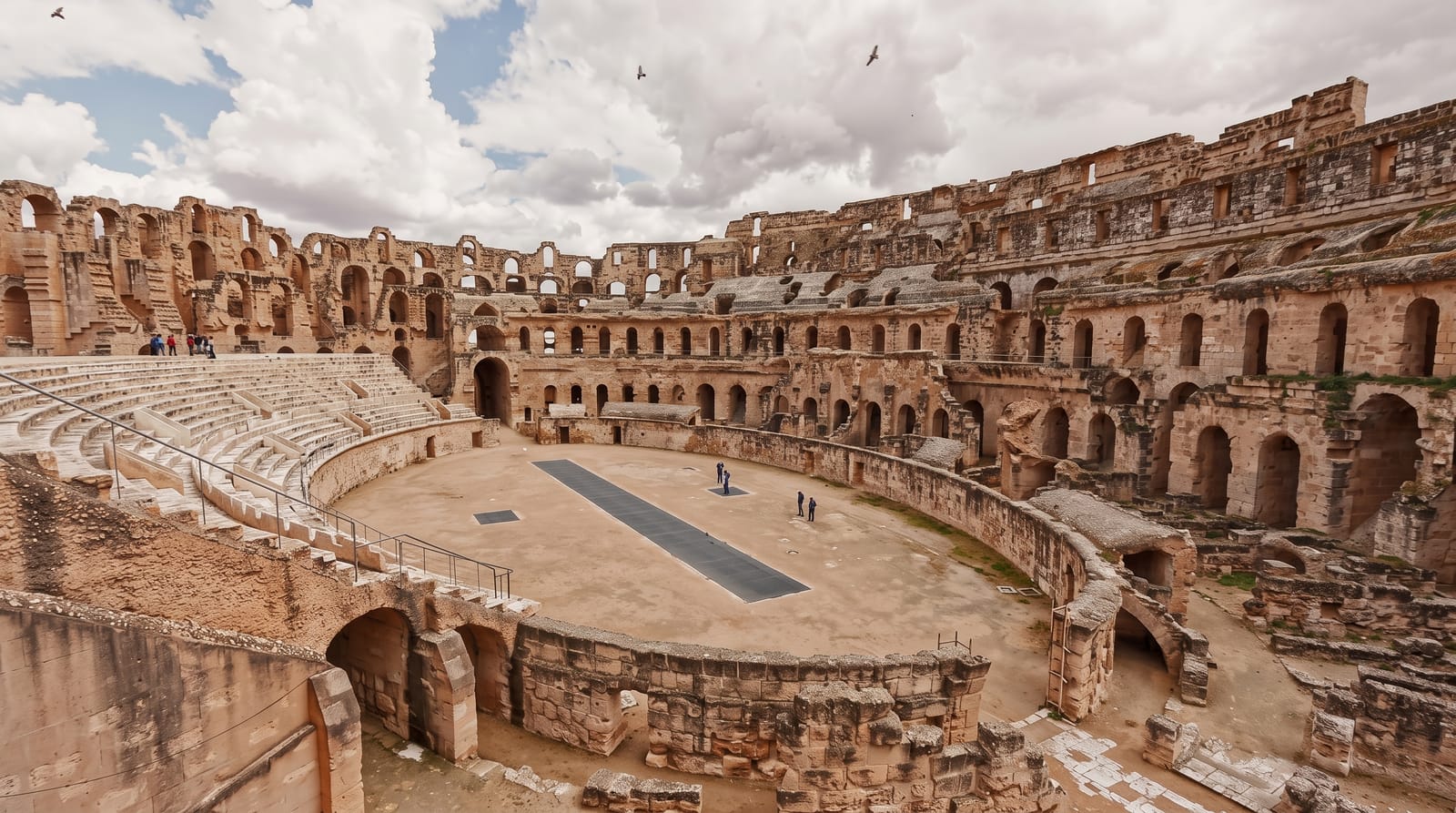
The amphitheatre of El Jem is one of the most impressive Roman monuments in Africa, a colossal colosseum that rises astonishingly from the streets of a modest Tunisian town in the interior plains. One of the largest and best-preserved amphitheatres in the entire Roman world, able to hold some 35,000 spectators, its towering, honey-coloured stone arches and tiers, and its atmospheric underground passages where gladiators and animals once waited, make it a UNESCO wonder rivalling the Colosseum of Rome.
History
Built around 238 AD in Thysdrus, in the Roman province of Africa, it is the third amphitheatre on the site, with room for some 35,000 spectators and axes of 148 and 122 metres. Tradition credits the local proconsul Gordian, later Gordian II, but his reign lasted only weeks, and it seems more likely that Gordian III, perhaps born at Thysdrus, meant it to adorn his home town; after his death it was left unfinished. In the Middle Ages it served as a fortress where people sheltered from the Vandals in 430 and the Arabs in 647, in 1695 Mohamed Bey El Mouradi made an opening in one of its walls, and since 1979 it has been a World Heritage Site (Wikipedia, Amphitheatre of El Jem).
What's there
- The great arena - the towering tiers and arches of the amphitheatre.
- The underground passages - the tunnels where gladiators waited.
- The upper tiers - the climb for views over the arena and town.
- The setting - the colossal ruin rising from a small town.
When to go
Spring and autumn for the mildest weather, as the interior plains are fiercely hot in summer; go early or late to avoid the heat and enjoy the golden stone in soft light. It hosts a classical music festival in summer within the arena.
Good to know
It is remote in the interior, so reaching it means a trip from the coastal resorts of Sousse or Sfax, often as a day tour. It is a single monument, seen in a couple of hours, though a genuinely awe-inspiring one, remarkably complete and far less crowded than Rome's Colosseum. The summer heat on the exposed stone is intense.
Nearby
The coastal cities of Sousse and Sfax and the town of Kairouan are within reach.
Key facts
Source: Wikidata, item Q2914326, read on 18 October 2026.
What to pack for The El Jem Amphitheatre
Chosen from what this place is for. Tap a kit for the full checklist.
- Head torch + spare batteries - Hands-free light is essential; caves are truly dark. Find on Amazon
- Comfortable walking shoes - Sightseeing means kilometres of pavement and cobbles daily. Find on Amazon
- Grippy closed shoes - Cave floors are wet, muddy and slick with formations. Find on Amazon
- A slim anti-theft daypack - Zips that close properly; keep it in front in crowds and on transit. Find on Amazon
Some links on this page are Amazon affiliate links - if you buy through them we may earn a small commission at no extra cost to you.
All packing kitsPlan your trip
Where to start if The El Jem Amphitheatre is going on the list.
Booking links on this page are affiliate links - if you book through them we may earn a small commission at no extra cost to you. It never changes what we write about a place.
Opening times, ticket prices and seasonal closures change - check the official source before you go: official site.