Jebel Barkal
The holy mountain of the Nile - Jebel Barkal, a UNESCO World Heritage site where a sacred flat-topped mountain towers over ancient temples, pyramids and the ruins of Napata, long a spiritual heart of the Kushite and Egyptian worlds along the Nile.
Updated 18 October 2026
AI illustration
UNESCO World Heritage
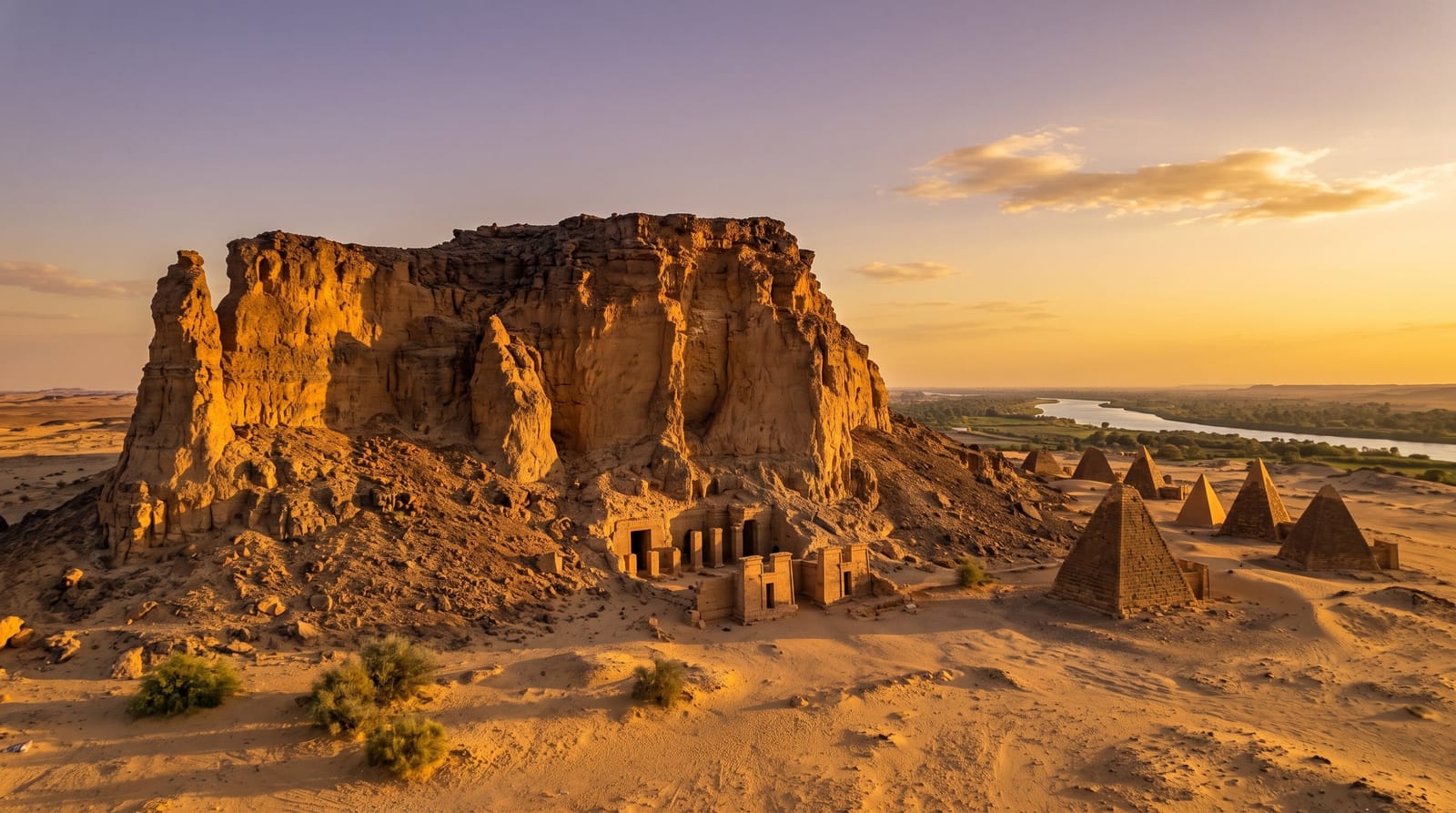
Jebel Barkal, a striking flat-topped sandstone mountain rising abruptly from the desert beside the Nile in northern Sudan, was for over a thousand years one of the most sacred places in the ancient Nile world, and it is a UNESCO World Heritage site. Revered as a home of the god Amun, it towered over the great city of Napata, capital of the Kushite kings who once ruled Egypt itself. At its foot spread magnificent temples cut into and built against the rock, along with royal palaces and clusters of steep pyramids nearby. Climbing the mountain at sunset for sweeping views over the Nile, temples and pyramids is an unforgettable experience of deep antiquity and beauty.
History
The earliest traces at the mesa, scattered potsherds, belong to the Kerma culture, which seems to have revered it, a tradition passed on to the Egyptians and later the Napatans and Meroites. Around 1450 BC the pharaoh Thutmose III conquered the area and built a fortified settlement as the southern limit of the Egyptian empire, the region came to be called Napata, and the Egyptians built temples centred on one to Amun of Napata, a local ram-headed form of the god of Thebes. After 800 BC it became the capital of the revived Kingdom of Kush, whose kings Kashta, Piye and Taharqa, who ruled Egypt as the 25th Dynasty, built and enlarged its monuments; after the Assyrians drove them out of Egypt in the mid-7th century BC its palaces and temples were renewed into the early 3rd century BC, and in 2003 the mountain and its archaeological site became a World Heritage Site (Wikipedia, Jebel Barkal).
Highlights
- The holy mountain - the sacred flat-topped rock over the Nile.
- The Amun temples - the great temples cut into the rock.
- The pyramids - the steep royal pyramids nearby.
- The summit views - the sweeping vistas over the Nile at sunset.
When to go
November to February, the cool dry season, is the most comfortable time to explore the temples and climb the mountain, avoiding the fierce heat; sunset from the summit, with light flooding the Nile, temples and pyramids, is the highlight. Winter days here are warm and clear.
Practical notes
Jebel Barkal lies in northern Sudan some way from the capital and, like the country's other sites, has modest visitor facilities, so it rewards travellers ready for a more adventurous journey. As a UNESCO World Heritage sacred mountain crowned by ancient temples and pyramids beside the Nile, a spiritual heart of the Kushite world, though, Jebel Barkal is a place of extraordinary depth and beauty.
Nearby
The town of Karima, the Nile and the pyramids of Nuri lie nearby.
Key facts
Source: Wikidata, item Q499019, read on 18 October 2026.
What to pack for Jebel Barkal
Chosen from what this place is for. Tap a kit for the full checklist.
- Loose, light, long clothing - Covering up beats bare skin in the desert - and locals dress this way for a reason. Find on Amazon
- Comfortable walking shoes - Sightseeing means kilometres of pavement and cobbles daily. Find on Amazon
- Modest clothing - Shoulders and knees covered - the single most common requirement. Find on Amazon
- A wide-brim hat + sunglasses - Shade for your face and eyes where there is none overhead. Find on Amazon
Some links on this page are Amazon affiliate links - if you buy through them we may earn a small commission at no extra cost to you.
All packing kitsPlan your trip
Where to start if Jebel Barkal is going on the list.
Booking links on this page are affiliate links - if you book through them we may earn a small commission at no extra cost to you. It never changes what we write about a place.
Opening times, ticket prices and seasonal closures change - check the official source before you go: official site.