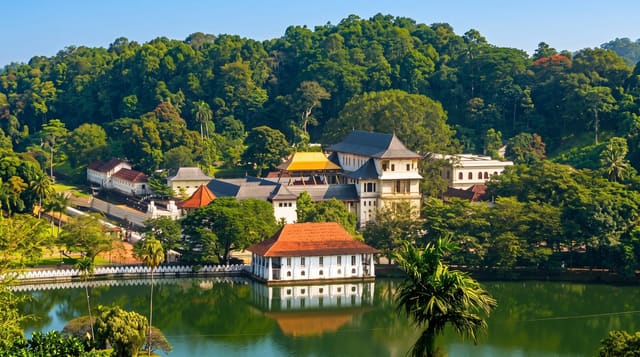
Lankatilaka Temple
A fourteenth-century temple near Kandy built on a rock outcrop, mixing Sinhalese, south Indian and Southeast Asian forms.
Updated 2 September 2026
Lankatilaka was built in the 1340s under the Gampola kingdom directly on a rock outcrop, its brick and stone walls rising out of the granite, and the design pulls together Sinhalese, Dravidian and Southeast Asian elements in a way that reflects how connected the island was at the time. Inside is a large seated Buddha under a painted ceiling, with subsidiary shrines to Hindu deities around the building, which was and remains normal practice here. The building was heavily restored in the 1970s after long neglect, and the roof it carries now is a reconstruction of what the fourteenth-century structure is thought to have had.
The main sights
- The rock foundation - walls rising directly from the granite outcrop.
- The mixed architecture - Sinhalese, Dravidian and Southeast Asian forms combined.
- The painted ceiling - decoration above the main seated Buddha.
- The Hindu shrines - devale shrines built into the same structure.
When to go
January to April is the driest and most comfortable. Mornings are quietest. Poya days bring worshippers.
Practical notes
The temple is active and shoes must be removed; the stone gets hot. Photography inside is restricted. Reaching it and the neighbouring temples needs a vehicle.
Nearby
Embekka is nearby, and Kandy is northeast.
What to pack for Lankatilaka Temple
Chosen from what this place is for. Tap a kit for the full checklist.
- Comfortable walking shoes - Sightseeing means kilometres of pavement and cobbles daily. Find on Amazon
- Modest clothing - Shoulders and knees covered - the single most common requirement. Find on Amazon
- A slim anti-theft daypack - Zips that close properly; keep it in front in crowds and on transit. Find on Amazon
- A scarf or shawl - To cover the head or shoulders on entry; women especially at mosques. Find on Amazon
Some links on this page are Amazon affiliate links - if you buy through them we may earn a small commission at no extra cost to you.
All packing kitsPlan your trip
Where to start if Lankatilaka Temple is going on the list.
Booking links on this page are affiliate links - if you book through them we may earn a small commission at no extra cost to you. It never changes what we write about a place.
Opening times, ticket prices and seasonal closures change - check the official source before you go: official site.