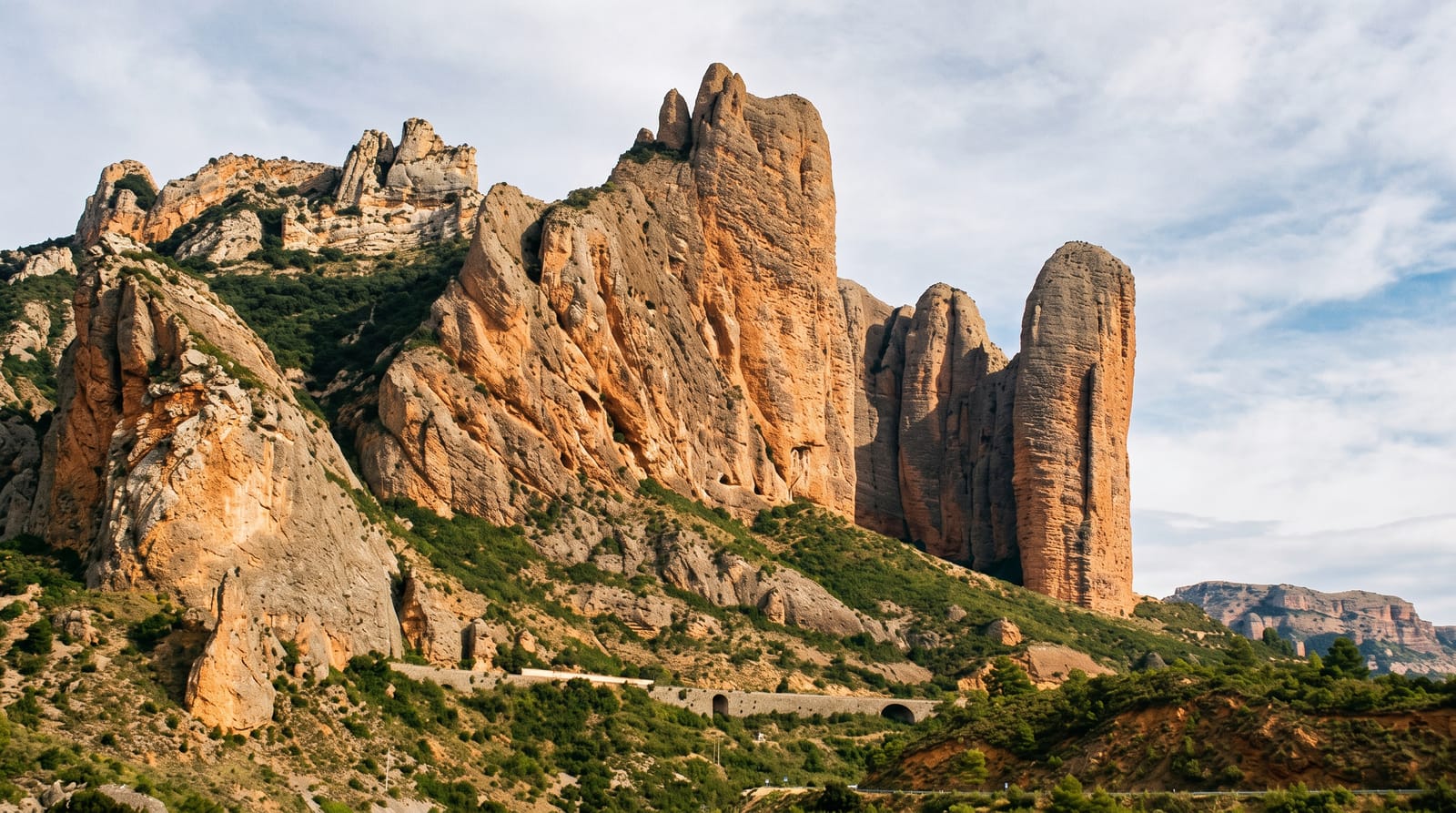
San Juan de la Pena
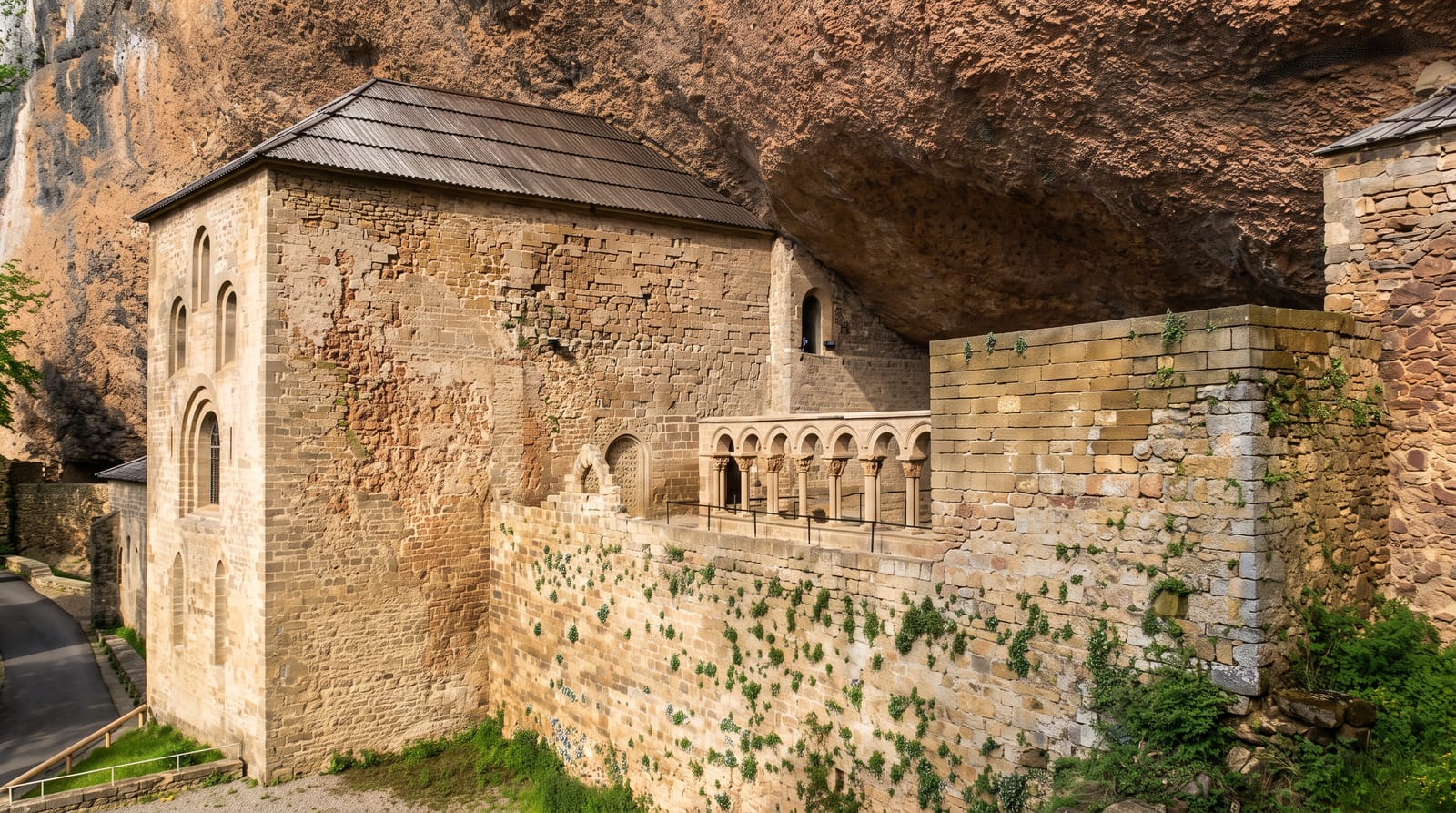
A monastery built under a great rock overhang near Jaca, the royal pantheon of early Aragon, with a half-lit cloister.
Updated 19 October 2026
AI illustration
UNESCO World Heritage
The old monastery of San Juan de la Pena is built into the space beneath an enormous overhanging rock, which forms its roof: a lower church of the tenth century, an upper church consecrated in 1094, a royal pantheon holding early kings of Aragon and Navarre, and a Romanesque cloister whose carved capitals show biblical scenes and which is open on one side to the rock above and the valley below, so it is half in shadow and half in light. It was the first Aragonese house to adopt the Roman rite and functioned as the kingdom's spiritual centre. A chalice kept here until 1399 is one of several claimed as the Holy Grail, now in Valencia. A fire in 1675 led to a new baroque monastery being built higher up the hill.
History
The old monastery, built in 920 beneath a great rock sometimes linked with the legendary Monte Pano, was one of the most important in medieval Aragon; in the 11th century it joined the Benedictine order and became the first monastery in Spain to use the Latin Mass, and its two-level church is partly cut into the cliff, the lower one keeping Mozarabic elements. The cloister was built around 1190, and the royal pantheon of the kings of Aragon and Navarre, where Ramiro I, Sancho Ramírez and Peter I lie, took its present form under Charles III in 1770. Legend says the chalice of the Last Supper was sent here for safekeeping, and it is claimed to be the cup that Alfonso V gave to Valencia Cathedral in 1438. After the fire of 1675 a new monastery was built in 1705 on a plateau higher up; the old one became a National Monument on 13 July 1889 and the new one in 1923. The monastery also gave its name to the Chronicle of San Juan de la Peña, partly compiled here, and in August 2026 the remains of the three kings were moved for safekeeping as wildfires approached (Wikipedia, Royal Monastery of San Juan de la Peña).
The main sights
- The rock overhang - a monastery roofed by the cliff above it.
- The royal pantheon - tombs of early Aragonese and Navarrese kings.
- The open cloister - carved capitals under the rock with the valley beyond.
- The new monastery - a baroque replacement higher up, with exhibitions.
When to go
May to October; the mountain road can be difficult in winter and hours are reduced. In summer cars are stopped at the new monastery and a shuttle runs down to the old one. Booking is advisable in August.
Good to know
Summer access to the old monastery is by shuttle only, with cars left above. The site is small and the visit takes about ninety minutes. The road up is narrow and winding.
Nearby
Jaca and its citadel lie northeast; the Pyrenees and the Aragues valleys are north.
Key facts
Source: Wikidata, item Q1389060, read on 18 October 2026.
What to pack for San Juan de la Pena
Chosen from what this place is for. Tap a kit for the full checklist.
- Comfortable walking shoes - Sightseeing means kilometres of pavement and cobbles daily. Find on Amazon
- Modest clothing - Shoulders and knees covered - the single most common requirement. Find on Amazon
- A slim anti-theft daypack - Zips that close properly; keep it in front in crowds and on transit. Find on Amazon
- A scarf or shawl - To cover the head or shoulders on entry; women especially at mosques. Find on Amazon
Some links on this page are Amazon affiliate links - if you buy through them we may earn a small commission at no extra cost to you.
All packing kitsPlan your trip
Where to start if San Juan de la Pena is going on the list.
Booking links on this page are affiliate links - if you book through them we may earn a small commission at no extra cost to you. It never changes what we write about a place.
Opening times, ticket prices and seasonal closures change - check the official source before you go: official site.