Castillo de la Mota
A great brick Mudejar castle at Medina del Campo, built for artillery and used as a prison, where Isabella died nearby.
Updated 12 October 2026
AI illustration
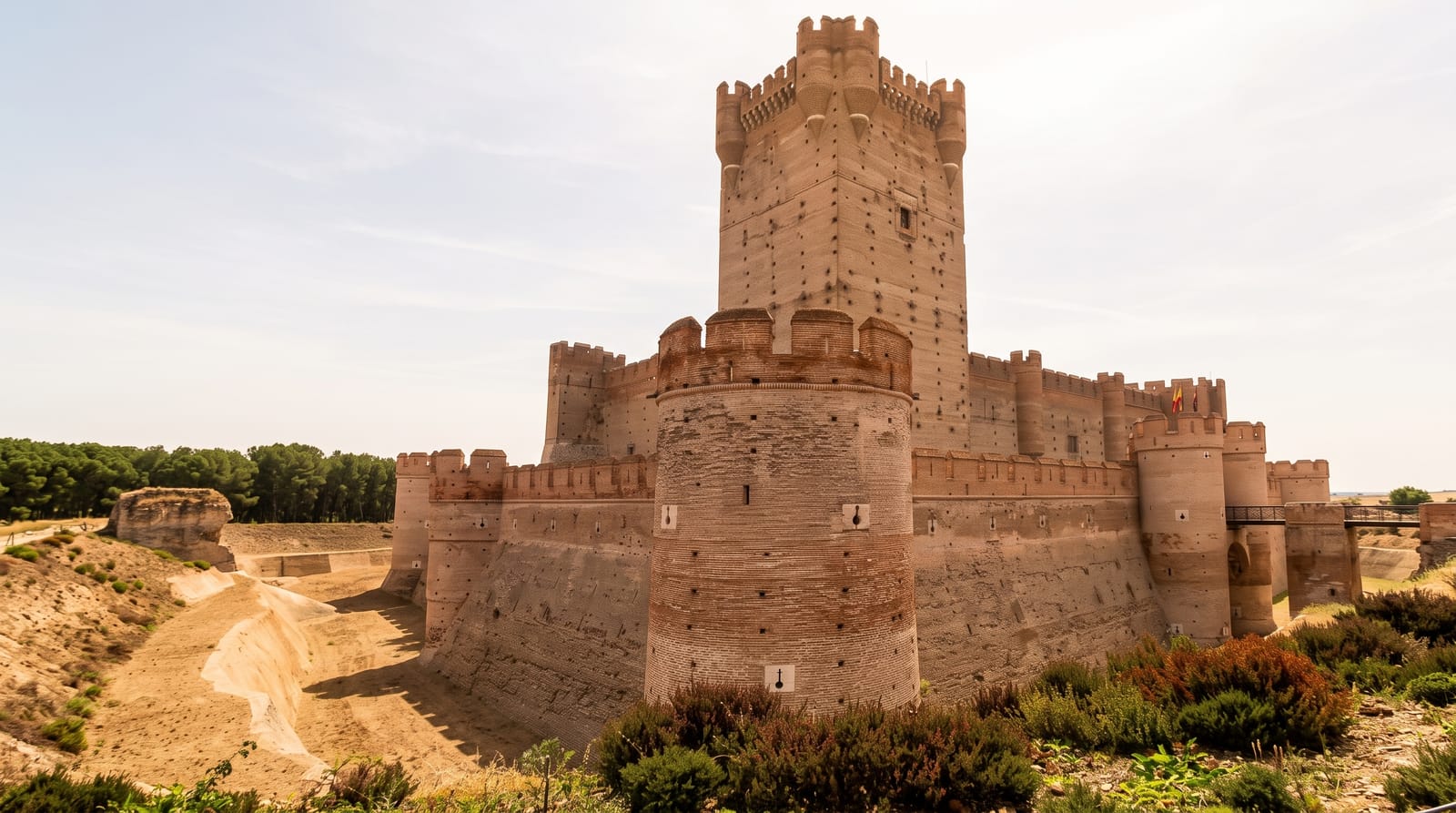
La Mota stands on a low rise above Medina del Campo, a town that held one of the great trade fairs of medieval Europe, and the castle was rebuilt in brick between 1440 and 1483 in Mudejar technique, with an outer barbican designed for firearms, one of the earliest artillery fortifications in Spain, enclosing a taller inner ward with a keep of nearly forty metres. Isabella the Catholic used it and died in 1504 in the palace in the town below, not in the castle itself as is often said. It later served as a prison, holding Cesare Borgia, who escaped from the keep in 1506. Restored in the twentieth century, it now runs guided visits including the tunnels and the keep.
Highlights
- The brick Mudejar walls - a fortress built in brick rather than stone.
- The artillery barbican - an early outer work designed for firearms.
- The keep - a tower of nearly forty metres above the inner ward.
- The tunnels - underground galleries within the defences.
When to go
April to June and September to November; the Castilian plain is very hot in summer and cold in winter. Visits are guided at set times and the castle closes on some weekdays, so checking hours before travelling helps.
Before you go
Access to the keep and tunnels is by guided tour only at fixed times. Much of the structure is twentieth-century restoration. Medina del Campo has little else for visitors beyond the castle and a small museum.
Nearby
Valladolid lies north; Tordesillas and the Duero wine country are close.
Key facts
Source: Wikidata, item Q2969574, read on 18 October 2026.
What to pack for Castillo de la Mota
Chosen from what this place is for. Tap a kit for the full checklist.
- Head torch + spare batteries - Hands-free light is essential; caves are truly dark. Find on Amazon
- Comfortable walking shoes - Sightseeing means kilometres of pavement and cobbles daily. Find on Amazon
- Grippy closed shoes - Cave floors are wet, muddy and slick with formations. Find on Amazon
- A slim anti-theft daypack - Zips that close properly; keep it in front in crowds and on transit. Find on Amazon
Some links on this page are Amazon affiliate links - if you buy through them we may earn a small commission at no extra cost to you.
All packing kitsPlan your trip
Where to start if Castillo de la Mota is going on the list.
Booking links on this page are affiliate links - if you book through them we may earn a small commission at no extra cost to you. It never changes what we write about a place.
Opening times, ticket prices and seasonal closures change - check the official source before you go: official site.