Cardona Castle and Salt Mountain
A medieval fortress on a hill above a mountain of rock salt, mined since prehistory and visitable underground.
Updated 4 September 2026
AI illustration
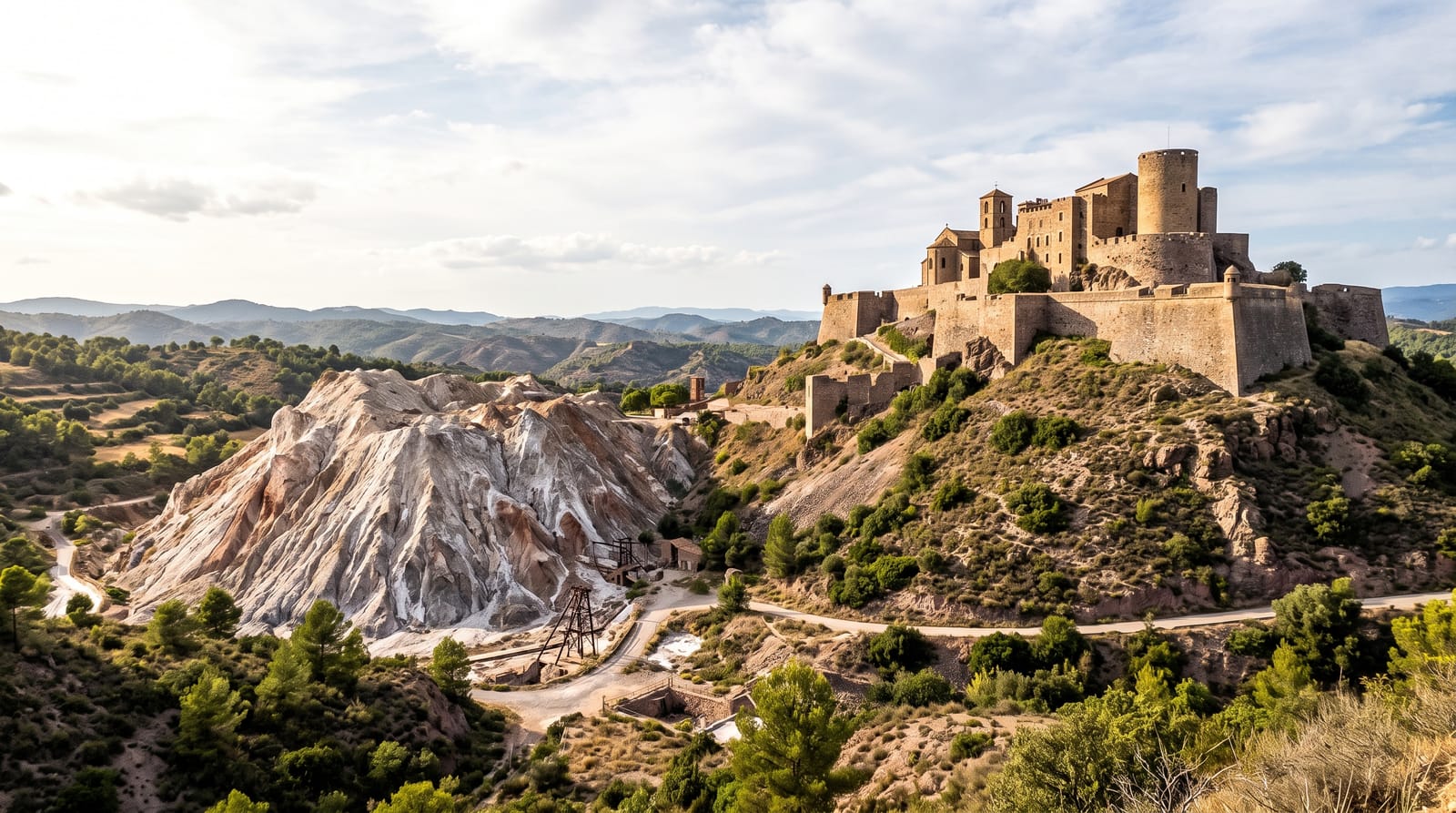
Cardona sits above a geological oddity: a diapir, a dome of rock salt pushed up from a buried evaporite layer until it reaches the surface, forming a hill of salt that has been worked since the Neolithic and which made the local lords, the Cardona family, among the most powerful in Catalonia; they were called the uncrowned kings of Aragon. Their castle on the opposite hill holds the collegiate church of Sant Vicenc, consecrated in 1040, one of the earliest Lombard Romanesque buildings in Catalonia, with a crypt and a cloister; the rest is now a parador. The Salt Mountain park runs guided visits into galleries eighty-six metres below ground where the walls are banded salt in white, grey and pink.
The main sights
- Sant Vicenc - a 1040 Lombard Romanesque church inside the castle.
- The salt galleries - guided routes eighty-six metres underground.
- The banded salt walls - white, grey and pink rock salt formations.
- The diapir hill - a surface outcrop of a deep salt dome.
When to go
March to June and September to November; the mine is a constant temperature year-round and works as a summer option. Mine tours are guided at set times and must be booked, particularly at weekends.
Before you go
Mine visits are guided only, with helmets issued and a bus down to the gallery level. Parts of the castle are a working hotel and closed. The two sites are on opposite hills with a drive between.
Nearby
Manresa and Montserrat lie southeast; Solsona is north.
What to pack for Cardona Castle and Salt Mountain
Chosen from what this place is for. Tap a kit for the full checklist.
- Head torch + spare batteries - Hands-free light is essential; caves are truly dark. Find on Amazon
- Comfortable walking shoes - Sightseeing means kilometres of pavement and cobbles daily. Find on Amazon
- Grippy closed shoes - Cave floors are wet, muddy and slick with formations. Find on Amazon
- A slim anti-theft daypack - Zips that close properly; keep it in front in crowds and on transit. Find on Amazon
Some links on this page are Amazon affiliate links - if you buy through them we may earn a small commission at no extra cost to you.
All packing kitsPlan your trip
Where to start if Cardona Castle and Salt Mountain is going on the list.
Booking links on this page are affiliate links - if you book through them we may earn a small commission at no extra cost to you. It never changes what we write about a place.
Opening times, ticket prices and seasonal closures change - check the official source before you go: official site.