Lake Sibaya
The country's largest freshwater lake, held behind coastal dunes with hippos in it and no river running out.
Updated 1 September 2026
UNESCO World Heritage
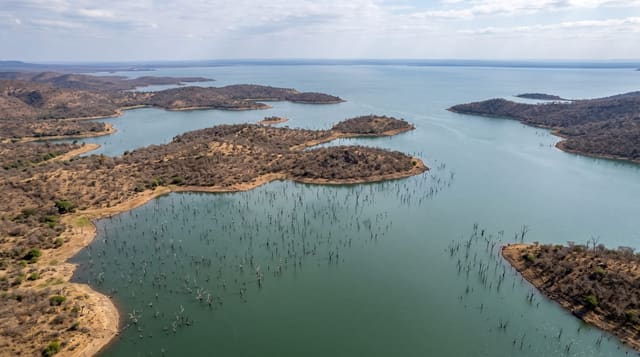
Sibaya lies behind the high coastal dunes of Maputaland, a shallow freshwater lake of around sixty to seventy square kilometres depending on the year - the largest natural freshwater body in South Africa. It has no river outlet; water arrives as rain and groundwater and leaves by evaporation and seepage through the dunes to the sea a couple of kilometres away, which is why the level swings dramatically between wet and dry cycles and why sections have dried out entirely in drought years. Hippos and crocodiles live in it, so swimming is out. The shoreline is fringed with reeds and swamp forest, the birding is strong, and communities living around the lake fish it and draw water. It is inside iSimangaliso, and access is by sand track through settlement, which means most visitors arrive through a lodge rather than independently.
Highlights
- The largest freshwater lake - about sixty square kilometres with no river outlet.
- The dune barrier - a lake held two kilometres from the sea by high vegetated dunes.
- The level swings - a water body that has partly dried in drought cycles.
- The hippos - resident animals that rule out any swimming.
When to go
April to October. A day. Water levels vary enormously between years.
Good to know
Sand tracks need 4x4 and local directions; independent access is awkward. Hippos and crocodiles make the water dangerous. Malaria risk applies here. In drought years the lake retreats a long way from where maps put its shore.
Nearby
Sodwana Bay is on the coast; Mabibi is north.
Key facts
Source: Wikidata, item Q1453557, read on 18 October 2026.
What to pack for Lake Sibaya
Chosen from what this place is for. Tap a kit for the full checklist.
- Reef-safe sunscreen - High SPF that will not bleach the coral you are swimming over. Find on Amazon
- Loose, light, long clothing - Covering up beats bare skin in the desert - and locals dress this way for a reason. Find on Amazon
- Quick-dry towel - A microfibre towel packs small and dries in minutes. Find on Amazon
- A wide-brim hat + sunglasses - Shade for your face and eyes where there is none overhead. Find on Amazon
Some links on this page are Amazon affiliate links - if you buy through them we may earn a small commission at no extra cost to you.
All packing kitsPlan your trip
Where to start if Lake Sibaya is going on the list.
Booking links on this page are affiliate links - if you book through them we may earn a small commission at no extra cost to you. It never changes what we write about a place.
Opening times, ticket prices and seasonal closures change - check the official source before you go: official site.