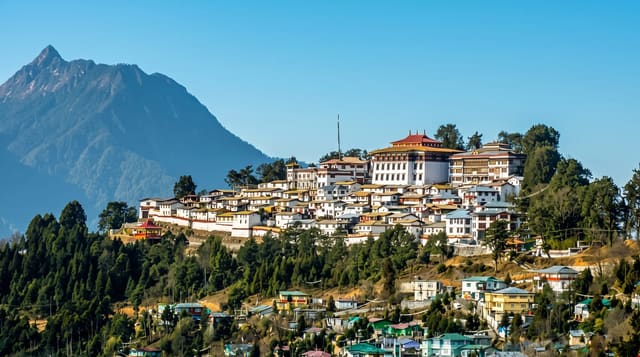
Pskovo-Pechersky Monastery
A monastery built into caves near the Estonian border, and one of the very few in Russia never closed in the Soviet period.
Updated 22 October 2026
The monastery is built into a hillside of soft sandstone near the Estonian border, around caves that were in use before the foundation in 1473 - the name Pechory comes from the word for caves. It is unusual in two ways. It was never closed: from 1920 to 1944 Pechory belonged to Estonia, and the monastery went on working through those years and after, making it one of a very small number of Russian monasteries with unbroken life through the twentieth century. And the caves are burial galleries - about two hundred metres of passages holding some ten thousand burials, in which bodies were placed in wall recesses and, because of the sandstone's constant temperature and dryness, do not produce the smell of decay, which the monastery treats as a sign. Visits to the far caves are by arrangement and lit by candle. The complex is painted in strong colours down a ravine.
History
Hermits settled in the caves in the mid-15th century, and the first cave church of the Dormition was built in 1473; the Pskov dyak Mikhail Munekhin-Misyur rebuilt the monastery in 1519, and in the 1550s-1560s it and its posad were walled, the fortifications being rebuilt in 1701. It withstood Stefan Batory's siege of 1581-1582, and in 2013 it marked its 540th anniversary (Wikipedia, Pskov-Caves Monastery).
What you'll find
- The burial caves - about two hundred metres of galleries holding some ten thousand burials.
- The unbroken life - one of very few Russian monasteries never closed in the Soviet period.
- The Estonian interval - the years 1920-1944, when Pechory belonged to Estonia.
- The ravine setting - painted buildings stepping down a wooded gully.
When to go
May to September. Two to three hours. The far caves need arranging in advance and are not part of a casual visit.
Things to know
Access to the deep caves is limited and must be arranged; most visitors see only the near section. Strict dress rules, enforced. Photography is prohibited in much of the complex. Pechory is a border town with checks in the area.
Nearby
Izborsk is south-east; the Estonian border is a few kilometres west.
Key facts
Source: Wikidata, item Q2629776, read on 18 October 2026.
What to pack for Pskovo-Pechersky Monastery
Chosen from what this place is for. Tap a kit for the full checklist.
- Head torch + spare batteries - Hands-free light is essential; caves are truly dark. Find on Amazon
- Comfortable walking shoes - Sightseeing means kilometres of pavement and cobbles daily. Find on Amazon
- Modest clothing - Shoulders and knees covered - the single most common requirement. Find on Amazon
- Grippy closed shoes - Cave floors are wet, muddy and slick with formations. Find on Amazon
Some links on this page are Amazon affiliate links - if you buy through them we may earn a small commission at no extra cost to you.
All packing kitsPlan your trip
Where to start if Pskovo-Pechersky Monastery is going on the list.
Booking links on this page are affiliate links - if you book through them we may earn a small commission at no extra cost to you. It never changes what we write about a place.
Opening times, ticket prices and seasonal closures change - check the official source before you go: official site.