Sarmizegetusa Regia
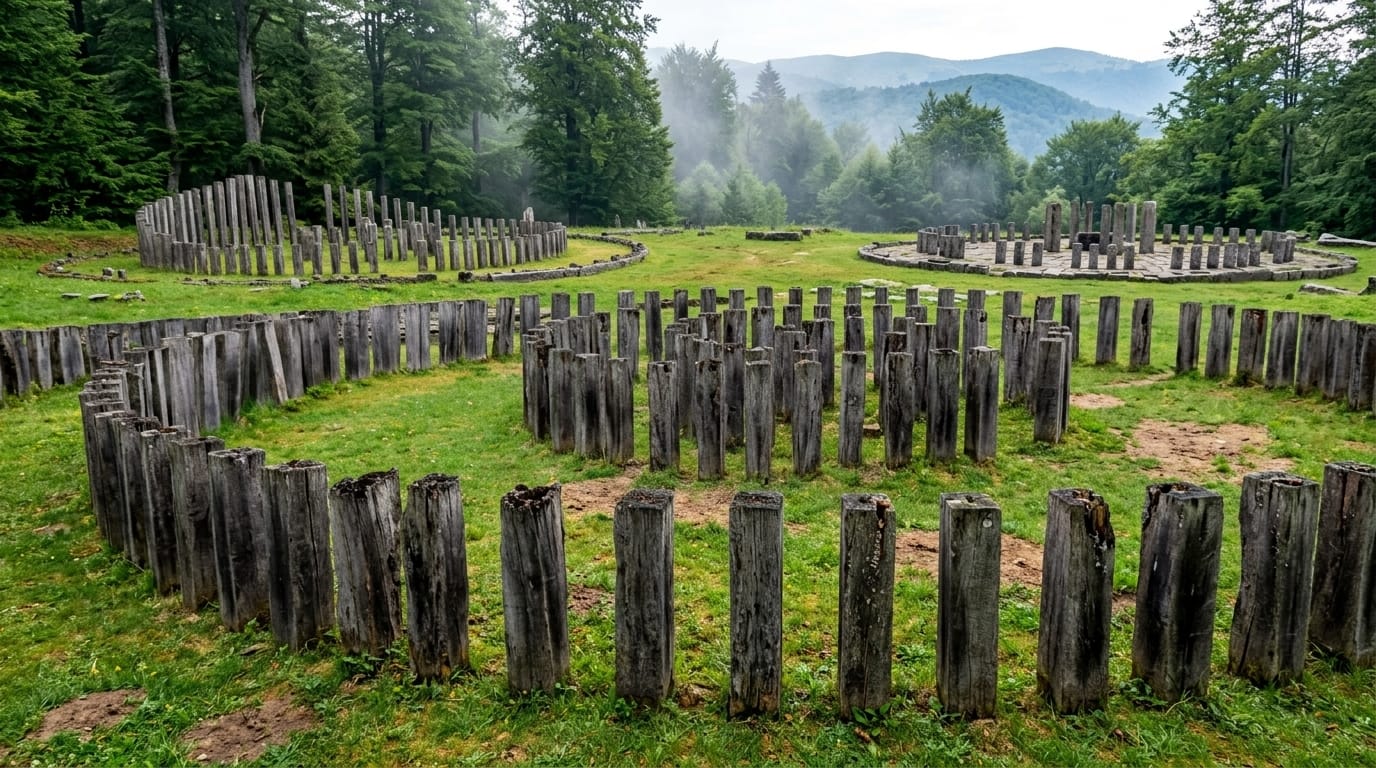
The capital of the Dacian kingdom high in the Orăștie mountains, with a circular sanctuary of andesite and limestone posts.
Updated 18 October 2026
AI illustration
UNESCO World Heritage
Before the Roman conquest, the Dacian kingdom had its capital here at around 1,200 metres in the Orăștie mountains, protected by a ring of hill fortresses and reached by paved roads. What survives is a fortified citadel of limestone blocks and, below it, a sacred precinct: a large circular sanctuary of andesite posts arranged in concentric rings, a smaller round setting, and a curious andesite sun disc set into the ground. Their purpose is debated and confidently explained by whoever is standing next to you, with calendar theories being the popular option. The Romans destroyed the place after the wars of the early second century, and the forest took the rest. It is quiet, green, and unlike any other archaeological site in the region.
History
Towards the end of his reign Burebista moved the Geto-Dacian capital here from Argedava, and for at least a century and a half Sarmizegetusa was the Dacians' capital, reaching its peak under Decebalus; finds point to the important role of the god Zalmoxis and his chief priest, and include a doctor's kit with a scalpel and tweezers, a large vase inscribed DECEBAL PER SCORILO, gold coins marked KOSON, and smithies whose tongs, hammers and anvils made some 400 metal objects, from scythes to ploughshares, as well as weapons. It was the heart of a defensive system of six fortresses, all now World Heritage Sites. Its walls were partly pulled down at the end of the First Dacian War in AD 102 and rebuilt as Roman fortifications, which were wrecked again, possibly by the Dacians, and rebuilt after the siege of AD 105-106; the Romans then built a new capital, Ulpia Traiana Sarmizegetusa, 40 kilometres away, which took the old name so as to seem its successor (Wikipedia, Sarmizegetusa Regia).
What's there
- The great circular sanctuary - concentric rings of andesite and wooden post settings.
- The andesite sun disc - a carved stone setting whose function remains unresolved.
- The citadel walls - Dacian limestone blockwork in the murus dacicus technique.
- The paved road - a surviving stretch of the ancient approach through the forest.
When to go
May to October, when the forest road is passable and the site is green. Autumn colour is superb. Mist is common and atmospheric here but hides the layout, so a clear morning is better for understanding what you are looking at.
Practical notes
The access road is long, narrow and in poor repair, and a low car will struggle; check conditions locally before setting out. Interpretation on site is limited and the sanctuary's meaning is genuinely uncertain, so treat confident explanations with scepticism. The other fortresses in the UNESCO group, including Costești and Blidaru, need separate rough drives and steep walks.
Nearby
The Roman colonial capital of Ulpia Traiana Sarmizegetusa lies west; Retezat rises south-west.
Key facts
Source: Wikidata, item Q739802, read on 18 October 2026.
What to pack for Sarmizegetusa Regia
Chosen from what this place is for. Tap a kit for the full checklist.
- Comfortable walking shoes - Sightseeing means kilometres of pavement and cobbles daily. Find on Amazon
- Modest clothing - Shoulders and knees covered - the single most common requirement. Find on Amazon
- A slim anti-theft daypack - Zips that close properly; keep it in front in crowds and on transit. Find on Amazon
- A scarf or shawl - To cover the head or shoulders on entry; women especially at mosques. Find on Amazon
Some links on this page are Amazon affiliate links - if you buy through them we may earn a small commission at no extra cost to you.
All packing kitsPlan your trip
Where to start if Sarmizegetusa Regia is going on the list.
Booking links on this page are affiliate links - if you book through them we may earn a small commission at no extra cost to you. It never changes what we write about a place.
Opening times, ticket prices and seasonal closures change - check the official source before you go: official site.


